














WASHINGTON WATCH
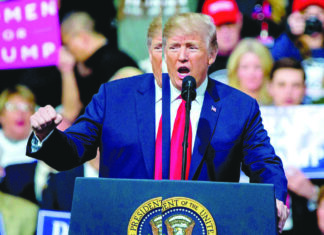
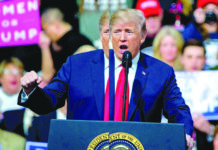
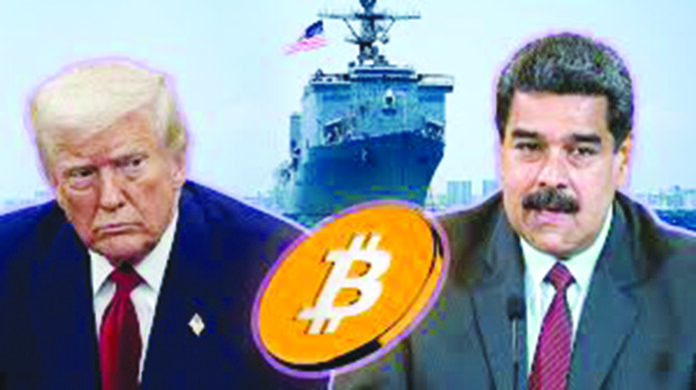
President Trump might be popping corks to toast what he called “one of the most stunning, effective, and powerful displays of American military might and competence in American history.” Celebrations, however, are premature. In reality, the assault on Venezuela and the kidnapping and transfer of President Maduro to New York to stand trial in A US court are by no means a done deal. On closer scrutiny, more questions than answers are apparent.
Several issues must be considered.
The deadly US military attack and kidnapping is not just a violation of international law. It is more precise to say that it rings the death knell for the structures of international law and diplomacy that were created in the aftermath of the two world wars.
The disturbing lesson emerging from all of this is that if a nation is powerful enough, it can impose its will and get away with it. This has been understood by Israel which, with US blessing, has, for years, been committing murder and mayhem and imposing its will on its neighbors with impunity. Other nations, if they find conditions to be favorable, may now decide to follow suit, thus rendering obsolete the entire enterprises of the United Nations, international courts and international law.
There is also the domestic political concern that the president has unilaterally committed the US military to attack another country without congressional authorization, as is required by the US Constitution. This is not to say that such approval would have made the actions in Venezuela legitimate, but doing so without even notifying Congress makes Trump’s actions doubly egregious. And the administration’s argument that this was not a war, but the enforcement of a criminal indictment, is rendered bogus by the fact that for weeks we have been bombing Venezuelan ships and have positioned a naval armada to enforce a blockade of the country.
President Trump isn’t the first US leader to act in contravention of international law. But previous presidents have couched their actions with high-minded rhetoric to mask their aggressive intent. What makes Trump’s actions so outrageous is the fact that he has straightforwardly stated his imperialist goals, and he and members of his cabinet have used threatening language more suited to gangland bosses than leaders of a democratic nation.
There has been no pretense of restoring democracy to the country. Instead, the president made clear that the USA has acted to “take back” Venezuelan oil facilities that were nationalized a decade and a half ago and recently seized oil tankers with claims they will be used to repay the USA for lost oil revenues. The president declared that “we will run the country” and that the newly installed interim president “will do what we want” or she will face a fate worse than Maduro. President Trump’s conclusion: “She really doesn’t have a choice.”
Then there is the murkiness that clouds the entire undertaking. What is the end game and how do we seek to accomplish whatever that is? The president says that the USA will run the country and will only turn it over when it’s fixed— presumably meaning after US oil companies are back in control of the country’s vast oil resources with the Venezuelan government acting like a client state.
In the case of Venezuela, polls show that US public opinion is, at the outset, already divided on the administration’s actions, with only 40 percent in support and 42 percent opposed. While there is a deep partisan split, independents are two to one opposed. Should it become necessary to station US troops in the country, or should there be casualties— American and Venezuelan— opposition will no doubt grow. At that point, the President will need to confront nervous Republicans in Congress who will see disaster in the polls. He will need to either dig in deeper, putting his leadership at risk, or do what he has done before— announce victory, change course, and/or create a new crisis to distract attention from yet another failed policy gambit.
While thus far things appear to have gone smoothly, this may not last. Venezuela has governing institutions and Maduro’s party has control over the military and a sizable militant armed support base. The question that must be answered is how does the US seek to impose its will on these structures that are ideologically opposed to US domination? The only way proposed thus far is by threats of more US military strikes against the country and/or threats of violence against government figures to force compliance.
It is unlikely that this can be accomplished without committing US troops over an extended period of time. This raises the final question: Will the President be able to sustain US public support for this entire affair? If there is Venezuelan resistance, the answer is most likely “No.”
Some analysts have compared the Venezuelan affair to Iraq. Comparisons can be made, but only to a point. For example, when the USA first invaded Iraq, President Bush had support from both Democrats and Republicans. The Bush Administration had been making the case for a connection between Iraq and Al Qaeda’s 9/11 terrorist attacks. And they further argued that deposing Saddam and establishing a friendly government could be done in a matter of a few months, requiring only a limited deployment of US troops, and little cost as Iraqi oil would cover the costs of the war. That, of course, was not to be the case. As the war dragged on with rising casualties and costs, public support eroded.
In the case of Venezuela, polls show that US public opinion is, at the outset, already divided on the administration’s actions, with only 40 percent in support and 42 percent opposed. While there is a deep partisan split, independents are two to one opposed. Should it become necessary to station US troops in the country, or should there be casualties— American and Venezuelan— opposition will no doubt grow. At that point, the President will need to confront nervous Republicans in Congress who will see disaster in the polls. He will need to either dig in deeper, putting his leadership at risk, or do what he has done before— announce victory, change course, and/or create a new crisis to distract attention from yet another failed policy gambit.