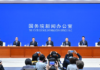















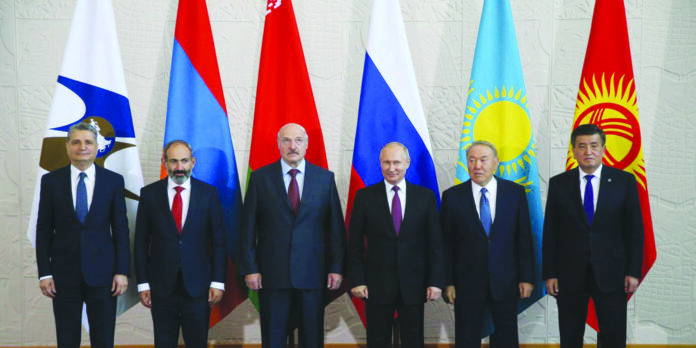
The latest summit of the Eurasian Economic Union (EAEU) brought together the leaders of its five member states— Russia, Belarus, Kazakhstan, Kyrgyzstan, and Armenia— at a moment of significant transition in global economic and political affairs. President Vladimir Putin of Russia, President Alexander Lukashenko of Belarus, President Kassym-Jomart Tokayev of Kazakhstan, President Sadyr Japarov of Kyrgyzstan and Armenian Prime Minister Nikol Pashinyan convened to assess the trajectory of a regional bloc that, a decade after its creation, is still defining its place in an unsettled international environment.
Established in 2015, the EAEU was designed to foster economic integration among post-Soviet states through the free movement of goods, services, capital, and labor. With a combined gross domestic product exceeding $2.5 trillion, the union represents a substantial economic space stretching from Eastern Europe to Central Asia. Yet its true significance lies not only in aggregate figures, but also in its ambition to function as a coordinated economic entity capable of shaping trade, regulatory standards, and development strategies across a vast region.
In the summit, the agenda reflected both continuity and adaptation. Leaders reviewed ongoing EAEU activities, discussed ways to deepen economic integration, and examined progress toward the creation of a unified single market. Several documents were adopted, underscoring the bloc’s emphasis on institutional consolidation and legal harmonization. Among the most anticipated outcomes was the expected signing of a free trade agreement between the EAEU and Indonesia, following the conclusion of negotiations earlier in 2025. This agreement signals the union’s intention to expand its external economic ties beyond its immediate neighbourhood.
President Putin’s characterization of the EAEU as a “self-sufficient centre of the emerging multipolar world” set the tone for much of the discussion. His remarks were not merely rhetorical; they reflected a broader strategic vision in which regional organizations play a larger role as global economic power becomes more dispersed. In this view, the EAEU is not only a mechanism for internal coordination but also a platform for collective engagement with Asia, the Middle East, Africa, and Latin America.
From Moscow’s perspective, the EAEU offers a framework through which Russia can maintain economic linkages and influence across Eurasia at a time when its relations with Western economies remain deeply strained. Emphasis on mutual trade growth, industrial cooperation, and infrastructure connectivity reflects an effort to reduce vulnerabilities and cultivate alternative markets. The summit’s focus on practical economic issues rather than abstract declarations, suggests an awareness of the need to demonstrate tangible benefits to member states.
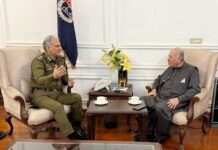
Belarus, represented by President Lukashenko, remains one of the strongest advocates of deeper integration. For Minsk, close alignment with Russia and participation in the EAEU provide access to markets, energy resources, and financial support. Bilateral talks between Putin and Lukashenko on the sidelines of the summit, covering defense and economic cooperation, highlighted the continued interdependence between the two countries. These discussions also illustrated how EAEU meetings often serve as venues for parallel bilateral diplomacy, reinforcing both formal and informal ties.
In a world marked by shifting alliances and uncertain growth, the EAEU’s efforts to deepen cooperation and expand its reach deserve close attention. The union’s future will not be decided in a single meeting, but each summit contributes to shaping a regional project that seeks relevance in an increasingly complex global landscape.
Kazakhstan occupies a more nuanced position within the union. President Tokayev has consistently supported economic cooperation while emphasizing respect for national sovereignty and balanced foreign relations. For Astana, the EAEU is one pillar of a broader strategy that includes engagement with China, the European Union, and other regional partners. Kazakhstan’s interest lies in ensuring that integration enhances trade efficiency and industrial development without constraining its diplomatic flexibility.
Kyrgyzstan, as a smaller economy, views the EAEU primarily through the lens of labor mobility, remittances, and access to larger markets. President Japarov’s participation underscored the importance of addressing practical concerns such as customs procedures, technical standards, and support for small and medium-sized enterprises. For countries like Kyrgyzstan, grand strategy and more by everyday economic outcomes measure the success of the EAEU less.
Armenia’s presence at the summit carried particular significance. Represented by Prime Minister Pashinyan, Armenia remains a member of the EAEU despite ongoing debates about its foreign policy orientation and security partnerships. While the Armenian presidency is largely ceremonial, Pashinyan’s role reflects Yerevan’s pragmatic approach to economic engagement. For Armenia, participation in the EAEU offers access to a large market and labour opportunities, even as it navigates complex regional and domestic challenges. One of the most notable developments discussed at the summit was the anticipated free trade agreement with Indonesia. As Southeast Asia’s largest economy, Indonesia represents a significant partner for the EAEU’s external trade ambitions. The agreement is expected to reduce tariffs, streamline customs procedures, and open new avenues for cooperation in sectors such as agriculture, energy, and manufacturing. More broadly, it signals the EAEU’s intent to position itself as a credible economic partner beyond the Eurasian space.
This outward-looking approach reflects an understanding that the union’s long-term viability depends on diversification. Internal trade among EAEU members has grown steadily, but external partnerships are essential for sustaining growth and attracting investment. By engaging with economies like Indonesia, the EAEU seeks to demonstrate that it is not an inward-looking bloc but a participant in global commerce. Yet challenges remain. Differences in economic structure, levels of development, and policy priorities among member states complicate efforts to create a truly unified market. Regulatory harmonization, while progressing, often encounters resistance at the national level. Moreover, geopolitical tensions and sanctions affecting some members create asymmetries that the union must manage carefully.
The summit’s emphasis on adopting concrete documents suggests an awareness of these limitations. Incremental progress through agreed rules, shared standards, and coordinated policies may lack dramatic flair, but it forms the backbone of any durable integration project. In this sense, the EAEU appears to be favoring steady institutional work over sweeping announcements. In assessing the significance of this summit, it is useful to view the EAEU not as a finished product but as an evolving experiment. Its members are bound by geography, history, and economic ties, yet they differ in outlook and ambition. The challenge lies in translating shared interests into collective action that delivers measurable benefits.
President Putin’s framing of the EAEU as part of a multipolar order captures an aspiration that resonates with many non-Western states seeking greater autonomy in economic affairs. Whether the union can fulfill this role will depend on its ability to balance internal cohesion with external engagement, and political alignment with economic pragmatism. As the EAEU moves forward, its credibility will rest less on declarations and more on results: smoother trade flows, competitive industries, and partnerships that extend beyond symbolic agreements. The latest summit suggests that the leaders are aware of this reality. The task ahead is to ensure that integration remains a practical tool for development rather than a purely strategic slogan.
In a world marked by shifting alliances and uncertain growth, the EAEU’s efforts to deepen cooperation and expand its reach deserve close attention. The union’s future will not be decided in a single meeting, but each summit contributes to shaping a regional project that seeks relevance in an increasingly complex global landscape.