

















Europe has recently taken a historic step, launching an International Claims Commission to assess and compensate damages caused by the war in Ukraine. The scale of mobilisation has been unprecedented: tens of thousands of claims registered, governments committing legal, financial, and political support, and plans already underway to consider reparations, even from frozen assets. This structured, multilateral effort signals a firm belief that victims of war —regardless of nationality —deserve recognition, accountability, and justice.
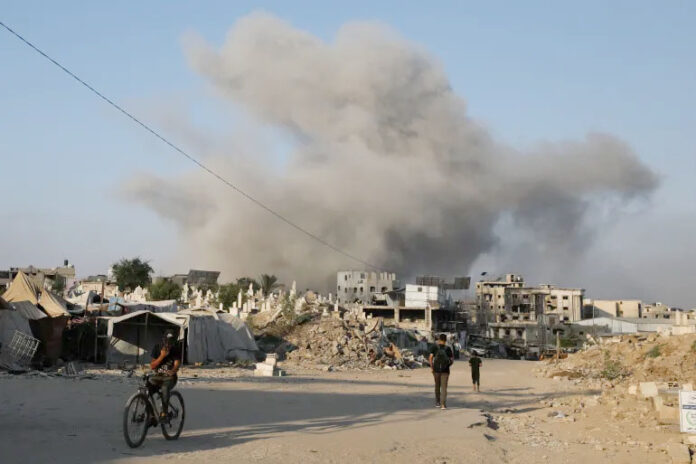
Yet, while Europe acts decisively for Ukraine, the same principle of accountability appears absent for Gaza. Gaza has endured devastation of staggering proportions: thousands of civilians killed, tens of thousands displaced, homes, schools, and hospitals destroyed, and its already fragile infrastructure reduced to rubble. Entire communities live without water, electricity, or medical services. Economically, the Strip faces near-total collapse. The destruction rivals, and in some respects surpasses, that witnessed in Ukraine.
The time to act is now. Structural, enforceable mechanisms of accountability for Gaza must be pursued with the same energy, seriousness, and political will that Europe has shown for Ukraine. Anything less is not only morally inadequate but legally and ethically indefensible. The world cannot cotinue to turn a blind eye. Gaza’s tragedy deserves more than rhetoric — it demands justice
And yet, there is no formal international mechanism to assess, validate, or compensate for these damages. No commission, no claims process, no structured accountability framework —nothing approaching the scale or seriousness of Europe’s efforts for Ukraine. Humanitarian aid flows intermittently, but aid alone cannot replace destroyed lives, homes, or livelihoods, nor can it address the structural injustice inflicted on Gaza’s population.
This glaring disparity raises the big question: If Europe and its partners can mobilise resources, legal frameworks, and political will to create a structured compensation mechanism for Ukraine, why is Gaza left without a similar system despite equal or even greater devastation? Why does the international community —and particularly the Muslim world, which shares historical, cultural, and religious bonds with the Palestinian people —remain largely silent or ineffective in translating outrage into actionable accountability?
The silence is deafening. Regional organisations, Muslim-majority states, and global institutions have repeatedly condemned violence in Gaza, but these condemnations rarely translate into enforceable mechanisms of justice. Meanwhile, Western powers, citing geopolitical calculations, continue to prioritise conflicts closer to their strategic spheres, leaving Gaza trapped in cycles of destruction and neglect. This selective application of justice exposes a stark double standard: some victims of war receive immediate recognition, structured legal redress, and global attention, while others, equally deserving, are left in the shadows.
The moral and legal implications are profound. International law, human rights conventions, and humanitarian norms are intended to be universal, yet their application is uneven. The people of Gaza have a right to recognition, redress, and compensation. The absence of a formal mechanism not only perpetuates injustice but also erodes faith in international institutions and norms. If accountability is to be meaningful, it cannot be selective.
The world must confront this paradox. Gaza’s suffering is not a distant or abstract issue; it is a litmus test of the credibility of international justice. The comparison with Ukraine serves as a mirror, reflecting the inequities of a system where geopolitics often trumps principle. It compels the Muslim world, civil society, and international actors to ask difficult questions: Are we upholding the principles we profess? Are we willing to mobilise legal, political, and financial mechanisms to ensure that Gaza’s destruction is recognised, assessed, and addressed?
There is precedent, and there is possibility. The International Claims Commission for Ukraine demonstrates that it is feasible to establish structured, multilateral mechanisms to quantify war damage, validate claims, and pursue reparations. If such a framework can be instituted for Europe, why not for Gaza? The absence of action is not due to lack of options, but rather a lack of prioritisation, political courage, and collective will.
Gaza deserves more than temporary humanitarian relief. It deserves justice, recognition, and accountability —in line with the same principles being applied elsewhere. The big question must echo loudly in diplomatic halls, international forums, and the corridors of power: If Ukraine’s destruction can trigger rapid institutionalised justice, why does Gaza’s devastation not command the same response? Until this question is answered, the credibility of international justice remains compromised, and Gaza’s people remain the invisible victims of a selective system.
The time to act is now. Structural, enforceable mechanisms of accountability for Gaza must be pursued with the same energy, seriousness, and political will that Europe has shown for Ukraine. Anything less is not only morally inadequate but legally and ethically indefensible. The world cannot continue to turn a blind eye. Gaza’s tragedy deserves more than rhetoric — it demands justice.



In the world of indie games download, players are always searching for better experiences, especially when they try to gaming news today from trusted sources. Many gamers explore different genres such as free online games or even deep story-based trending mobile games to discover new entertainment. As the demand grows, the trend of action games online continues to shape the gaming community and attract more users every day.
Many people today are increasingly interested in subjects like Artificial intelligence because of their major influence on global technology and financial systems. At the same time, the rise of markets such as Invest attracts individuals who want to explore new opportunities and learn how digital economies operate. Others choose to study areas like Forex to understand long‑term strategies, risk management, and potential growth across different sectors.
في المنازل التي بها أطفال وكبار سن، الأفضل اختيار حلول مكافحة الحشرات ذات السمية المنخفضة واتباع تعليمات السلامة بعد الخدمة. اقرأ توصيات السلامة في المقال.
웹디자인기능사실기 작업 순서를 미리 익혀두는 게 중요하네요.
There is definately a lot to find out about this subject. I like all the points you made
I like the efforts you have put in this, regards for all the great content.
I do not even understand how I ended up here, but I assumed this publish used to be great
This is my first time pay a quick visit at here and i am really happy to read everthing at one place
Great mix of research and practical application. Very helpful.
Nice balance of theory and practical advice. Well done!
Your tone is friendly and informative — made for an enjoyable read.
I tried your suggestion and it worked perfectly for me. Cheers!
Very readable and informative. Saved this for future reference.
You’re so awesome! I don’t believe I have read a single thing like that before. So great to find someone with some original thoughts on this topic. Really.. thank you for starting this up. This website is something that is needed on the internet, someone with a little originality!