

Lindsey Graham's death clouds future of US support measures for Ukraine
WASHINGTON: Senator Lindsey Graham's death has raised doubts over the future of Russia sanctions legislation and broader US military support for Ukraine. He had been a key advocate for Kyiv and an influential ally of President Donald Trump.

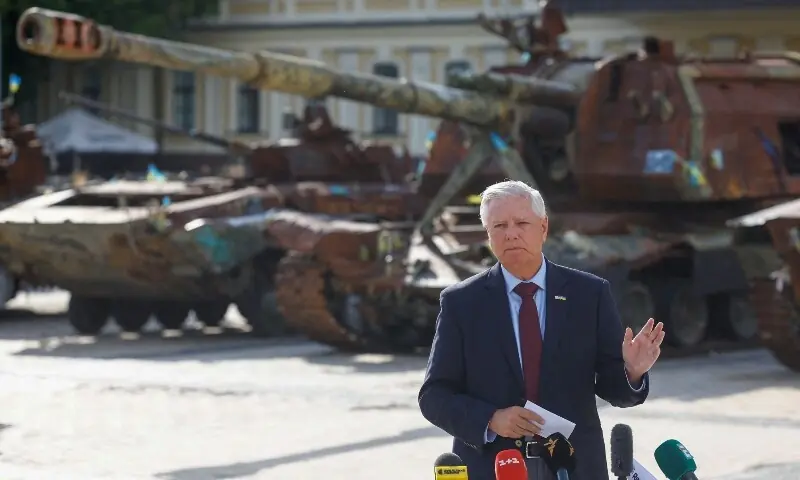
WASHINGTON: The death of US Senator Lindsey Graham has cast fresh uncertainty over whether recent gains by Ukraine's supporters in Washington can endure without one of President Donald Trump's closest Republican allies pressing Kyiv's case inside the administration.
The immediate questions centre on two major issues: a long-delayed Russia sanctions bill that Graham had championed for more than a year, and future military backing for Ukraine as it faces intensified Russian attacks and pressure to bring the nearly 4.5-year war to an end.
Graham, 71, died late on Saturday, one day after his 10th visit to Ukraine since Russia's full-scale invasion in February 2022. During that trip, he announced that he and other senators backing the proposed Sanctioning Russia Act had reached an understanding with the White House to move ahead with the legislation. The bill had remained stuck because of Trump's resistance, despite having 85 co-sponsors in the 100-member Senate.
Trump said last week that he would give Kyiv a licence to produce interceptors for the Patriot air defence system. Ukraine, however, has said it urgently needs more defensive munitions now.
Key link between Kyiv and Trump
The South Carolina Republican had spent years advocating military support for Ukraine and was seen as an important intermediary between Kyiv and the Trump administration, often working across party lines. Last year, he also helped broker a critical minerals agreement between Washington and Kyiv, persuading Trump to support an arrangement granting the United States preferential access to new Ukrainian minerals projects in return for investment.
Matthew Murray, a former Commerce Department official who now teaches at Georgetown and Columbia universities, said Graham had played a decisive role in changing Trump's approach.
“He was successful in leading President Trump to pivot in his position toward Ukraine,” said Matthew Murray, a former Commerce Department official now teaching at Georgetown and Columbia universities. “The senator’s good work here will be self-sustaining and self-executing,” Murray said.
Ukrainian President Volodymyr Zelenskiy said he was deeply affected by Graham's death and noted that the two had remained in frequent contact.
“We remained in constant dialogue, and I will miss our conversations. We met twice in just the past week,” he said in a statement.
Uncertainty over sanctions and aid
Analysts said Graham's record on Ukraine was complicated by Trump's uneven relationship with Zelenskiy, the president's America First approach, and the drain on US resources caused by the war with Iran, which has also increased pressure to permit Russian oil shipments to help contain energy prices.
Scott Anderson of the Brookings Institution said Graham's loss would be significant for Ukraine because he served as an influential voice from the more internationalist wing of the Republican Party and could shape Trump's thinking behind the scenes. Even so, Graham had not succeeded in persuading Trump to allow a vote on the sanctions bill before now.
The last major Ukraine aid package approved by both chambers of Congress was the $61 billion measure passed in April 2024. Since Trump began his second term in January 2025, many Republicans have become less supportive of Kyiv.
Charles Lichfield, deputy director of the Atlantic Council's GeoEconomics Center, said Graham's absence could make it harder to secure the sanctions bill or additional security assistance, especially as other pro-Ukraine lawmakers, including former Republican Senate leader Mitch McConnell, are also due to leave Congress in January.
“Ukraine has lost an advocate that had the president’s ear,” said Charles Lichfield, deputy director of the Atlantic Council’s GeoEconomics Center.
Backers say they will press on
Trump has repeatedly pushed Zelenskiy's government to accept a peace agreement that could require painful concessions and has sharply criticised the Ukrainian president in the past. Trump rebuked Zelenskiy in the Oval Office early last year, accusing him of showing insufficient gratitude for American military support.
More recently, however, Trump's language has softened. After a North Atlantic Treaty Organisation summit this month, Zelenskiy said Ukraine and the United States had reached a political agreement on licensing for Patriot interceptor production and were also discussing joint drone manufacturing.
Trump is now expected to permit a vote on the sanctions bill, which targets countries buying Russian oil, gas and uranium. Supporters of the measure in both the Senate and House of Representatives said they would continue working for its passage in Graham's memory, and some suggested the bill could be renamed after him.
Democratic Senator Jeanne Shaheen of New Hampshire, the ranking Democrat on the Foreign Relations Committee and a co-sponsor of the bill, said in a statement:
“There can be no more fitting tribute to Lindsey,” Democratic Senator Jeanne Shaheen of New Hampshire, the top Democrat on the Foreign Relations Committee and a bill co-sponsor, said in a statement.
No voting schedule has yet been announced by the Senate. But Senate Republican leader John Thune of South Dakota said on CNN that passing the bill would be an “incredible legacy” for Graham.
Comments
No comments yet. Be the first to join the discussion!


