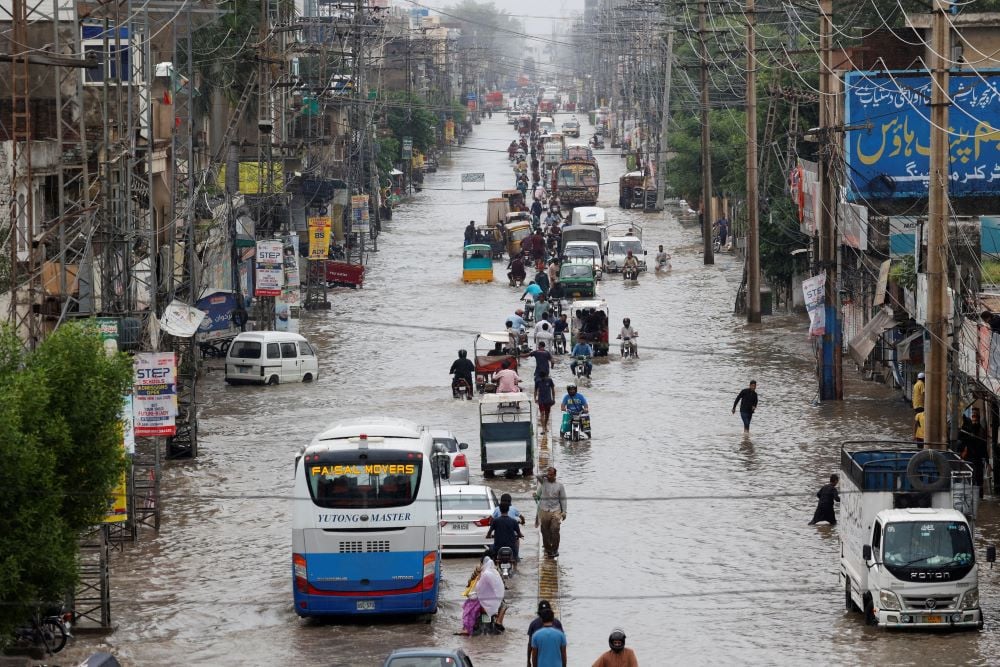
Punjab, Centre join forces to bolster climate resilience ahead of monsoon
Punjab and the Centre agreed to strengthen climate resilience ahead of the monsoon, including an integrated early warning system, district-level coordination and expanded preparedness under Punjab’s Climate and Disaster Resilience Plan 2026.

CM Maryam, Musadik agree on integrated early warning system for extreme weather
Districts to activate coordinated response at least six hours before climate emergencies
Punjab unveils Climate and Disaster Resilience Plan 2026, reviews first climate-tagged budget
NDMA, PDMA to deepen coordination as modern rescue drones, logistics and embankments boost preparedness
LAHORE: Punjab Chief Minister Maryam Nawaz and Federal Minister for Climate Change Dr Musadik Malik on Thursday agreed to strengthen federal-provincial coordination on climate resilience, flood preparedness and disaster management ahead of the monsoon season, approving a series of measures, including an enhanced early warning system, district-level coordination mechanisms and expanded preparedness plans to mitigate the growing risks posed by extreme weather events.
The decisions were taken during a high-level meeting chaired by the chief minister to review Punjab's climate resilience strategy, flood preparedness and institutional coordination in view of increasingly frequent and unpredictable climate-related emergencies.
Senior Provincial Minister Marriyum Aurangzeb presented the Punjab Climate and Disaster Resilience Plan 2026 and gave a comprehensive briefing on the province's preparedness measures, disaster response mechanisms and long-term climate adaptation strategy.
وزیراعلیٰ پنجاب مریم نواز شریف اور وفاقی وزیر ڈاکٹر مصدق ملک کی ملاقات میں موسمیاتی تبدیلی، مون سون تیاریوں اور ڈیزاسٹر مینجمنٹ کے اقدامات کا جائزہ لیا گیا۔ اجلاس میں "پنجاب کلائمیٹ اینڈ ڈیزاسٹر ریزیلینس پلان 2026" پیش کیا گیا، شدید موسمی حالات سے بروقت آگاہی-
وزیراعلیٰ مریم نواز… pic.twitter.com/yOvdC25ZwS— Government of Punjab (@GovtofPunjabPK) July 9, 2026
The meeting agreed to establish an integrated early warning system for forecasting extreme weather events through close coordination between the federal government and Punjab. Participants also discussed the installation of centralised information screens across districts in collaboration with the federal government to facilitate timely dissemination of weather alerts and emergency information.
It was decided that coordination among all relevant authorities would commence at least six hours before the onset of any anticipated extreme weather event, while a proposal to install climate and flood-related centralised information screens at both district and tehsil levels was also reviewed.
Mock exercises to strengthen preparedness
The chief minister directed the authorities concerned to immediately launch mock exercises across the province to test monsoon and flood preparedness and instructed the Provincial Disaster Management Authority (PDMA) to further strengthen coordination with the National Disaster Management Authority (NDMA).
She also directed officials to ensure controlled tourism during periods of extreme heat and heavy rainfall and ordered the issuance of comprehensive public advisories identifying expected rainfall zones and heatwave-prone areas.
The Punjab CM instructed the authorities to further enhance district-level logistics and emergency response capacity for floods and other severe weather events.
Referring to last year's floods, she said that despite large-scale devastation, no epidemic had broken out anywhere in Punjab because of effective planning and coordinated response.
She said flood-affected communities had been provided with medicines, food, clean drinking water, shelter and sanitation facilities, while no disease outbreak had occurred among either humans or livestock. She added that Clinics on Wheels and field hospitals had been deployed to provide uninterrupted healthcare services in affected areas.
Climate threats becoming more severe
The chief minister said the Provincial Disaster Management Authority and Rescue 1122 had been upgraded on modern technical lines to improve disaster response capabilities.
She said the provincial government was investing billions of rupees to enhance water storage capacity and strengthen climate resilience infrastructure across Punjab.
She further said that whereas the Water and Sanitation Agency (WASA) and solid waste management services had previously been confined largely to Lahore, WASA had now been established in every district of Punjab.
CM Maryam Nawaz noted that in the past, machinery for dealing with urban flooding had to be dispatched from Lahore and a few other major cities, but every district now possessed modern machinery and operational fleets capable of responding independently to emergencies.
Highlighting the growing impact of climate change, she observed that the frequency of severe and unpredictable weather events had increased alarmingly, underscoring the need for stronger preparedness and coordinated planning.
Federal minister praises Punjab's preparedness
Speaking on the occasion, Federal Minister for Climate Change Dr Musadik Malik said Punjab had carried out exemplary work under the leadership of Chief Minister Maryam Nawaz, adding that even the government's strongest political opponents acknowledged its performance.
He said the pace of development and administrative reforms undertaken by the Punjab government had compelled critics to appreciate its achievements.
Expressing his personal desire to work closely with the chief minister on environmental and climate-related initiatives, Dr Malik said significant progress had been made in the fields of environmental protection, climate action and disaster management.
Referring to last year's flood situation, which he termed was triggered by Indian water aggression, he said Punjab had delivered an effective response despite having limited time to prepare.
He commended Rescue 1122, the PDMA and other provincial institutions for their professional handling of flood relief and rescue operations.
The federal minister further said Prime Minister Shehbaz Sharif had directed all provincial governments to work jointly on climate change planning under the federal government's "Fix, Expand and Build" policy, assuring Punjab of the Centre's full support.
Timely action prevented greater damage
Senior Provincial Minister Marriyum Aurangzeb said timely intervention by Chief Minister Maryam Nawaz had prevented the flood situation from worsening and credited her leadership with ensuring uninterrupted rescue and relief operations round the clock.
She said that unlike previous years, the provincial government had adopted a proactive strategy by alerting all departments well before the arrival of the monsoon season.
During the meeting, officials presented a detailed overview of Punjab's 2025 flood response, informing participants that a high-level committee comprising all relevant departments had been established in September and was implementing disaster management at two operational levels.
The briefing stated that, for the first time, comprehensive surveys had been conducted to assess flood-related losses and compensation had been paid in full to affected people.
Officials informed the meeting that the government had prepared short-, medium- and long-term strategies to address climate change and natural disasters under a comprehensive three-year plan.
Punjab’s first climate-tagged budget
They also said Punjab had introduced the country's first climate-tagged budget.
According to the briefing, approximately three million people and 2.5 million livestock were rescued during the 2025 floods.
The meeting reviewed reports on compensation payments, restructuring of the PDMA and modernisation of the irrigation, communication and works, agriculture and livestock departments.
Officials said all flood-damaged irrigation infrastructure across Punjab had been fully restored, vulnerable points had been mapped and the carrying capacity of barrages had been enhanced.
Province-wide alerts for heatwaves and other severe weather events were being issued regularly, while fodder, drinking water, medicines and mobile veterinary dispensaries had already been deployed in vulnerable districts.
The briefing further stated that the Livestock and Dairy Development Department had also been restructured, while Rescue 1122 had been equipped with modern navigation systems and its technology, operational capability and human resources had been significantly upgraded.
Participants reviewed a detailed monsoon preparedness activity chart and measures taken to strengthen the PDMA. Officials informed the meeting that union council-level field formations and warehouses had been established in vulnerable districts to improve emergency response.
The briefing said all provincial departments were now working together under a "One Government Flood Management" framework and that work on the Jalalpur Flood Protection Bund would be completed by July 31.
The meeting also reviewed procurement plans for modern disaster response equipment and progress on post-flood restoration projects. Photographic evidence of restoration work on the Jalalpur Flood Protection Bund, Nooraja Bhatta Flood Bund and Chandarban Flood Bund was presented.
The NDMA chairman informed the meeting that Punjab had procured modern water rescue drones and undertaken extensive district-level flood preparedness measures.
A detailed briefing on the monsoon outlook, flash floods, cloudbursts and riverine flooding said lists of flood- and heatwave-vulnerable districts had already been shared with the PDMA and district disaster management authorities.
Officials warned that heavy rainfall in northern areas coupled with snowmelt could increase flood risks, while climate change had contributed to more frequent cloudbursts and flash floods.
The meeting also reviewed temperature forecasts and the pre-monsoon outlook. Officials cautioned that flooding in the Chenab, Sutlej and Ravi rivers could occur in the event of Indian water aggression.
According to the briefing, southern Punjab, Multan, Dera Ghazi Khan, Sargodha and Mandi Bahauddin remained among the districts most vulnerable to heatwaves. It added that 18 deaths had so far been reported nationwide due to the ongoing heatwave.
The NDMA chairman informed the meeting that advance warnings had been issued to all climate-vulnerable districts, while a comprehensive survey of flood protection embankments across Punjab was under way. He added that round-the-clock coordination between the Punjab government and the NDMA remained in place.
The meeting was informed that first responders, NGOs, Rescue 1122, the military and trained volunteers had all been placed on alert, while cleaning of drains and waterways continued across the province.
Officials further warned that unusual rainfall was forecast for Chakwal, Talagang and the Potohar region, while unseasonal downpours and cloudbursts could trigger localised flooding in vulnerable districts. Flooding was also possible in the Koh-i-Suleman range and Rod Kohi system areas.

Comments
No comments yet. Be the first to join the discussion!