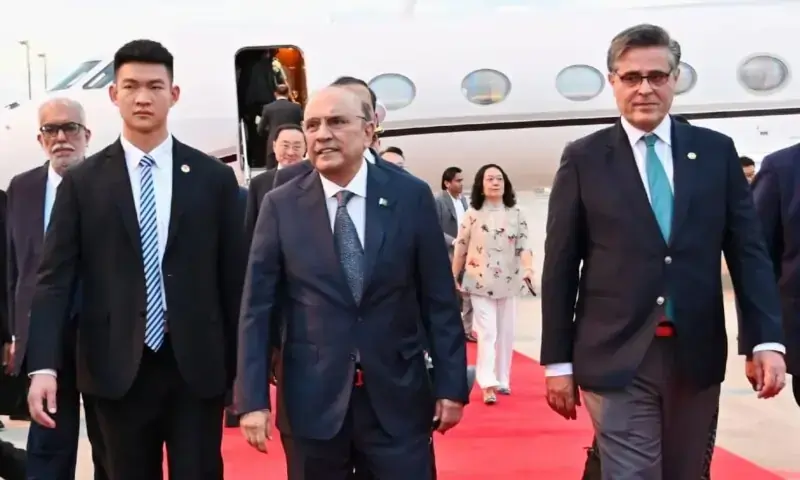
Pakistan, Kyrgyzstan reaffirm push to expand trade and strategic cooperation
President Asif Ali Zardari and Kyrgyz President Sadyr Zhaparov have reaffirmed plans to deepen bilateral ties, with trade, investment, connectivity, and security cooperation at the centre of talks in Bishkek.

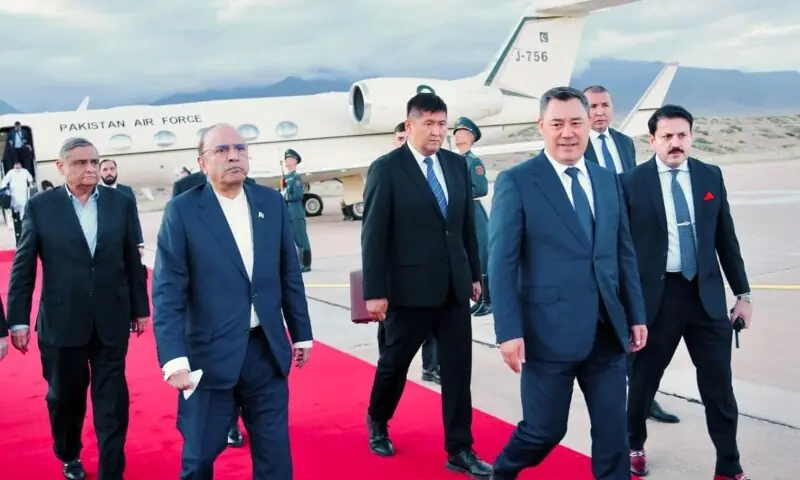
BISHKEK: President Asif Ali Zardari and Kyrgyz President Sadyr Zhaparov on Tuesday renewed their commitment to strengthening bilateral relations, with both sides placing particular emphasis on expanding trade, economic links, and investment cooperation, according to a joint statement issued during Zardari’s official visit to Kyrgyzstan.
Zardari arrived in Kyrgyzstan a day earlier on a four-day visit from July 6 to 9. The joint statement said the two presidents expressed satisfaction over the progress in ties between their countries and reiterated the need to move forward on understandings reached during Zhaparov’s visit to Pakistan in December.
The two leaders stressed the importance of sustained political engagement and closer institutional contact, including between parliaments, governments, and foreign ministries. They also signalled their willingness to work towards what the statement described as “a strategic partnership” centred on trade, economic cooperation, and investment. Ministers and relevant agencies were directed to step up efforts to carry out previously agreed measures and take practical steps to promote commercial activity, investment, and business-to-business engagement.
The statement said both sides also called for stronger inter-agency coordination and more effective functioning of the Kyrgyz-Pakistani Intergovernmental Commission on Trade, Economic, Scientific and Technical Cooperation, as well as relevant joint working groups. They pledged full support for stronger connections between business communities, including chambers of commerce and industry, investment promotion bodies, and banking and financial institutions, while also encouraging joint projects and joint ventures.
Sectoral cooperation and connectivity
Pakistan and Kyrgyzstan identified multiple sectors for deeper cooperation, including energy, mining, agriculture, textiles, light industry, the halal sector, healthcare, pharmaceuticals, digital economy, information and communication technologies, tourism, and finance. In the energy sector, the two sides highlighted the scope for greater collaboration through the CASA-1000 project, which the statement described as an important link between Central and South Asia.
The discussions also covered medical education, regulatory coordination, vaccine and biological product manufacturing, and pharmaceutical joint ventures. The statement said both countries discussed facilitating market access through closer coordination between their drug regulatory authorities.
Transport, logistics, and transit also featured prominently in the talks. The two presidents reaffirmed the need to implement existing understandings in these areas and said they were ready to continue working on effective use of Pakistan’s seaports. They also discussed using Kyrgyzstan’s transit and logistics capacity to improve access to markets in Central Asia and the Eurasian Economic Union, alongside additional steps to increase cargo movement.
Security and multilateral coordination
The leaders also reviewed cooperation in education, science, culture, tourism, youth exchanges, and medical and public health links, including quality assurance in medical education and professional regulatory collaboration.
On security issues, the statement said the two presidents discussed increasing cooperation in combating terrorism, extremism, illicit narcotics trafficking, organised crime, irregular migration, cybercrime, and other contemporary threats. They condemned terrorist attacks in the region and elsewhere and expressed readiness to work together at international forums.
According to the statement, both sides underlined the value of closer coordination and mutual backing at the United Nations, the Shanghai Cooperation Organisation, the Organisation of Islamic Cooperation, the Economic Cooperation Organisation, and other regional and international bodies. Zardari expressed support for Kyrgyzstan’s priorities during its chairmanship of the SCO and said Pakistan would maintain close coordination during its own upcoming chairmanship of the SCO and ECO.
President Zhaparov thanked Pakistan for supporting Kyrgyzstan’s candidature for election as a non-permanent member of the United Nations Security Council for the 2027-2028 term. The Kyrgyz side also appreciated Pakistan’s role as a non-permanent UNSC member for 2025-2026, as well as its mediation role in the Middle East conflict and the subsequent signing of the Memorandum of Understanding between the United States and Iran.
The statement added that both countries agreed a secure and enabling environment was essential to unlock the wider potential of cooperation and regional connectivity between Central Asia and South Asia.
Pakistan also backed Kyrgyzstan’s plans to host the Second Global Mountain Summit Bishkek+25 in 2027. The Kyrgyz side invited Pakistan to take part in the VI World Nomad Games, scheduled in Kyrgyzstan from August 31 to September 7, and Pakistan accepted the invitation.
The joint statement said both presidents voiced hope that Zardari’s visit would contribute to stronger bilateral ties, broader mutually beneficial cooperation, and greater prosperity for the people of both countries. Zardari also thanked the people of Kyrgyzstan for their “warm hospitality” and invited Zhaparov to visit Pakistan. The invitation was accepted, with dates to be finalised through diplomatic channels.
Comments
No comments yet. Be the first to join the discussion!