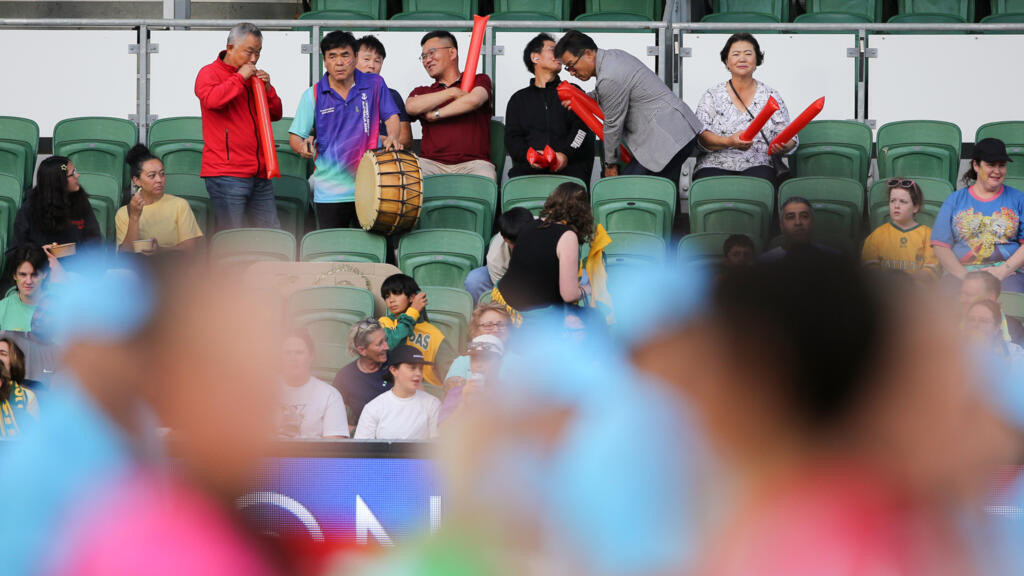
Robot footballers draw crowds at South Korea's RoboCup
Humanoid robot teams attracted spectators in Incheon at RoboCup, where autonomous machines played football on compact pitches. Researchers and visitors said advances in AI are bringing robot sport closer to a broader audience.

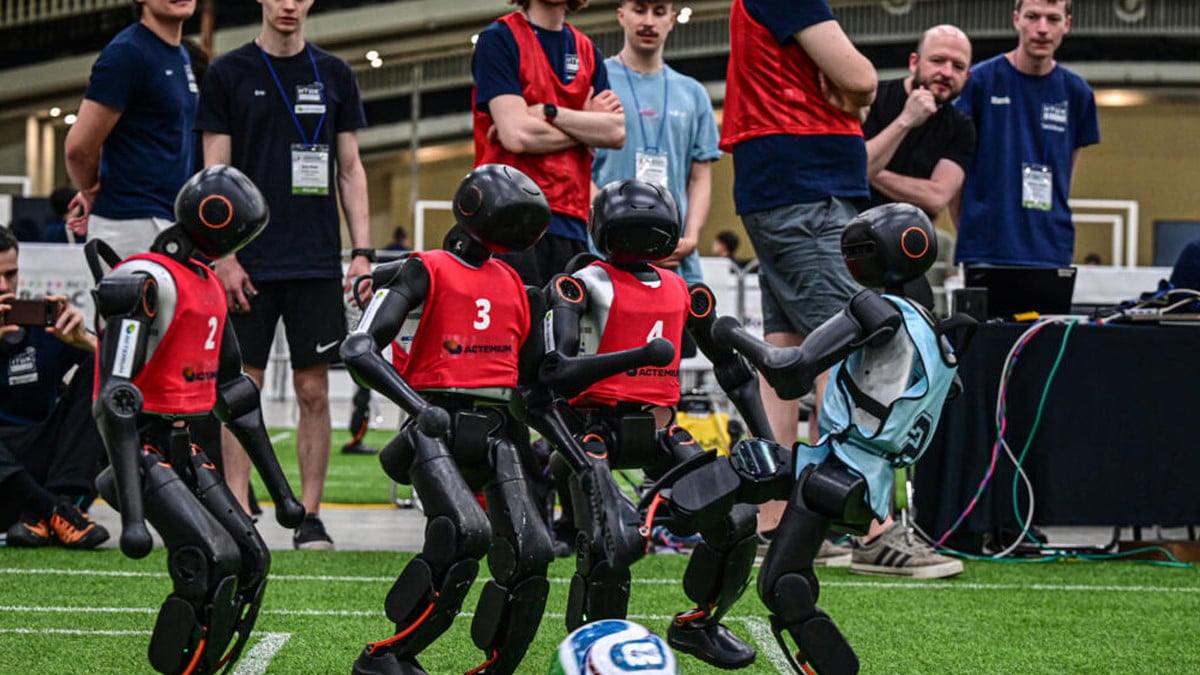
INCHEON: Humanoid robots in red and blue kits drew cheers from spectators in South Korea's port city of Incheon as RoboCup matches showcased how far autonomous football-playing machines have come.
The event, described as the world's largest robotics competition, features teams pursuing a long-term goal of developing a fully autonomous side capable of beating the FIFA World Cup champions by 2050. Unlike remote-controlled machines, the robots competing at RoboCup make their own decisions once play starts, providing a test of recent advances in artificial intelligence.
During a match on Friday, a referee's call of stop after the ball went out prompted every robot on the pitch to halt immediately. Soon after, a player identified as number one scored to applause from dozens of onlookers. In another moment, a robot collided with the goalkeeper and sent it tumbling, prompting laughter from the crowd.
Across the Songdo Convensia convention centre, matches were taking place at the same time on compact fields, with small, medium and large humanoid robots competing as visitors moved between courts.
Competition built around autonomous play
RoboCup was founded in Japan in 1997 and has since expanded beyond football into rescue, home service and industrial robotics. Its football competition remains tied to the project's longer-term ambition of producing a team of autonomous robots able to defeat the human world champions by mid-century.
Lea Wedmann of the Hamburg Bit-Bots team from the University of Hamburg told AFP that while the robots play autonomously, human team members still pass the referee's commands, including stop and resume, into the system during matches.
Spectators told AFP the experience of watching robot football felt closer to a human sporting contest than they had expected. Cho Woo-cheol, a 45-year-old construction company worker, said the blue side drew his support because it looked slightly more human.
“I had never seen robots playing football before. It was fascinating and really fun”, Cho said.
“When I first saw them, I found myself supporting the blue team because they looked a bit more human. They're obviously not moving exactly like people yet, but they were much closer than I expected. Robot football has its own unique charm”, he stated.
Another visitor, Kim Mi-hong, 60, said improving technology could eventually create loyal followings for robot teams and players.
“If they become really good, I think they'll have fans. People were already saying, 'The red team is better,' and recognising players by their numbers. As the technology improves, I think fandoms will naturally emerge”, he added.
Researchers see rapid progress
Thomas Rofer, spokesperson for Germany's B-Human team at the German Research Center for Artificial Intelligence, said researchers believe robots can overcome humans in football by 2050. He said recent humanoid robot development had advanced sharply and pointed to a company at the event demonstrating a robot able to kick as hard as a human.
"We think robots can defeat humans by 2050."
Rofer told AFP.
Researchers see artificial intelligence as a major driver of that progress. Morgan Stanley Research has estimated that by 2050 about 930 million humanoid robots could be working in repetitive, structured tasks, while the global humanoid robotics market could reach $5 trillion.
There is no prize money at RoboCup, and university teams take part mainly to push robotics research forward. Even so, Shim In-wook, a professor of smart mobility engineering at Inha University, said robot football could eventually stand as a sport in its own right.
"In the FIFA World Cup you might have one Lionel Messi."
Shim told AFP, adding “But once you build one Messi robot, you can build thousands more.”
Comments
No comments yet. Be the first to join the discussion!