The real reason Trump crumbled against Iran
A key driver behind Trump’s shift on Iran may have been depleted US missile and interceptor supplies, not just Hormuz fears—analysing claims about Patriot, THAAD, and cruise inventories.

He ran out of missiles
The MoU signed between the USA and Iran has been described by Trump’s critics as humiliating. It has been resisted by many politicians in Washington, including voices from both Democratic and Republican circles. It reportedly angered supporters of Israel and those who believed the USA should have pressed forward rather than entered into negotiation. Yet, despite opposition from political allies, media commentators, and regional partners, President Trump moved toward the MoU.
Why?. The conventional answer is that the USA feared the closure of the Strait of Hormuz. But that may not have been the prime reason. Disruption of oil supply, the rise in petrol prices, and the inflationary burden on US consumers may have added pressure.
However, the reality was depletion of arms and ammunition. In a Middle East Eye clip quoting US author Brandon Weichert speaking to Tucker Carlson, Weichert claimed that the USA had used roughly 50 percent of its Patriot interceptors, up to 80 percent of its THAAD interceptors, about one-third of its Tomahawk cruise missile supply, and nearly the entire pre-war inventory of new Precision Strike Missiles. He also referred to the major use of JASSM missiles and naval interceptors such as SM-3 and SM-6. These figures must be treated as attributed claims unless independently confirmed by official data, but if even broadly accurate, they reveal a far
The conventional US-Israeli calculation may have been based on treating Iran as a normal regional power. A normal country may possess missiles, drones, and naval weapons, but usually in limited numbers. Such weapons are preserved for deterrence, symbolic retaliation, and emergency use. A normal country might fire a dramatic opening salvo, but after several days or weeks of war, its missile depots, launchers, command centers, and radar systems would be degraded. Its firing rate would collapse. Its leadership would become cautious because it would fear exhausting its national arsenal. That calculation may have made sense against a conventional state. It did not make sense against Iran.
Iran is not a normal missile country. Iran is a missile-war state. For decades, Iran understood that it could not match the USA or Israel aircraft-for-aircraft, tank-for-tank, or ship-for-ship. It could not build a navy equal to the US Navy. It could not build an air force equal to Israel’s or the USA’s. It could not protect every city, base, oil installation, port, and military site with a perfect defensive shield. So Iran chose a different path. It built missiles, drones, decoys, tunnels, mobile launchers, coastal batteries, mines, fast boats, small submarines, and asymmetric naval systems.
This was the central strategic miscalculation by Washington and Tel Aviv. They calculated Iran was a normal country with missiles. Iran revealed itself as a missile state with a country.
As a brilliant strategic masterstroke, Iran did not spend most of its limited resources trying to build an expensive nationwide anti-ballistic missile system. If Iran had tried to build an Israeli-style or American-style interceptor shield over the entire country, it would likely have been financially suicidal and militarily insufficient. Iran is too large, its territory too dispersed, and its targets too numerous.
The MOU was not born from generosity. It was born from necessity. The USA did not simply choose to stop. It was forced to pause, replenish, reassess, and negotiate from a position far weaker than it wanted the world to know.
To defend all of Iran would require enormous numbers of radars, command systems, interceptor batteries, trained crews, spare parts, and replacement missiles. Even then, such a defensive network could be overwhelmed by the combined air and missile power of the United States and Israel. So Iran refused to play America’s game. It did not try to build an Iron Dome over Iran. It built a sword aimed at the shield of its enemies.
Instead of spending its limited wealth on defensive interceptors, Iran spent it on offensive saturation. This decision changed the cost equation of the war. A Patriot, THAAD, Arrow, SM-3, or SM-6 interceptor can cost millions of dollars and may take months or years to replace. A drone, decoy, loitering munition, or simpler missile, can be far cheaper and easier to produce.
Iran did not need every missile or drone to hit its target. It only needed to force Israel and the USA to respond. Every incoming object had to be detected, classified, tracked, and, if dangerous, intercepted. In the fog of war, the defender cannot always know immediately which target is a decoy and which is lethal. Therefore, expensive interceptors are often spent against cheaper threats.
That was the winning cost-exchange. Iran spent a quantity. The USA and Israel spent treasure. This is why Iran’s strategy was not necessarily to defeat the USA in one dramatic battlefield encounter. Its aim was to impose an unbearable burn rate. Ballistic missiles, cruise missiles, drones, decoys, and maritime threats forced the USA and Israel to spend their most sophisticated defensive weapons at a pace that could not be sustained.
The same logic applied at sea. In the Strait of Hormuz, Iran did not need a blue-water navy equal to the USA’s. Geography was its ally. The Strait is narrow, close to Iranian territory, and vulnerable to coastal missiles, mines, drones, fast boats, and unmanned naval systems. Iran could threaten US naval forces without defeating them in a conventional naval battle. It could force the US Navy to spend large numbers of defensive interceptors simply to keep ships, bases, and shipping lanes safe.
This may explain why the reported use of SM-3 and SM-6 naval interceptors is so significant. If large numbers of these weapons were fired, then US ships may have faced far greater threats than officials publicly admitted. That does not mean the Navy failed. It may mean the Navy successfully defended itself. But a successful defence can still reveal strategic vulnerability if it rapidly depletes limited stocks.
That was the moment when the war became larger than Iran. Every THAAD, Patriot, SM-3, or SM-6 interceptor used against Iran was one less available against a future threat from China, North Korea, or another adversary. The USA may have discovered that its global commitments exceeded its weapons inventory.
This is why the MoU can be interpreted by critics as a form of conditional surrender. If a superpower accepts terms it dislikes because continuing the war would expose its inability to sustain the fight, then the political meaning is unmistakable. It has been compelled by battlefield realities.
In that sense, Iran’s strategic masterpiece was not that it built better weapons than th USA. It built cheaper weapons in larger numbers and forced the USA to defend with weapons it could not replace quickly. Iran understood that it could not win a defensive technology race against the USA and Israel, but it could win an offensive cost-imposition race.
That is why Trump crumbled against Iran. Not because Washington suddenly trusted Tehran. Not because Israel supported the compromise. Not because the US political class welcomed restraint. But because the USA may have reached the point where continuing the war would have exposed an even greater humiliation: the inability to defend its own assets, its closest regional ally, and its global deterrence posture at the same time.
The MOU was not born from generosity. It was born from necessity. The USA did not simply choose to stop. It was forced to pause, replenish, reassess, and negotiate from a position far weaker than it wanted the world to know.
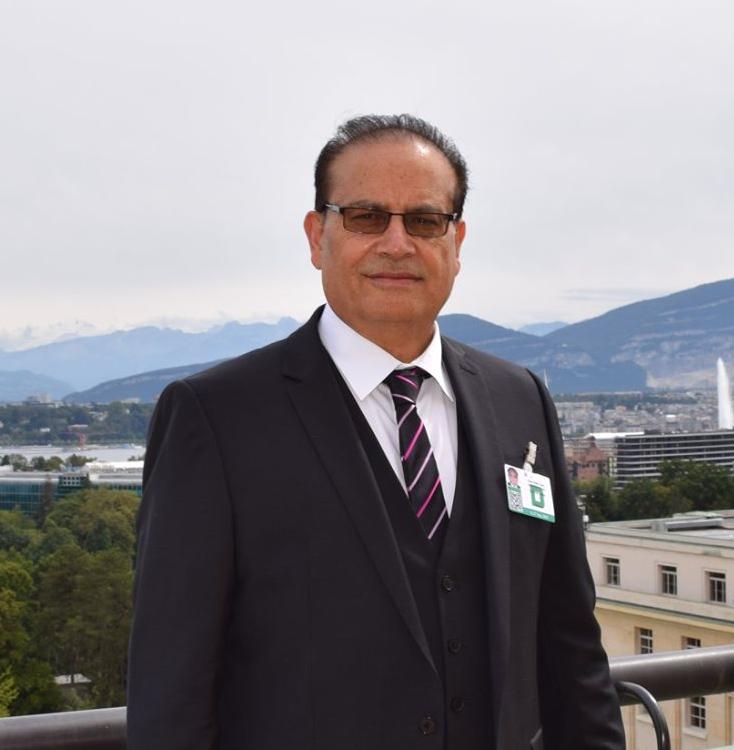
The writer retired as Press Secretary the President, and is former Press Minister at Embassy of Pakistan to France and former MD, Shalimar Recording & Broadcasting Company Limited
View all articles →Comments
No comments yet. Be the first to join the discussion!