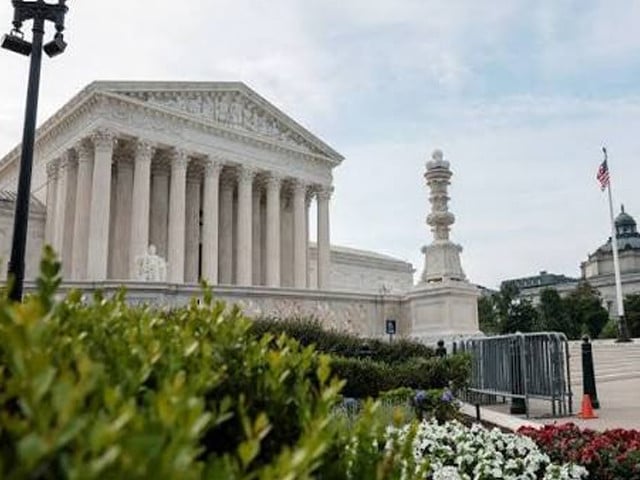
US Supreme Court rejects Trump's birthright citizenship push, upholds trans sports bans
The US Supreme Court struck down Donald Trump's bid to restrict birthright citizenship, while upholding state bans on transgender athletes in women's sports and removing some campaign finance limits.


WASHINGTON: The US Supreme Court on Tuesday dealt President Donald Trump a setback by striking down his attempt to limit birthright citizenship, while also allowing states to bar transgender student athletes from girls' and women's sports teams and invalidating additional campaign finance restrictions.
The court's nine-month term included major decisions on presidential authority, immigration, voting rights and gun laws. The court has a 6-3 conservative majority, including three justices appointed by Trump. During the term, Trump secured important wins in some cases but also faced losses on tariffs, the removal of a Federal Reserve official and, on Tuesday, birthright citizenship.
Birthright citizenship ruling
Restricting birthright citizenship was a central part of Trump's immigration agenda, and he signed an executive order on the issue on his first day back in office last year. The order directed federal agencies not to recognise the citizenship of children born in the United States if neither parent is a US citizen or a lawful permanent resident, commonly known as a green card holder.
In a 6-3 ruling written by Chief Justice John Roberts, the court said the order conflicted with the citizenship clause of the 14th Amendment. The amendment, adopted in 1868 after the Civil War, grants citizenship to people born in the United States who are subject to its jurisdiction, with narrow exceptions such as children of foreign diplomats or members of an occupying enemy force.
Roberts wrote that the 14th Amendment's framers extended citizenship protections broadly.
"Citizenship, then and now, was the right to have rights — to freely participate in our political community", he added "We keep that promise today."
Some experts had estimated before the decision that the directive could affect the legal status of as many as 250,000 babies born each year and could force millions of other families to prove the citizenship status of their newborn children. Critics of Trump's approach to immigration had accused him of racial and religious discrimination.
Transgender sports case
The court also ruled on laws in West Virginia and Idaho that assign public school and university sports teams on the basis of biological sex and prohibit students identified by the laws as male from joining female teams. The two states argued the measures were needed to protect fairness and safety in competition for women and girls. 25 other states have enacted similar laws.
The justices overturned lower court rulings that had favoured transgender students challenging the bans under the Constitution and federal anti-discrimination law. The court ruled 9-0 that the state laws do not violate Title IX, which prohibits discrimination in education on the basis of sex. On the constitutional question, the justices split along ideological lines, with the six conservatives in the majority, and held that the laws also do not breach the 14th Amendment's equal protection guarantee.
Justice Brett Kavanaugh wrote for the court "Consistent with Title IX and the Equal Protection Clause, we hold that the states may maintain women's and girls' sports for biological females. They may determine eligibility for women's and girls' sports based on biological sex. The Constitution and Title IX do not require an overhaul of women's and girls' sports throughout America".
The issue of transgender athletes as part of broader US culture-war disputes. This was the second major Supreme Court ruling against transgender plaintiffs within a year, after a June 2025 decision from Tennessee that allowed states to ban gender-affirming medical treatment for transgender minors.
Campaign finance and other major rulings
In another 6-3 decision, the court sided with Republican challengers, including Vice President JD Vance, against federal limits on coordinated spending between political parties and candidates. The ruling came as major Republican committees moved toward the November midterm elections with a significant cash advantage over Democratic rivals. The court held that the cap on party spending carried out with candidate input violated First Amendment protections for freedom of speech.
The court has issued multiple consequential rulings during the term. In February, it rejected Trump's sweeping global tariffs imposed under a law intended for national emergencies. On Monday, it allowed Trump to remove a Federal Trade Commission member, expanding presidential control over government and overturning a 1935 precedent that had long restricted a president's ability to dismiss officials at independent agencies. In a separate case, however, it declined to immediately let him fire Federal Reserve Board Governor Lisa Cook.
In April, the court weakened a key part of the Voting Rights Act in a ruling seen as a win for Republicans. This month, it allowed the Trump administration to revoke humanitarian protections that had shielded hundreds of thousands of Haitian and Syrian immigrants from deportation, and it also ruled in Trump's favour in a case involving asylum seekers. The court further broadened gun rights this month by striking down a Hawaii law that restricted the carrying of handguns on private property open to the public without the owner's permission, and by narrowing the reach of a US law barring firearm possession by certain drug users.
Comments
No comments yet. Be the first to join the discussion!