

June 12, 2026
SC restores Imran Khan’s right to defence in Shehbaz defamation case
The Supreme Court has, by a 2-1 majority, restored Imran Khan’s right to defence in the Rs10 billion defamation suit filed by Prime Minister Shehbaz Sharif. The case has been sent back to the trial court for further proceedings.

June 12, 2026
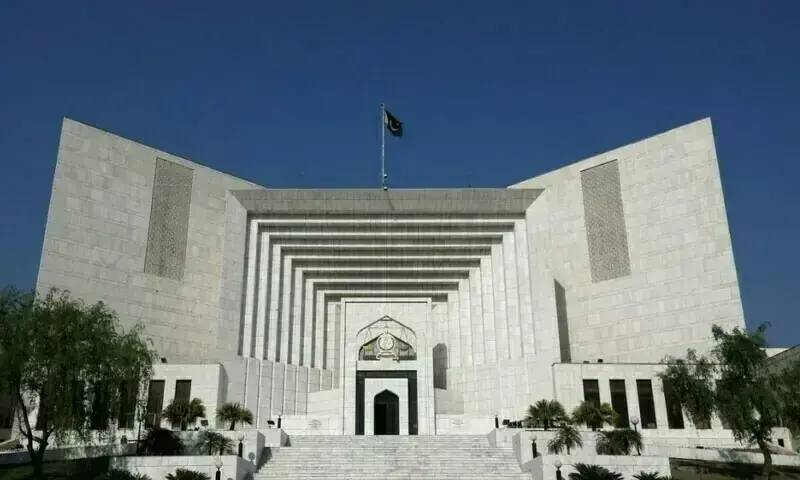
ISLAMABAD: The Supreme Court, by a 2-1 majority, on Thursday set aside its December 29, 2022 order that had upheld the closure of PTI founder Imran Khan’s right to defence in a Rs10 billion defamation suit filed by Prime Minister Shehbaz Sharif.
A three-member bench headed by Justice Ayesha A. Malik and comprising Justice Muhammad Hashim Khan Kakar and Justice Ishtiaq Ibrahim heard the review petitions filed by the former prime minister. Justice Kakar disagreed with the majority view. The court overturned the earlier rulings of the Lahore High Court and the trial court, and sent the matter back to the trial court with directions to give Imran Khan a reasonable opportunity to submit his reply to the interrogatories and then proceed with the case in accordance with the law.
In the majority ruling authored by Justice Ibrahim, the court said Imran Khan’s challenge to the earlier judgment was based mainly on two legal objections: that his past conduct had been used retrospectively to justify a penal sanction, and that Order XI, Rule 21 of the Civil Procedure Code was invoked without a formal application, which the judgment described as a mandatory jurisdictional requirement. The judgment said this provision was not an ordinary case-management tool but a penal measure with severe consequences for a litigant’s defence.
Justice Ibrahim wrote that the law does not support taking away a substantive right of defence on a technical ground unless the conduct of the party is shown to be contumacious, obstinate and stubbornly defiant. He said that when a court considers a step that deprives someone of the right to defence, which is linked to the constitutional guarantee of a fair trial under Article 10A, it must act with restraint and caution.
The judgment noted that in its orders of November 8 and 17, 2022, the trial court had accepted Imran Khan’s inability to answer the interrogatories because of serious injuries he suffered in the November 3, 2022 shooting incident. According to the ruling, once the trial court had accepted the fact of the shooting incident on November 8, the element of wilfulness no longer remained in law. It added that the trial court later changed course on November 24, 2022 and struck out the defence even though the same medical incapacity continued to exist.
Justice Ibrahim observed that when a party is hospitalised with gunshot wounds, failure to sign an affidavit or consult counsel cannot be treated as a contumacious act. The judgment further held that the law does not require a person to perform what is impossible, and that a default caused by physical catastrophe or force majeure cannot be regarded as wilful or contumacious in the circumstances of the case.
The majority ruling also said the trial court had acted mechanically in imposing the penalty, and that the earlier majority judgment had erred in its treatment of this aspect. It acknowledged that Imran Khan had sought many adjournments since the case began, as noted in the earlier judgment, but said the trial court had granted them without using lesser sanctions that were available to it. The judgment said that if the court believed the petitioner was delaying the proceedings strategically, it could have imposed high costs or passed peremptory orders with realistic timelines instead of resorting directly to the harshest penalty.
The ruling said the trial court had remained inactive in exercising discipline for years and then moved to the most extreme step on November 24, 2022, less than a month after the documented shooting incident. It said this approach ran counter to the principle of proportionality and that the judicial duty to ensure speedy justice did not permit summary injustice. The majority concluded that the earlier judgment contained errors apparent on the face of the record that had led to a manifest miscarriage of justice, including by validating the use of Order XI, Rule 21 on the basis of past conduct while overlooking the immediate medical incapacity following the assassination attempt.
Separate notes by Justice Malik and Justice Kakar
In an additional note, Justice Ayesha Malik said that in a matter marked by adjournments since 2017, the trial court had to balance the requirements of a fair trial with the grounds advanced for the latest adjournment request. She observed that courts are responsible for delivering justice in a timely manner and said that this duty may have been overlooked in some earlier adjournments that were granted mechanically and without proper consideration. At the same time, she said Imran Khan’s public shooting and injury at a political rally justified allowing an adjournment for a reasonable period in the circumstances.
Justice Kakar, in his dissenting note, described the matter as a classic case of delay by the petitioner and of the trial court’s failure to conclude the lis within a reasonable time. He noted that the suit had been filed in 2017, while the written statement was submitted after about four years. He further observed that interrogatories were served on March 16, 2022 and that despite availing five to six opportunities, the petitioner did not answer them.
Referring to the order sheet of April 26, 2022, Justice Kakar said the answers to the interrogatories were ready and only required the senior counsel’s signature. He wrote that on the next hearing date, instead of complying with the trial court’s directions and earlier undertaking, objections were filed again, which in his view was done to delay the proceedings. He said such conduct appeared to amount to wilful disobedience. He also referred to the trial court’s October 20, 2022 order dismissing the petitioner’s objections to the interrogatories and directing him to submit answers, followed by the November 24, 2022 order striking off his right of defence for failing to do so.
Background of the suit
In the defamation suit filed in 2017, Prime Minister Shehbaz Sharif said Imran Khan had made baseless allegations against him. He sought a decree for recovery of Rs10 billion as compensation for publication of defamatory content. According to the suit, Imran Khan had wrongly accused Shehbaz Sharif of offering him Rs10 billion through a common friend in return for withdrawing the Panama Papers case.
0 Comments
No comments yet. Be the first to join the discussion!


