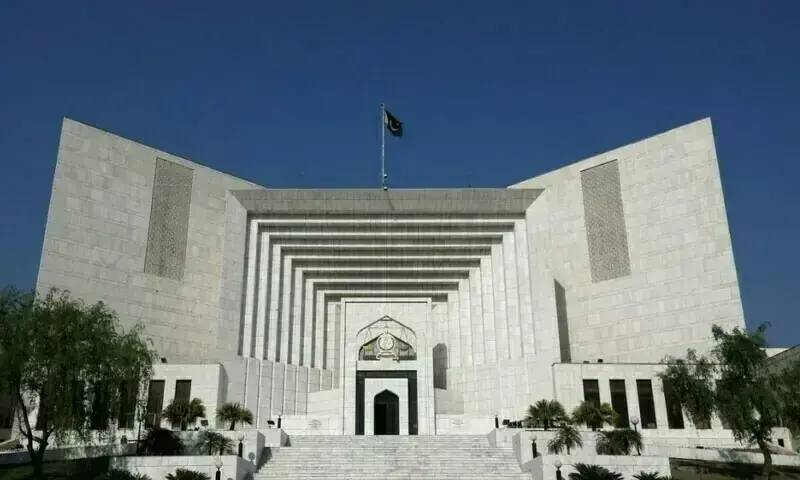
SC halts trial of PM Shehbaz’s Rs10b defamation suit against Imran Khan
The Supreme Court of Pakistan has temporarily halted the trial of PM Shehbaz Sharif's Rs10 billion defamation suit against Imran Khan, citing procedural issues.

Three-judge Supreme Court bench stays Lahore trial court proceedings, issues notice as no one appear in court on behalf of PM
Bench also directs apex court office to fix matter for hearing at the earliest
ISLAMABAD: The Supreme Court of Pakistan on Friday stayed proceedings in a Rs10 billion defamation suit pending before an additional district judge in Lahore, filed by Prime Minister Shehbaz Sharif against PTI founder Imran Khan.
A three-member bench, headed by Justice Ayesha A Malik and comprising Justices Muhammad Hashim Khan Kakar and Ishtiaq Ibrahim, heard the review petitions filed by Imran Khan. The bench issued a notice to the respondent after no one appeared on behalf of the prime minister and directed the apex court office to fix the matter for hearing at the earliest.
The defamation suit was instituted by PM Shehbaz in 2017, alleging that Imran Khan levelled baseless accusations against him and seeking recovery of Rs10 billion as compensation for the publication of defamatory material. The suit contends that Imran had wrongly accused PM Shehbaz of offering Rs10 billion through a common friend in exchange for withdrawing the Panama Papers case.
In his written reply, the PTI founder maintained that the disclosure of the alleged incident was made in the public interest and, therefore, did not constitute defamation. He further argued that he had not specifically attributed any statement to the prime minister while narrating the incident.
Appearing before the Supreme Court, Senator Barrister Ali Zafar, counsel for Imran Khan, submitted that his client was unable to appear before the trial court due to injuries sustained after being shot in the leg during an assassination attempt in November 2022. He argued that despite acknowledging the injury, the trial court had closed the right of defence and had now proceeded to record evidence and witness testimonies in the case.
At this, Justice Malik questioned how the trial court could have “terminated the right to defence” after taking note of the petitioner’s injury. The bench subsequently issued a notice to the respondent and ordered that the review petitions be fixed for hearing at the earliest.
Imran Khan had approached the Supreme Court through review petitions after the trial court closed his right to defence — a decision earlier upheld by the Lahore High Court and later endorsed by the Supreme Court on February 21, 2023.
The trial court, through its order dated October 20, 2022, had dismissed Imran’s objections to the rejection of PM Shehbaz’s interrogatories — written questions served by one party on the other — and directed him to submit his replies. Subsequently, on November 24, 2022, the court struck off his right to defence due to non-submission of answers.
Earlier, in a 2–1 majority judgment, the Supreme Court had held that Imran Khan had been “wilfully contumacious and disobedient” throughout the proceedings and that the trial court had not committed any illegality or material irregularity in closing the right to defend. The Lahore High Court had also rightly declined to interfere in its revisional jurisdiction, then-Justice Syed Mansoor Ali Shah had observed in the judgment authored by him.
Justice Malik, who was part of that bench, had dissented. She held that in a case marked by repeated adjournments since 2017, courts must strike a balance between ensuring a fair trial and assessing legitimate grounds for seeking adjournments. She observed that Imran Khan’s public shooting and subsequent injury at a political rally justified granting an adjournment for a reasonable period, adding that the right to defence could not be struck off without considering all relevant circumstances.
Justice Malik had further noted that the trial court appeared to have proceeded in a “mechanical manner”, granting numerous adjournments without imposing costs to discourage delays. She cautioned that striking off the right to defence at that stage, while ignoring legitimate factors, would amount to a “gross injustice”, stressing that under the circumstances, the right to a fair defence must prevail.
Conversely, Justice Shah had held that Imran Khan’s conduct disentitled him from the discretionary relief of the court under Article 185(3) of the Constitution, observing that his appeal lacked merit. He remarked that while interrogatories were meant to shorten litigation and reduce costs, the process had been abused in the present case to prolong the trial and should be curbed firmly to safeguard the administration of justice.
Comments
No comments yet. Be the first to join the discussion!