

June 12, 2026
Literacy rises to 63pc as education spending drops, Economic Survey says
Pakistan’s literacy rate has risen to 63pc, according to the Economic Survey 2025-26, but education spending has dropped to Rs962 billion. The survey also reported fewer out-of-school children, alongside persistent regional and gender disparities.

June 12, 2026
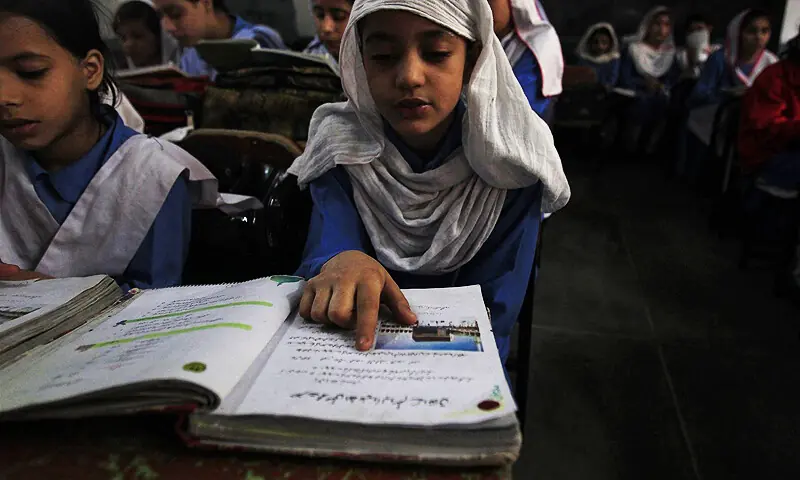
ISLAMABAD: Pakistan’s literacy rate for people aged 10 and above increased from 61 per cent to 63pc, according to the Economic Survey 2025-26, which also reported a sharp fall in education spending in the latest fiscal year.
The survey said male literacy stood at 73pc and female literacy at 54pc, pointing to gradual improvement and a narrowing gender gap. Urban areas remained ahead of rural regions, with literacy recorded at 74pc overall in cities — including 81pc for males and 68pc for females — compared with 55pc in rural areas, where the rate was 67pc for males and 44pc for females. The survey noted that rural female literacy showed the strongest improvement.
Among provinces, Punjab posted the highest literacy rate at 68pc. Sindh and Khyber Pakhtunkhwa were both at 58pc, while Balochistan remained the lowest at 49pc. The survey said the urban-rural gap continued to be significant, with urban Punjab at 78pc and rural Sindh at 39pc, underscoring uneven progress across regions.
Education spending declines
The Economic Survey said education expenditure fell to Rs962 billion in financial year 2025, down from Rs1251.06bn a year earlier. It added that spending on education in 2024-25 was equal to 0.8pc of GDP, compared with 1.5pc in 2022-23 and 1.7pc in 2021-22, showing a continuing downward trend. The survey also listed education expenditure at 1.4pc of GDP in 2020-21 and 1.9pc in 2019-20.
The report also recorded a decline in the share of out-of-school children in Pakistan, saying the figure dropped from 38pc in 2023 to 28pc in 2025. It broke this down as a fall from 35pc to 25pc for boys and from 42pc to 31pc for girls. According to the survey, all provinces showed improvement, with Balochistan seeing the biggest reduction, from 69pc to 45pc. Sindh improved from 47pc to 39pc, Punjab from 32pc to 21pc, and Khyber Pakhtunkhwa from 30pc to 28pc.
School facilities remain uneven
The survey said about 65pc of schools in the country had access to electricity, although provincial disparities remained. It said Punjab and Islamabad Capital Territory had comparatively higher access, while Balochistan had much lower coverage and needed focused attention. Punjab and ICT were also ahead in the share of primary schools with water facilities, while Balochistan and Azad Jammu and Kashmir were reported to have only 23pc coverage.
It added that access to toilets varied considerably across provinces, while the availability of boundary walls was described as moderate overall, with Punjab, Khyber Pakhtunkhwa and ICT leading in this area. The survey further said that as schools move to higher levels, the provision of electricity, drinking water, toilets and boundary walls generally improves.
In the survey, the government said education remained central to long-term development priorities.
0 Comments
No comments yet. Be the first to join the discussion!


