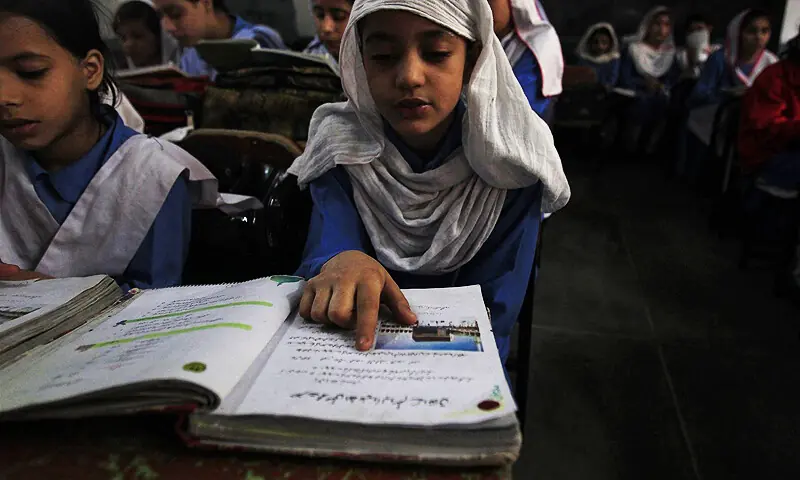
Pakistan Social and Living Standard Measures (PS&LSM) Survey 2014-15 revealed that literacy rate in Pakistan among the age groups 10 years and older is 60 percent.
The figures included 70 per cent male and 49 per cent female all over the country whereas the province-wise break-up indicates that Punjab has top literacy ratio of 61 per cent including 71 per cent male and 55 per cent female.
In Sindh, the ratio remained 60 per cent with 71 per cent male and 55 per cent female followed by Khayber Pakhtunkhwa with 53 per cent literate people including 71 per cent male and 35 per cent female and 44 per cent in Balochistan showing 61 per cent male and 25 per cent female, official sources said.
They informed that education for all development index was a composite index using four of the six EFA goals, selected on the basis of data availability. The goals included Universal Primary Education (UPE), adult literacy, quality of education, and gender.
They informed that according to EFA Global Monitoring Report 2015, Pakistan’s education index value was 0.654 and stood at 106 out of 113 countries.
They further stated that the National Commission for Human Development (NCHD) Ministry of Federal Education and Professional Training was running 5949 feeder schools with 6581 feeder teachers, where 310,146 students were enrolled.
Secondly, NCHD has established 164,190 literacy centers across the country where 3.84 million people were made literate. The total contribution of NCHD in national literacy rate was three per cent. NCHD has also assigned the task of preparation of National Plan of Action for Vision 2025 to raise the literacy rate up to 90 per cent by 2025.
At federal level, Basic Education Community Schools (BECS) project was managing 12,304 schools with enrolment of 493,972 students. Khayber Pakhtunkhwa (KP) has planned to open 1,000 non-formal community schools. Punjab Literacy and Non-Formal Education Department was implementing various projects related to literacy and non-formal basic education.
Literacy curriculum has been developed in Punjab, Sindh and Islamabad to improve literacy skills.