June 9, 2026
Budget uncertainty grows as Centre seeks to cap provinces’ NFC shares
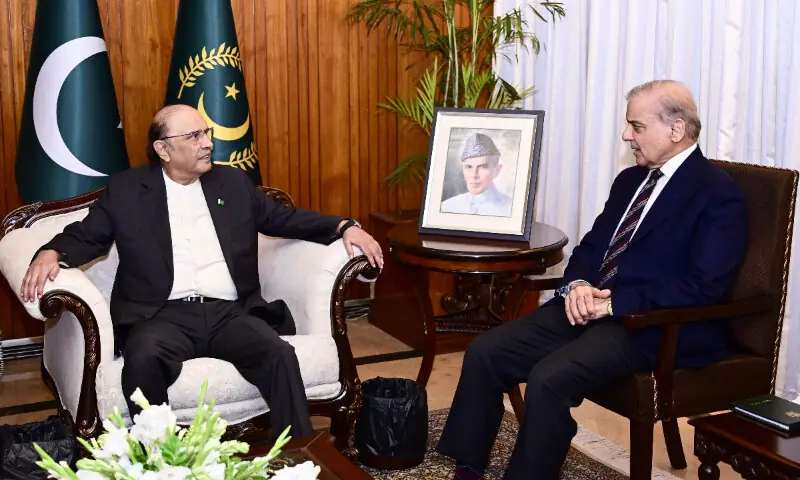
President Asif Ali Zardari and Prime Minister Shehbaz Sharif discussed the budget as disputes continued over a federal plan to retain Rs1.2 trillion from provincial NFC shares. KP’s finance adviser said the proposal had created major uncertainty and could not legally be implemented through the NEC.

June 9, 2026
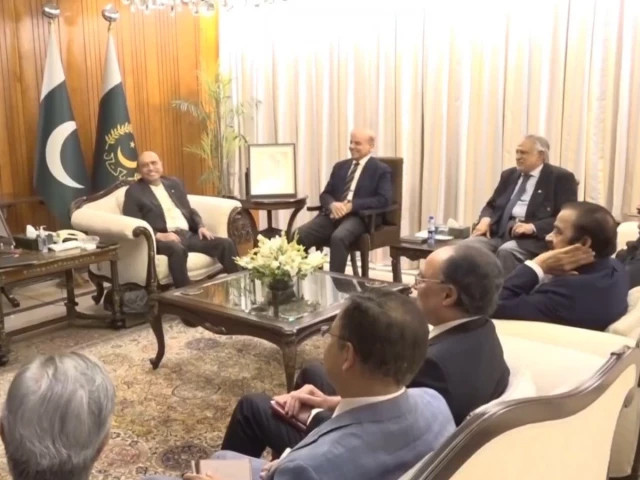
ISLAMABAD: President Asif Ali Zardari and Prime Minister Shehbaz Sharif met on Monday as differences persisted over the upcoming federal budget, while Khyber-Pakhtunkhwa’s finance adviser said the federal government wanted to hold provincial transfers at this year’s level to retain about Rs1.2 trillion.
The meeting took place on the same day the government postponed, for a third time, a session of the National Economic Council (NEC), the constitutional forum responsible for approving development budgets and the broader macroeconomic framework. According to a statement issued by the Presidency, the prime minister met the president along with his team and the two sides discussed the economy, the next fiscal year’s budget, the recent Gilgit-Baltistan elections, the situation in Azad Kashmir, law and order, and other matters of national importance.
The Presidency said that during the discussion on budget proposals and public relief, President Zardari stressed that the federal budget should prioritise public welfare, provincial rights and economic stability. He directed that full efforts be made to align the upcoming budget’s growth targets and public welfare measures.
Dispute over provincial shares
The federal government is seeking to retain Rs1.2 trillion from the provinces’ shares under the National Finance Commission (NFC) Award for fiscal year 2026-27, a move that has delayed the budget announcement and created uncertainty over the budget timetable.
After meeting federal authorities, Khyber-Pakhtunkhwa Chief Minister’s Finance Adviser Muzzammil Aslam told a press conference that there was serious uncertainty surrounding the next year’s budget. He said there was no agreement between the Centre and the provinces over the proposed Rs1.2 trillion deduction and the distribution of the federal development budget, and that there were also differences between the Finance Ministry and the International Monetary Fund (IMF) over the new budget.
Aslam said the NEC meeting scheduled for Monday had been postponed without any reason being given and that it was unclear whether it would take place on Tuesday. He added that because there was no consensus on the Centre’s demand for additional resources, it was uncertain whether the budget would be presented on June 10.
He said the federal government had proposed freezing the provinces’ NFC shares at this year’s actual transfer level. For the current fiscal year, the government had indicated transfers of Rs8.2 trillion to the provinces, but due to what he described as very weak Federal Board of Revenue performance, the provinces may receive Rs7.5 trillion. He said the roughly Rs1.2 trillion increase expected next year from higher federal tax collection was proposed to be kept by the Centre.
Speaking about the legal route being considered, Aslam said the federal government wanted the provinces to endorse the arrangement through the NEC. He argued, however, that the NEC could not be used to deduct provincial shares.
He said the Centre had asked all four provinces to contribute according to their NFC shares, with Khyber-Pakhtunkhwa’s portion around Rs180 billion. According to the figures he shared, Punjab’s contribution could be about Rs650 billion, Sindh’s Rs300 billion, Khyber-Pakhtunkhwa’s Rs180 billion and Balochistan’s Rs110 billion. He added that the federal government had initially sought Rs1.7 trillion from the provinces before reducing the demand.
Aslam said the additional money had been requested for some strategic purposes and remarked that even former prime minister Imran Khan would not have refused to contribute. However, he maintained that even if all provinces agreed, the amount could not technically be transferred on the basis of an NEC decision alone. He also said the Rs1.2 trillion demand was over and above provincial cash surpluses and would push provincial budgets into deficit.
"Everything is fluid, uncertain and no one has the clarity. NEC is not the forum to deduct provincial shares," Aslam said in a direct assessment of the situation.
IMF concerns and fiscal pressures
Government sources said the Finance Ministry had also raised with the IMF the plan to obtain additional resources from the provinces through the NEC mechanism. According to these sources, the IMF was reluctant to accept this method for reducing provincial shares, and its support was considered important before the government could proceed.
The Finance Ministry was also said to be exploring different ways on Monday to persuade the IMF, including the possibility of a call to the managing director of the global lender.
Government sources said the Rs1.2 trillion being sought from the provinces was intended for defence, strategic water projects, tax relief for the corporate sector and lower withholding taxes on property transactions. They said some of these steps could not be accommodated within the Centre’s limited fiscal space.
The Finance Ministry did not respond to questions on whether Pakistan had formally shared with the IMF its plan to seek Rs1.2 trillion from the provinces through the NEC mechanism. It also did not comment on whether the IMF had agreed to the arrangement, or whether the funds sought from the provinces were only for defence or would also be used for tax relief.
Aslam further said the Rs1.2 trillion demand was nearly half of the Rs2.2 trillion revenue shortfall faced by the FBR over two fiscal years, adding that this weak tax performance had left the federal government dependent on the provinces and also resulted in the petroleum levy on petrol rising to Rs116 per litre.
Khyber-Pakhtunkhwa concerns
Aslam also said his province continued to be marginalised in federal allocations. He stated that Khyber-Pakhtunkhwa had been allocated only Rs2.3 billion out of the Rs1.12 trillion budget for next year. He added that the federal allocation under the Accelerated Implementation Programme had also been reduced by Rs10 billion to Rs56 billion.
0 Comments
No comments yet. Be the first to join the discussion!