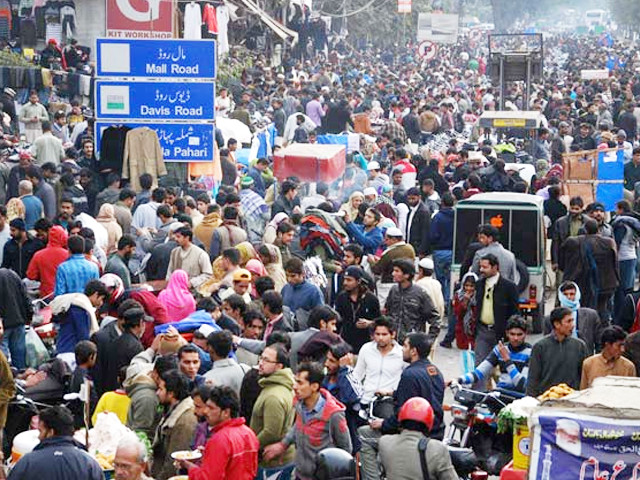
Ahsan Iqbal calls for NFC reforms to link provincial funding to population control
Ahsan Iqbal calls for constitutional NFC changes to reward provinces that slow population growth. Pakistan’s population could reach up to 389.9m by 2050, raising pressure on services.

Planning minister says provinces that slow population growth should receive greater federal incentives
National and Provincial Population Projections 2023–2050 place country’s population at up to 389.9m by 2050
Warns mounting pressure on health, education, jobs and food security systems
Terms population growth a ‘national emergency’ requiring urgent policy action
ISLAMABAD: Federal Planning Minister Ahsan Iqbal on Wednesday proposed reforms to the constitutional formula governing the distribution of federal revenues among provinces, suggesting that provinces demonstrating effective population control should be given stronger financial incentives under future arrangements.
Speaking at the launch of the National and Provincial Population Projections 2023–2050 report, the minister said reforms were necessary to encourage provinces to adopt “responsible population management policies,” according to a statement issued by the Planning Ministry.
The report estimates that Pakistan’s population could rise from 241.5 million in 2023 to between 371.9 million and 389.9 million by 2050, depending on fertility trends.
Under the National Finance Commission (NFC) Award, which determines the distribution of federal tax revenues between the Centre and provinces, around 82 percent of allocations are currently linked to population size.
Ahsan Iqbal said provinces achieving measurable progress in stabilising population growth should receive “additional incentives and recognition” in the fiscal framework.
He warned that if current trends continue, Pakistan’s population could approach 370–400 million by 2050, placing severe pressure on health, education, employment, water, food security and other public services.
The newly released projections further outline two scenarios: under a slow fertility decline, the population is expected to reach 389.9 million by 2050, while a rapid fertility decline scenario projects 371.9 million.
The report also projects that Pakistan’s working-age population will rise from 135.2 million in 2023 to 255.4 million by 2050, potentially creating a demographic dividend if supported by investments in education, healthcare and job creation.
At the same time, it warns that the population under 18 years of age could increase from 117.9 million to 139.7 million, further intensifying pressure on social services and infrastructure.
Describing population growth as a “national emergency,” the minister said nearly 40 percent of children in Pakistan are affected by malnutrition and stunted growth due to limited household resources.
“Population balance is not a religious debate but a matter of national survival, human development and the wellbeing of future generations,” he said.
He added that the projections will serve as a demographic foundation for Pakistan’s Vision 2035 framework, future five-year development planning and upcoming NFC Award deliberations.
The report, prepared by the National Institute of Population Studies with support from the United Nations Population Fund, attributes Pakistan’s rapid population growth primarily to high fertility rates and demographic momentum.
Comments
No comments yet. Be the first to join the discussion!