

Iran says its demands were legitimate after Trump rejects peace response
Iran said its latest response to a US peace proposal contained legitimate demands, including ending the regional war and releasing frozen assets, after Donald Trump called it totally unacceptable. Tehran also said Pakistan remains the official mediator.

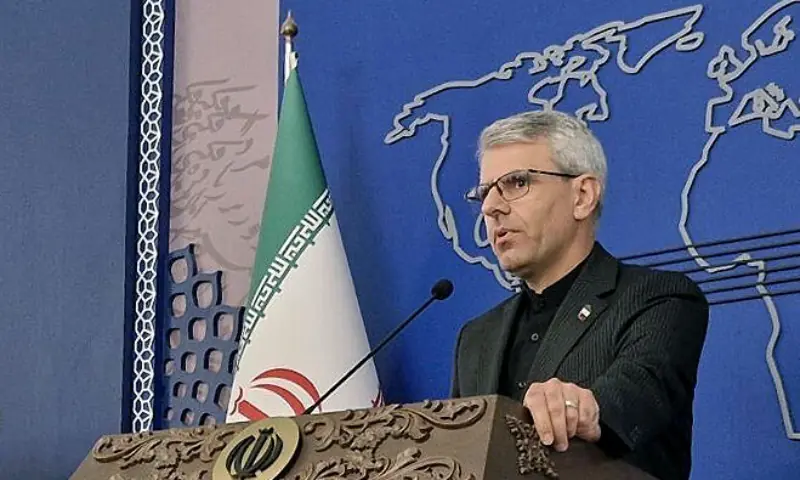
TEHRAN: Iran on Monday said the demands it set out in its latest formal response to the United States peace proposal were legitimate, after US President Donald Trump dismissed the reply as totally unacceptable.
Foreign Ministry spokesperson Esmaeil Baghaei told a weekly press briefing that Tehran had sought an end to the war across the region, the lifting of what he described as the US blockade of Iranian ports, and the release of Iranian assets frozen abroad.
We did not demand any concessions. The only thing we demanded was Iran’s legitimate rights.
Baghaei said. He added that Iran’s demands included an end to the war in the region, lifting the US blockade and piracy, and the release of assets belonging to the Iranian people that he said had for years been unjustly trapped in foreign banks.
He also said safe passage through the Strait of Hormuz, along with establishing security in the region and Lebanon, formed part of Iran’s demands, which he described as a generous and responsible offer for regional security.
Baghaei said Washington was continuing to insist on unreasonable and one-sided demands. According to remarks reported by Iran’s semi-official Tasnim News Agency, he warned that any intervention in the affairs of the Strait of Hormuz would further complicate the situation, and said the core issue was what he called the aggressive actions of the United States and Israel.
Iran’s semi-official ISNA news agency quoted Baghaei as saying European countries should not allow what he called the temptations of the United States and the Zionist regime on regional issues to draw them into a crisis.
We have conveyed this very clearly to European countries that they should not allow the temptations of the United States and the Zionist regime in regional issues to cause them to be unintentionally drawn into a crisis that will not benefit them.
he said.
Baghaei also said Pakistan remained the mediator in the US-Iran negotiations.
The mediator in the negotiations is still Pakistan, and Islamabad will continue its activities in this regard as an official mediator. Other countries, including Qatar, also have relations with both sides and have ideas and opinions that they will present whenever they deem necessary.
he said, according to ISNA.
He further said the US presence in the region itself was an example of creating a cycle of violence and bullying, and stressed that regional security should be ensured by countries of the region through stronger collective trust. He said recent developments had shown that security dependent on foreign forces would only deepen insecurity and would not bring stability.
Trump rejects response
Iran’s defence of its reply, which was conveyed through Pakistan on Sunday, came hours after Trump rejected it.
I have just read the response from Iran’s so-called ‘Representatives.’ I don’t like it TOTALLY UNACCEPTABLE.
Trump wrote on his Truth Social platform, without giving details of the Iranian response.
His rejection pushed oil prices higher on Monday, amid concern that the 10-week-old conflict could continue and keep shipping through the Strait of Hormuz paralysed.
According to Iranian state television, Tehran’s response, issued days after Washington presented its offer in an effort to restart negotiations, centred on ending the war on all fronts, particularly in Lebanon, where Israel has continued bombardment despite a ceasefire. State TV also said Iran sought compensation for war damage and underlined Iranian sovereignty over the Strait of Hormuz.
Iranian officials said Tehran proposed that the current stage of negotiations should focus mainly on ending hostilities in the region, while more contentious issues, including sanctions relief and the nuclear file, could be taken up later.
Another Iranian source said the response was positive and that the next move now rested with Washington. The source also expressed hope that the reply could help reopen dialogue in the coming days, and said the response had political consensus within Iran.
Comments
No comments yet. Be the first to join the discussion!


