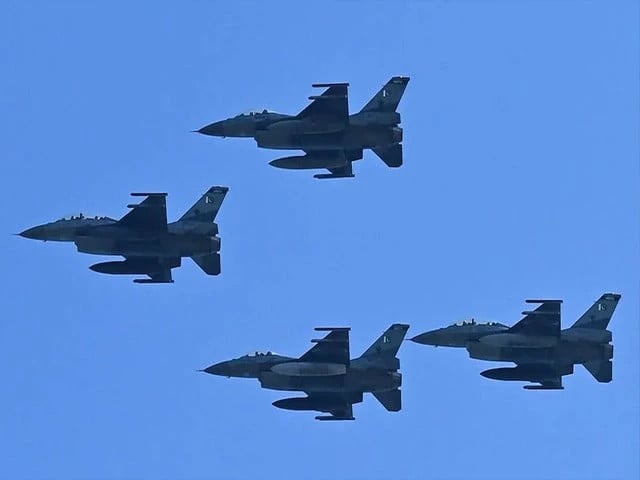
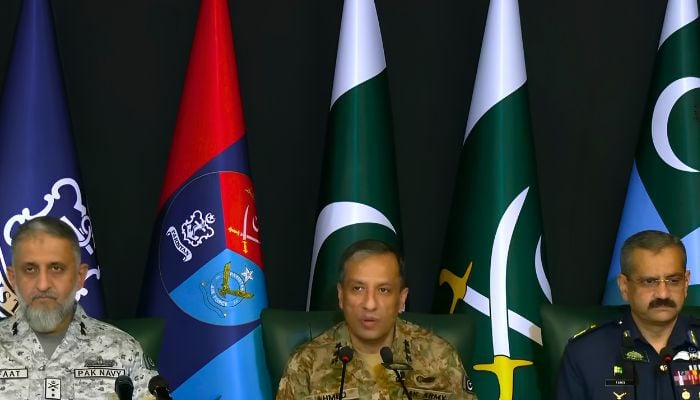
Civil-military leadership, institutional coordination, national unity proved decisive in Marka-e-Haq
Pakistan’s Interior Minister says intelligence inputs were 100% accurate during hostilities with India, Rangers shot down dozens of drones, border attacks were repelled, and cyberattacks failed.

Interior Minister hails intelligence agencies, Rangers, media role in safeguarding country in conflict with India
Says intelligence inputs during hostilities proved ‘100pc accurate,’ as Rangers shot down dozens of Indian drones at border
Lauds nearly 100 attacks on border posts repelled a strong and effective response
Says cyberattack attempts by India foiled through superior defence capabilities while precision strikes on Indian military targets avoided civilian areas
ISLAMABAD: Federal Interior Minister on Thursday said Pakistan’s civil armed forces, intelligence agencies and media played a decisive and exemplary role during the recent Pakistan-India hostilities, ensuring national security through advance preparedness, effective coordination and national unity.
Addressing a briefing, the minister thanked media representatives for their presence and said the interaction coincided with nationwide celebrations, making it important to highlight the role played by civil defence institutions, Rangers, Islamabad security teams and other forces in safeguarding the country with exceptional dedication.
He said that while Pakistan’s armed forces — the Army, Air Force and Navy — performed outstandingly during the conflict, the contribution of the country’s intelligence agencies was “far greater than publicly acknowledged.”
According to the minister, intelligence shared ahead of the conflict proved “100 percent accurate,” allowing Pakistan to make timely preparations and respond effectively to emerging threats.
The minister revealed that India deployed small and medium-sized drones extensively across several Pakistani cities, but said Pakistani forces intercepted and neutralized most of them at the border.
“Our Rangers shot down dozens of drones using only their guns. Very few managed to enter urban areas,” he said.
He further said India carried out nearly 100 attacks on Pakistani border posts but was met with a strong and effective response.
“Images of Indian forces raising a white flag along the Line of Control speak for themselves,” he added.
The minister also disclosed that India launched multiple cyberattack attempts against Pakistan, but said those efforts “failed completely” due to the country’s superior cyber defence capabilities.
“Nothing on their side remained secure,” he remarked.
Praising the Pakistani media for its role during the conflict, he said it remained united and spoke with one national voice, unlike Indian media, which he said remained confused and at times reported self-inflicted attacks.
“Pakistan maintained a clear policy — whenever we respond, we do so openly, not secretly,” he said.
Recalling key wartime moments, the minister said several critical military decisions succeeded against the odds, attributing the outcomes to both strategy and divine support.
He said Pakistan narrowly avoided major losses during a missile attack on an airbase in Balochistan.
“Out of 16 missiles fired, only one hit the base while the rest were diverted. This was not possible without God’s blessing,” he said.
He said Pakistan’s retaliatory missile strikes hit critical Indian military targets with precision while avoiding civilian areas.
“A slight deviation could have struck populated zones, but every missile hit exactly where it was intended,” he added.
The minister said several major Indian Navy and Air Force assets were within Pakistan’s operational range, which, he claimed, contributed to India’s decision to accept a ceasefire.
“Had the ceasefire not taken place, India’s losses would have been ten times greater,” he said.
He lauded the close coordination among the Field Marshal, the Air Force Chief and other service chiefs, noting that the Air Chief spent nearly two weeks inside the operations room overseeing operations.
“Such commitment and leadership were unprecedented,” he said.
Reiterating the importance of intelligence agencies, the minister said their timely and accurate information throughout the conflict proved decisive.
“Their performance surprised even people like me. It felt as though every detail was coming from within India,” he remarked.
He also acknowledged the role of the Information Ministry and Inter-Services Public Relations (ISPR) in managing wartime communication, ensuring responsible and accurate dissemination of information.
“ISPR handled an extremely sensitive and difficult responsibility with excellence, deciding what could be shared during wartime and how,” he said.
Concluding his remarks, the minister urged the nation to preserve the unity demonstrated during the conflict, calling it Pakistan’s greatest strength.
“Unity was our greatest strength then, and it must remain so. Divisions weaken nations; unity wins battles,” he said.
Comments
No comments yet. Be the first to join the discussion!