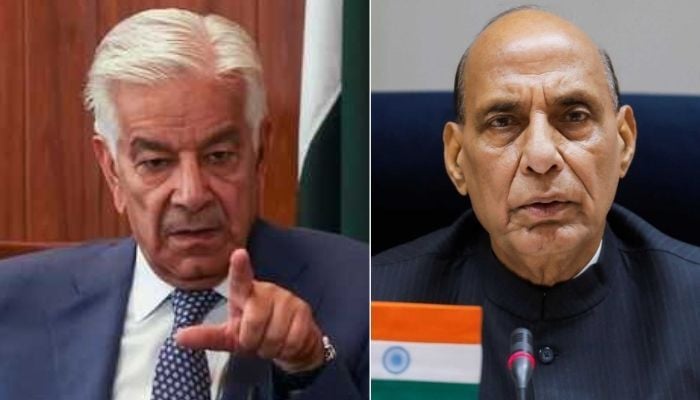
Kh Asif warns of ‘stronger response’ to any future aggression
Defence Minister Khawaja Muhammad Asif praised the armed forces’ “Marka-e-Haq” response and said Pakistan will meet any future Indian aggression or proxy war with an even more forceful, severe retaliation, highlighting national unity.

-
Defence Minister hails armed forces’ Marka-e-Haq success, saying nation united, armed forces ready to counter any future hostility
-
Warns Pakistan prepared for ‘more forceful’ response to Indian aggression or proxy war
-
Book launch highlights Marka-e-Haq as symbol of national resolve and military response
-
Minister says Pakistan emerged stronger, now seen as regional stabiliser and guarantor
-
Reiterates claims of downing Indian jets, drones and neutralising S-400 system in conflict
-
Credits armed forces, ISPR and Information Ministry for documenting war narrative and unity
ISLAMABAD: Defence Minister Khawaja Muhammad Asif on Tuesday lauded the Pakistan armed forces’ “swift and decisive response” to Indian aggression during “Marka-e-Haq” and warned that any future hostility would be met with an even “more forceful” and “severe” response, reiterating that the entire nation stands united against any external aggression.
وزیر دفاع خواجہ محمد آصف، وفاقی وزیر اطلاعات و نشریات عطاء اللہ تارڑ، پارلیمانی سیکریٹری اطلاعات بیرسٹر دانیال عزیز، وفاقی سیکریٹری اطلاعات و نشریات اشفاق احمد خلیل نے پکچر بک ”The Battle of Truth“ کی رونمائی کی — PTV News (@PTVNewsOfficial) May 5, 2026
تقریب میں کتاب کے حوالے سے دستاویزی فلم بھی دکھائی گئی pic.twitter.com/FfrR0q4vlS
Addressing the launch ceremony of a picture book titled “The Battle of Truth (Marka-e-Haq)”, published by the Ministry of Information and Broadcasting in collaboration with Inter-Services Public Relations, the minister said Pakistan had emerged as a more stable and stronger state, and was now regarded as a symbol of regional stability and a guarantor of peace.
“We are ready for any kind of Indian proxy war,” he added.
Pictorial book "The Battle of Truth" was launched in Islamabad today on the occasion of first anniversary of Marka-e-Haq@OfficialDGISPR @KhawajaMAsif @TararAttaullah @MoIB_Official @ForeignOfficePk #RadioPakistan #News https://t.co/8C1vcol7Pw pic.twitter.com/LfdYTXEuYm — Radio Pakistan (@RadioPakistan) May 5, 2026
Pakistan and India went to war in May last year after India launched an unprovoked attack on Pakistan following an incident in IIOJK.
New Delhi alleged that the attackers who killed 26 tourists in the Pahalgam incident were Pakistani nationals—an allegation strongly denied by Islamabad, which also called for a neutral and transparent investigation.
India followed these accusations with unlawful missile strikes inside Pakistan, resulting in the martyrdom of several civilians and security personnel.
Pakistan responded by downing seven Indian fighter jets, including three Rafale aircraft, destroying dozens of drones and neutralising an S-400 air defence system.
In addition, security forces carried out retaliatory strikes targeting more than 20 Indian military installations across multiple sectors.
The conflict between the two nuclear-armed neighbours ended on May 10 with a ceasefire agreement brokered by the United States.
Speaking at the ceremony, the defence minister said Pakistan’s armed forces had foiled India’s “nefarious designs” during Marka-e-Haq and successfully neutralised its S-400 air defence system.
He said no country in the region was safe from what he termed India’s “Hindutva mindset,” adding that India had repeatedly resorted to aggression against Pakistan to divert attention from internal challenges.
Referring to 2019, he said India launched so-called surgical strikes following the Pulwama incident but instead lost an aircraft and saw one of its pilots captured.
He added that a similar conspiracy was later attempted following what he described as a false-flag operation in Pahalgam.
The defence minister said India’s hegemonic mindset posed a serious threat to peace and development in South Asia.
“Pakistan has always responded responsibly to tensions while reaffirming its commitment to defending its sovereignty and territorial integrity,” he said.
Asif said Pakistan had consistently played a constructive role in global peace efforts and remained one of the leading contributors to United Nations peacekeeping missions, reflecting its peace-oriented approach.
He said the people of Pakistan, regardless of political or regional differences, had repeatedly demonstrated unity during crises, forming what he described as a “steel-like wall” against external threats.
He added that Pakistan had not only demonstrated strength in defence but had also achieved significant diplomatic gains, earning international recognition.
Reaffirming national resolve, he said Pakistan’s armed forces and people would remain united and fully prepared to respond effectively to any future challenges.
The minister described the book as more than a collection of images and text, calling it a “living narrative” of national resolve, sacrifices, and unity in the face of adversity.
He appreciated the efforts of the Ministry of Information and Broadcasting and ISPR for documenting Pakistan’s perspective and highlighting the country’s commitment to peace and stability.
Comments
No comments yet. Be the first to join the discussion!