Marka-e-Haq crushed India's military arrogance, Pakistan ready for any future aggression: DG ISPR
DG ISPR Lt Gen Ahmed Sharif Chaudhry marks the first anniversary of Marka-e-Haq, saying Pakistan defeated India across air, land, sea and cyber, and vows to crush any future aggression.

-- Pakistan Armed Forces mark first anniversary of Marka-e-Haq with strong warning to adversaries
-- DG ISPR says Pakistan defeated India across air, land, sea and cyber domains in unprecedented multi-domain warfare
-- PAF claims historic '8-0' edge over Indian Air Force, says Rafales and strategic assets neutralised
-- Pakistan reiterates commitment to regional peace, vows crushing response to any hostile design against homeland
RAWALPINDI: Director General of Inter-Services Public Relations (ISPR) Lt Gen Ahmed Sharif Chaudhry on Thursday said that “no one can harm Pakistan”, asserting that the country’s armed forces had inflicted a decisive defeat on an adversary “five times larger” during Marka-e-Haq and remained fully prepared to counter any future aggression.
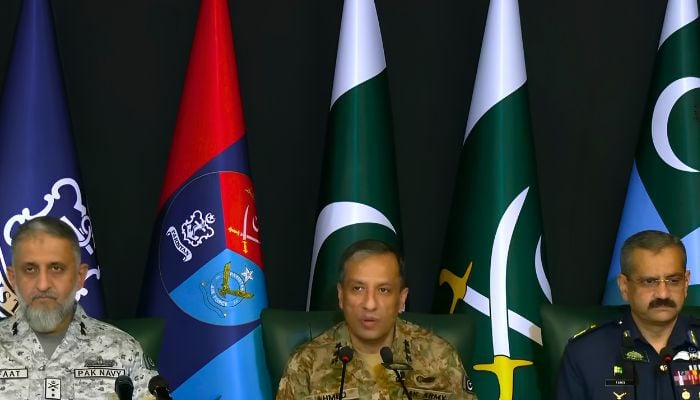
Addressing a joint press conference alongside senior officials of the Pakistan Navy and Pakistan Air Force on the completion of one year of Marka-e-Haq, Lt Gen Chaudhry congratulated the nation and paid tribute to the armed forces for what he described as a historic demonstration of operational capability and national resolve.
Marka-e-Haq refers to the 2025 Pakistan-India conflict that erupted following the April 22 Pahalgam attack and culminated in a ceasefire announced on May 10 after Pakistan launched Operation Bunyanum Marsoos in response to Indian strikes.
“A year ago, we buried India’s arrogance in the dust,” the DG ISPR said, adding that Pakistan had successfully defended itself across air, land, sea, and cyber domains through coordinated multi-domain operations. He maintained that the conflict had changed the nature of modern warfare and demonstrated Pakistan’s growing capability in integrated operations.
Lt Gen Chaudhry accused India of promoting a “false narrative” linking Pakistan to terrorism and said New Delhi had failed to present evidence regarding the Pahalgam incident despite registering an FIR within minutes of the attack. He alleged that India had repeatedly used “false flag operations” to malign Pakistan internationally.
“India’s terrorism narrative has collapsed forever,” he remarked, alleging that India itself was involved in sponsoring destabilisation and militancy in the region. He further claimed that terrorist incidents inside Pakistan had links with India and Afghanistan.
The military spokesperson stressed that Pakistan remained committed to regional peace and stability despite heightened tensions, warning that war between two nuclear powers would amount to “madness”. However, he reiterated that Pakistan’s armed forces were fully capable of defending the country’s sovereignty and territorial integrity against any threat.
He announced that the nation would witness “a small glimpse” of Pakistan’s military capabilities on August 14, saying the armed forces would continue investing in advanced technologies and operational preparedness to confront future security challenges.
Lt Gen Chaudhry also reaffirmed Pakistan’s support for the Kashmiri people, stating that Jammu and Kashmir remained an internationally recognised dispute under United Nations resolutions. He criticised what he called India’s treatment of minorities and alleged human rights abuses in Indian Illegally Occupied Jammu and Kashmir and Manipur.
Responding to a question regarding Pakistan’s defence ties with Saudi Arabia, the DG ISPR highlighted the significance of the longstanding mutual defence understanding between the two countries. He stated that the protection of Harmain Shareefain remained closely linked with Pakistan’s strategic commitments and any threat to Saudi Arabia would be considered a threat to Pakistan.
On Afghanistan, Lt Gen Chaudhry confirmed that Operation Ghazab lil Haq was still ongoing, but clarified that Pakistan held no hostility towards the Afghan people. “Pakistan has always acted as a brother and host to the Afghan people,” he said, reiterating Islamabad’s commitment to regional stability while combating terrorism.
Speaking at the briefing, Rear Admiral Shifaat Ali Khan termed Marka-e-Haq a “historic and memorable” episode, stating that Pakistan Navy had successfully neutralised India’s attempts to threaten maritime routes and strategic installations.
He revealed that Indian naval deployments in the northern Arabian Sea during the conflict were aimed at targeting Pakistan’s trade routes and ports, but Pakistan Navy maintained uninterrupted maritime security throughout the confrontation.
“The Pakistan Navy and Pakistan Air Force were fully prepared to destroy the Indian aircraft carrier Vikrant if required,” he said, adding that the Indian Navy ultimately remained confined to its own waters during the conflict.
Air Vice Marshal Tariq Ghazi of the Pakistan Air Force described the aerial engagements as a landmark in modern warfare, saying the PAF had achieved an “8-0 outcome” against the Indian Air Force during the conflict.
According to the PAF official, Pakistan successfully destroyed multiple Indian aircraft and aerial assets, including Rafale jets, a MiG-29, a Su-30, a Mirage-2000 and unmanned aerial systems.
He said the strikes on India’s S-400 air defence systems were carried out using domestically developed JF-17 Block III fighter aircraft, showcasing Pakistan’s indigenous defence capabilities.
AVM Ghazi noted that Marka-e-Haq would be studied internationally as a “classical case study” in air warfare due to its use of full-spectrum and multi-domain operations.
The escalation between Pakistan and India began after the April 22, 2025 Pahalgam attack, which killed 26 people. India blamed Pakistan for the incident, while Islamabad categorically rejected the allegations.
Tensions intensified after India suspended the Indus Waters Treaty, downgraded diplomatic relations and carried out missile strikes on Pakistani territory on May 7, 2025, resulting in civilian casualties. Pakistan responded by shooting down Indian aircraft and later launched Operation Bunyanum Marsoos following Indian missile strikes on Pakistani airbases.
The conflict ended on May 10, 2025 after a ceasefire was announced following diplomatic engagement led by the United States and supported by regional stakeholders.

The writer is Head of News at Pakistan Today. He has a special focus on current affairs, regional and global connectivity, and counterterrorism. He tweets as @mian_abrar and also can be reached at [email protected]
View all articles →Comments
No comments yet. Be the first to join the discussion!