

Iran-US war bringing instability into everyday life, Sherry Rehman says
Speaking in Karachi, Senator Sherry Rehman said the Iran-US war was reshaping the global energy map and creating long-term economic risks. She also highlighted Pakistan’s energy exposure, remittance dependence and renewed diplomatic relevance.

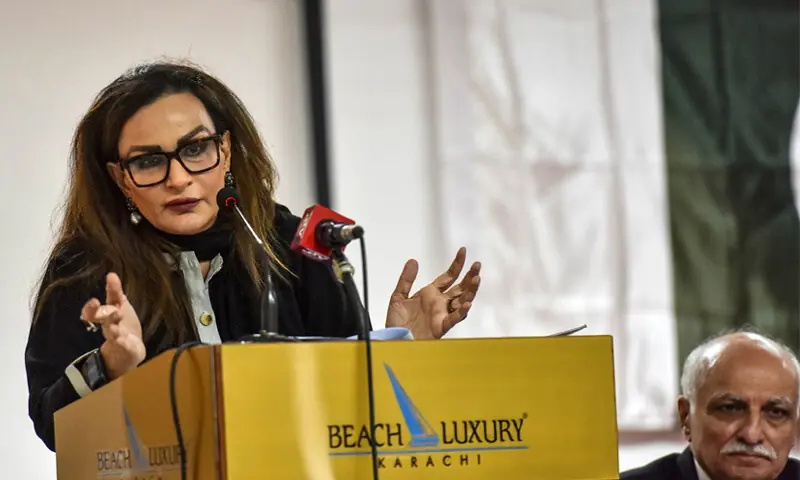
KARACHI: Senator Sherry Rehman said on Wednesday that the Iran-US war had carried the risks of an unstable era into daily life, warning that the conflict’s effects were being felt far beyond the battlefield through energy, security and economic pressures.
She was speaking at a talk titled Navigating War and Peace: Pakistan in a Volatile Century, organised by the English Speaking Union of Pakistan at the Beach Luxury Hotel in Karachi.
Rehman said, Since World War II, this has been a century of extreme war. The Iran-US war has brought the dangers of an unstable century into every home, factory, farm and school.
She also said she was proud of Pakistan for playing an important role in efforts that helped establish peace and secure a ceasefire.
Energy and security concerns
Rehman said the continuing blockages had drawn in major regional and global powers, naming Saudi Arabia, Iran, China, Russia and the United States as countries affected in different ways. She said Europe had remained fairly aloof, but added that energy and security had now become the central arena of the conflict.
According to the senator, the global energy landscape would be altered permanently by the war. She said the strategic importance of the Strait of Hormuz meant the consequences would be felt across the world, with higher oil prices and commodity costs affecting countries and populations dependent on energy. "After energy, everything follows. In a way, because of the strategic nature of the Strait of Hormuz, we are going to feel the impact worldwide. The surge in oil prices and in commodities will impact all. It is a very real long-term crisis that we are looking at for countries and populations dependent on energy. It is not something that will go away. There will be no victors, however it plays out."
She further said, The world is rapidly moving towards an unpredictable and violent multi-polar system.
Rehman said many countries would increasingly turn to single-interest mini-laterals to manage their survival, working together on one issue while cooperating with others separately on different interests. She said this environment would demand very high diplomatic agility.
Pakistan’s vulnerabilities
Turning to Pakistan, Rehman said the country must recognise that it has only 11 days of crude oil reserves. She said 81 per cent of Pakistan’s energy supplies pass through the Strait of Hormuz, while 54pc of the country’s remittances come from Gulf states.
She also warned that the war was affecting fertiliser supplies worldwide. According to her, fertiliser prices have risen by 41pc, and Pakistan’s agricultural output is being badly hit by expensive inputs and rising costs.
Rehman said developing countries still depend on the old world order, but added that the old order had been in the ICU for some time while a new one had yet to stabilise.
Regional tensions and mediation role
She said conflicts in South Asia, including Kashmir, remained a major barrier to peace. Rehman warned that miscalculations between India and Pakistan could heighten the danger of nuclear conflict. She added that tensions between Pakistan and Afghanistan had also undermined regional security.
At the same time, she said Pakistan was once again emerging as a global mediator.
Comments
No comments yet. Be the first to join the discussion!


