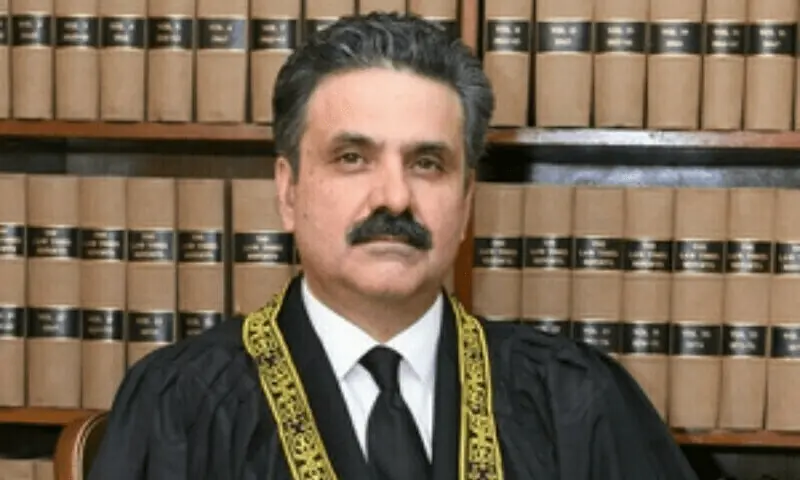
CJP opposes judges' transfer, warns of threat to federalism and judicial independence
Chief Justice Yahya Afridi, chairing the JCP, opposes transferring IHC judges to other high courts, warning the move could undermine federalism, representation, and judicial independence.

ISLAMABAD: Chief Justice of Pakistan Yahya Afridi has strongly opposed a proposal to transfer judges from the Islamabad High Court (IHC) to other high courts, warning that such a move could undermine key constitutional principles, including federalism and equitable representation.
In his capacity as chairman of the Judicial Commission of Pakistan (JCP), the CJP expressed concern that transferring Justice Khadim Hussain Soomro back to the Sindh High Court (SHC) would defeat the purpose of earlier judicial transfers aimed at promoting inclusivity within the superior judiciary.
The issue arose after IHC Chief Justice Sardar Muhammad Sarfraz Dogar informally requested a JCP meeting to consider transferring five IHC judges to other high courts, including the Lahore High Court (LHC), Peshawar High Court (PHC), Balochistan High Court (BHC), and SHC.
The proposed transfers included Justice Mohsin Akhtar Kiani to LHC, Justice Babar Sattar to PHC, Justice Arbab Tahir to BHC, and Justices Saman Rafat Imtiaz and Khadim Hussain Soomro to SHC.
CJP Afridi noted that Justice Soomro had only recently been transferred to the IHC under Article 200 of the Constitution as part of a broader effort to reflect the federation’s diversity within the capital’s high court. Reversing such a transfer, he argued, would render the constitutional ideals of federalism and equitable representation “redundant,” reducing judicial appointments to temporary administrative arrangements.
He further cautioned that transferring both Soomro and Justice Imtiaz — judges from Sindh — would leave the IHC without any representation from the province, undermining inclusivity.
The chief justice also pointed out that the transfer request lacked any stated reasons or institutional necessity. In such circumstances, he warned, transfers could take on a “penal character,” effectively amounting to the removal of judges without due constitutional process.
Referring to Articles 175A and 209 of the Constitution, CJP Afridi stressed that any action resembling removal from office must follow the prescribed mechanism through the Supreme Judicial Council, rather than being carried out indirectly through administrative transfers.
“A transfer which operates as a removal from office cannot be insulated from constitutional safeguards merely by its label,” he observed, cautioning that such practices would violate the framework governing judicial accountability.
The CJP also raised concerns over the scale of the proposal, noting that transferring five out of nine IHC judges would create significant vacancies and disrupt the court’s functioning, potentially eroding public confidence in the administration of justice.
He warned that allowing such transfers would set a dangerous precedent, treating judges as interchangeable and undermining the independence and stability of the judiciary.
“Such an approach would have serious implications for institutional integrity and public trust,” he emphasised, adding that any move with punitive implications finds no support within the constitutional scheme.
While rejecting the substance of the proposal, CJP Afridi acknowledged that under Article 175A(22), a meeting of the JCP must still be convened if requisitioned by the required number of members, and directed the commission’s secretary to proceed accordingly.
The development highlights growing institutional sensitivity around judicial independence, representation and the constitutional limits of administrative authority within Pakistan’s superior judiciary.
Comments
No comments yet. Be the first to join the discussion!