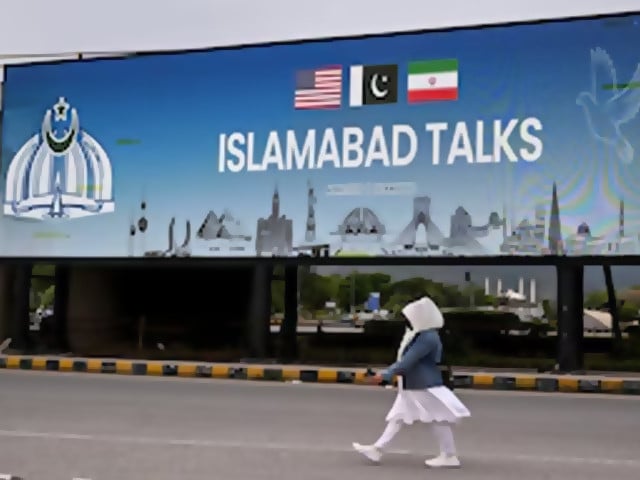
EU backs Pakistan’s peace push as world awaits US-Iran talks in Islamabad
EU Council President Antonio Costa tells PM Shehbaz Sharif the world awaits the next US-Iran “Islamabad Talks.” He praises Pakistan’s role and says the EU will support the process.

EU Council President voices hope for breakthrough in second round of ‘Islamabad Talks’ in phone call with PM Shehbaz
World ‘watching with great expectation,’ next round of ‘Islamabad Talks,’ says Antonio Costa
Lauds Pakistan's constructive role, saying EU ready to support process in every possible manner
Premier Shehbaz briefs EU leadership on Islamabad’s ongoing diplomatic outreach and peace efforts
ISLAMABAD: European Council President Antonio Costa on Monday voiced optimism about a potential breakthrough in US-Iran negotiations, telling Prime Minister Shehbaz Sharif that the “world is anticipating with great expectation” the next round of the “Islamabad Talks.”
According to a statement issued by the Prime Minister’s Office (PMO), the two leaders spoke over the phone and exchanged views on the evolving situation in the Middle East, with PM Shehbaz briefing the European Union leadership on its ongoing diplomatic outreach and peace efforts.
ISLAMABAD: 20 April 2026.
Prime Minister Muhammad Shehbaz Sharif received a telephone call this evening from H.E. António Costa, President of the European Council.
During their cordial conversation, the two leaders exchanged views on the current situation in the Middle East.… pic.twitter.com/bNnqILfE1x— Prime Minister's Office (@PakPMO) April 20, 2026
Costa praised Pakistan’s “constructive role” in facilitating dialogue between Washington and Tehran, and said the European Union was ready to support the process “in every possible manner,” the statement said.
Both leaders underscored the need to sustain dialogue and diplomacy to ensure lasting regional and global security, agreeing to remain in close contact as efforts for a second round of talks gather momentum.
Later, in a post on X, Costa said it was a “pleasure” speaking with the Pakistani premier, expressing “sincere gratitude” for Islamabad’s “tireless efforts” to promote peace and stability.
It was a pleasure to speak with the Prime Minister of Pakistan, @CMShehbaz .
I expressed my sincere gratitude to Pakistan for its tireless efforts and extended my best wishes for the upcoming crucial period.
The world is watching with great expectation the next meeting between…— António Costa (@eucopresident) April 20, 2026
He added that the world was “watching with great expectation” the next meeting between the United States and Iran, which he said should take place in Islamabad at the earliest opportunity.
“We hope that an agreement will be reached to bring an end to the conflict and lead to the full reopening of the Strait of Hormuz. The European Union supports all ongoing efforts towards peace in the Middle East,” Costa said.
I received a call from H.E. António Costa, President of the European Council, this evening.
During our cordial exchange, I shared with President Costa, updates on Pakistan’s ongoing diplomatic outreach and peace efforts in the Middle East.
Grateful for the European Union’s…— Shehbaz Sharif (@CMShehbaz) April 20, 2026
Prime Minister Shehbaz welcomed the EU’s appreciation of Pakistan’s diplomatic role and its readiness to back continued engagement, reaffirming Islamabad’s commitment to dialogue as the only viable path to regional peace and stability.
Last month, Costa had similarly reiterated the EU’s support for Pakistan’s peace efforts, emphasising that only sustained diplomacy could help de-escalate tensions in the region.
Talks amid fragile momentum
The diplomatic outreach comes after 40 days of airstrikes, following which US and Iranian negotiators opened talks in Islamabad earlier this month, focusing once again on the core trade-off between nuclear restrictions and economic relief.
During their most recent engagement, the United States proposed a 20-year suspension of Iran’s nuclear activities, while Tehran countered with a shorter halt of three to five years, according to officials familiar with the discussions.
Although formal negotiations are yet to fully commence, US President Donald Trump said earlier that Vice President JD Vance and an American delegation were expected in Pakistan for talks, expressing confidence that a deal could be reached swiftly and indicating willingness to meet Iranian leaders if progress is made.
However, Iranian President Masoud Pezeshkian struck a more cautious tone, voicing deep mistrust toward Washington and stressing that honouring commitments would be essential for any meaningful agreement.
Diplomats say a preliminary framework may be achievable, potentially built around a nuclear package and an economic package, though the nuclear component remains the most contentious.
At the heart of the dispute is Iran’s stockpile of around 440 kilogrammes of uranium enriched to 60 percent — material that could be further refined for weapons use — as well as the broader disagreement over Tehran’s right to enrich uranium at all.
While Washington has pushed for zero enrichment, Iran maintains that it is entitled to pursue nuclear enrichment for civilian purposes and denies seeking nuclear weapons.
The recent conflict has further hardened Tehran’s position, diplomats say, reinforcing its demand for a non-aggression guarantee following earlier attacks involving the United States and Israel during past diplomatic efforts.
Comments
No comments yet. Be the first to join the discussion!