Pakistan, Afghanistan agree to restraint in China-brokered talks: Beijing
Pakistan and Afghanistan agreed to avoid escalation after week-long China-hosted talks in Urumqi. Both sides pledged to resolve differences and return bilateral relations to normal as soon as possible.

-
Chinese Foreign Ministry spokeswoman says week-long trilateral ‘frank, pragmatic’ discussions held in Urumqi from April 1–7
-
Says both sides reaffirmed ‘their commitment’ to resolving differences, return to normalcy as soon as possible
-
Foreign Office yet to issue an official statement on development
BEIJING/ISLAMABAD: Pakistan and Afghanistan have agreed to avoid any escalation in their armed conflict following a week of China-hosted talks, China said on Wednesday, signalling a tentative diplomatic opening amid heightened tensions between the two neighbours.
“Representatives from China, Afghanistan and Pakistan held a week of informal meetings in Urumqi, Xinjiang, from April 1 to 7,” Chinese Foreign Ministry spokeswoman Mao Ning said.
The three delegations “engaged in frank and pragmatic discussions in a positive atmosphere,” she said during a regular news conference in Beijing.
Representatives of #China, #Pakistan and #Afghanistan held week-long informal talks in Urumqi, Xinjiang from April 1 to 7. The delegations of the three sides include representatives from authorities in charge of foreign affairs, defense and security. — Lin Jian 林剑 (@SpoxCHN_LinJian) April 8, 2026
The Afghan and Pakistani… pic.twitter.com/oLM8pRdzEh
According to the spokeswoman, Pakistan and Afghanistan reaffirmed “their commitment to resolving their differences as soon as possible and realising a return to normalcy in bilateral relations,” while agreeing not to take any actions that could escalate or further complicate the situation.
The Foreign Office (FO) has yet to issue an official statement on the development and declined to comment when approached.
Diplomatic engagement between Pakistan and Afghanistan had largely stalled since Pakistan launched Operation Ghazab lil-Haq against militant hideouts across the border in late February.
The talks in China were held under a trilateral mechanism at a time when tensions between Islamabad and Kabul remain elevated following recent cross-border security developments.
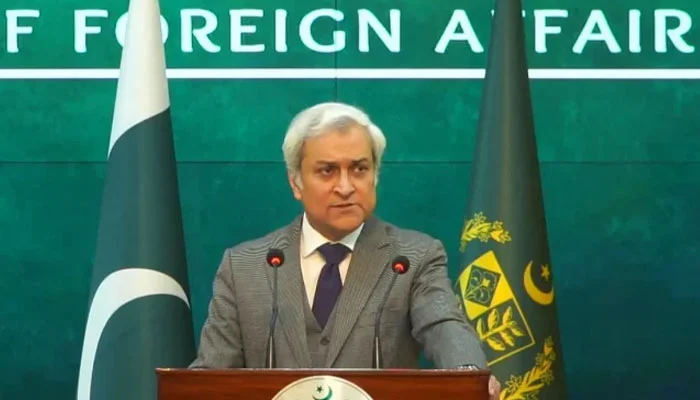
On April 2, FO spokesperson Tahir Andrabi said during a weekly briefing that while Pakistan was engaged in dialogue with Afghanistan to de-escalate the situation, Kabul must “demonstrate visible and verifiable actions”.
He said Pakistan’s participation in the China-hosted talks was “in line with its consistent position and longstanding practice of supporting a credible process that can lead to a durable solution … to stop border terrorism from Afghanistan”.
“Our participation is a reiteration of our core concerns,” he said, adding that “the burden of a real process lies with Afghanistan, which must demonstrate visible and verifiable actions against terrorist groups using Afghan soil against Pakistan.”
Strained relations between Pakistan and Afghanistan
Security ties between Pakistan and Afghanistan have remained strained, with a resurgence in militancy in Pakistan since the Afghan Taliban returned to power in Kabul in 2021.
Islamabad has repeatedly urged the Taliban administration to dismantle militant sanctuaries on Afghan soil, particularly those linked to the banned Tehreek-i-Taliban Pakistan (TTP), but officials say these appeals have gone largely unheeded.
Operation Ghazab lil-Haq was launched on the night of February 26 following what Pakistan described as unprovoked firing by the Afghan Taliban from across the border.
From March 18 to 23, Pakistan observed a five-day temporary pause in the operation on the occasion of Eidul Fitr, with the FO later stating the operation would continue “until its objectives are achieved”.
De-escalation appeals from Saudi Arabia, Qatar and Turkiye were among the factors behind temporary pauses announced by both sides, according to their respective statements.
Earlier, Chief of Defence Forces and Chief of Army Staff Asim Munir had said that lasting peace between Pakistan and Afghanistan would only be possible if the Taliban regime “renounced their support for terrorism and terrorist organisations”.
1 Comment
No comments yet. Be the first to join the discussion!