March 12, 2026
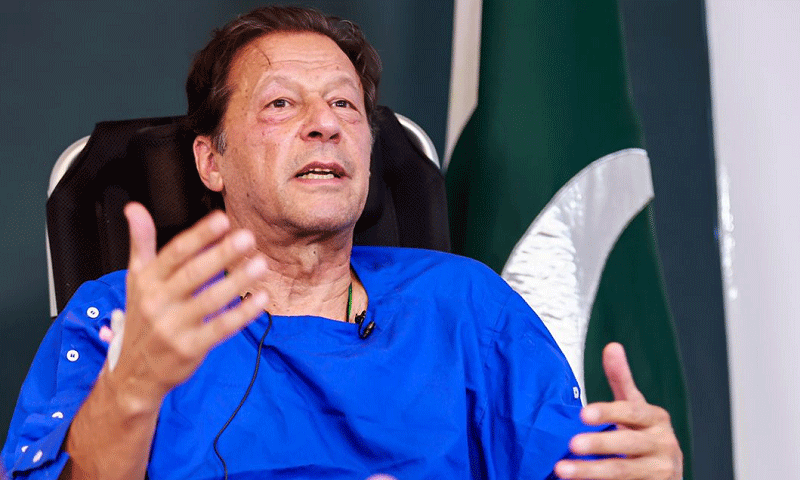
IHC orders medical board formation to review Imran Khan's treatment
The Islamabad High Court has directed the formation of a medical board to evaluate Imran Khan's health condition, emphasizing the importance of proper medical treatment and family access.
March 12, 2026

ISLAMABAD: The Islamabad High Court (IHC) on Thursday directed the formation of a medical board to review the health condition of Imran Khan while disposing of a petition seeking his transfer to Shifa International Hospital for specialised treatment.
A division bench comprising Justice Arbab Muhammad Tahir and Justice Khadim Hussain Soomro issued the order during proceedings on the plea filed by the incarcerated former prime minister.
The court directed Islamabad Chief Commissioner Muhammad Ali Randhawa to constitute the medical board and include Dr Muhammad Arif and Dr Nadeem Qureshi among its members. Dr Qureshi, a retina specialist from Al-Shifa Trust Eye Hospital in Rawalpindi, is also part of a medical board earlier constituted on the orders of the Supreme Court of Pakistan. Dr Arif heads the ophthalmology department at the Pakistan Institute of Medical Sciences (PIMS) in Islamabad.
In its written verdict, the court directed the authorities to ensure that Imran Khan is allowed to meet his lawyers and family members. It also instructed Dr Qureshi to remain in contact with the PTI founder’s family regarding his medical treatment.
The order stated that the petition had been disposed of and that the medical board must submit its recommendations to the Islamabad chief commissioner at the earliest. The commissioner, the court noted, would then decide in accordance with the law and prison rules whether the former premier should be shifted to a hospital outside the prison premises.
The bench observed that under Rule 795 of the Pakistan Prison Rules, prison authorities are obligated to inform relatives when a convicted prisoner develops a serious medical condition. It also emphasised that under Rule 197 of the rules, the power to transfer a convicted prisoner for special treatment outside the jail lies with the government.
Therefore, the court ruled that its jurisdiction under Section 561-A of the Code of Criminal Procedure could not be invoked to interfere with powers vested in the executive. It also noted that the report submitted by the Adiala jail superintendent indicated that substantial steps had already been taken to ensure proper treatment for the former prime minister and that his condition had shown improvement.
Earlier during the hearing, the bench had reserved its verdict after hearing detailed arguments from both sides. Representing Imran Khan, senior counsel Sardar Latif Khosa argued that his client had been suffering from a retinal problem since October and that the matter had initially been treated as routine by jail doctors.
Khosa told the court that the former prime minister’s eyesight had deteriorated significantly and claimed that he was left with only about 15 per cent vision. He also referred to the case of former prime minister Nawaz Sharif, arguing that the current government had previously allowed a convict to travel abroad for medical treatment.
On the other hand, Islamabad Advocate General Ayyaz Shaukat and Additional Attorney General Rashid Hafeez defended the government’s stance, telling the court that a medical board had already been formed following observations by the Supreme Court and included leading retina specialist Dr Nadeem Qureshi.
During the proceedings, the bench questioned whether the prisoner’s satisfaction regarding his treatment should also be taken into account. Justice Arbab asked the advocate general whether the government would take responsibility if anything happened to the prisoner.
Imran Khan’s sister, Aleema Khan, also addressed the court briefly, expressing distrust in the jail’s medical facilities and questioning why the former premier’s personal doctors were not being given access to his medical reports.
The bench observed that although the prison rules may be outdated, the right to life remained paramount. Justice Arbab remarked that the court had been hearing the case on a day-to-day basis because of its sensitive nature, adding that life was the highest priority.
Concerns about Imran Khan’s health have been raised by his family and party since doctors diagnosed him with right central retinal vein occlusion earlier this year. His family and personal physicians have repeatedly sought his transfer to Shifa International Hospital in Islamabad for specialised treatment.
The petition seeking his transfer was filed in the Islamabad High Court on March 2 under Section 561-A of the Criminal Procedure Code by Sardar Latif Khosa, alleging that jail authorities were conducting medical examinations in secrecy and denying access to the former prime minister’s personal doctors.
According to the petition, the 73-year-old PTI founder has been incarcerated since August 2023 and has suffered severe deterioration in vision in one eye. However, doctors at PIMS said earlier this month that follow-up examinations conducted at Adiala jail showed that his eyesight had improved considerably.
0 Comments
No comments yet. Be the first to join the discussion!