Nuclear trust and India

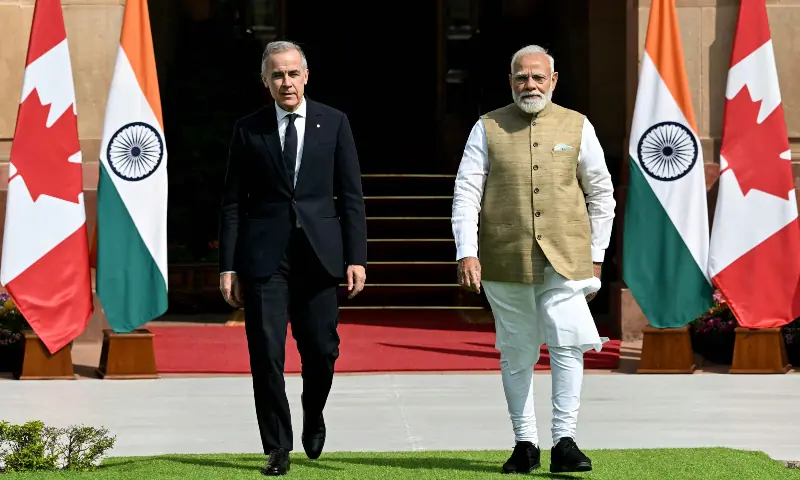
In late November, international media outlets reported that India and Canada were close to finalizing the 10-year uranium deal worth $2.8 billion. Canada’s Cameco Corp. will supply the uranium. This deal is being portrayed as an enormous breakthrough between the two states, whose broader nuclear cooperation had been temporarily halted.
Diplomatic terms have begun to get back on track since the change in the Canadian leadership, because during Justin Trudeau’s government in 2023, their ties deteriorated to a record low after the assassination of Hardeep Singh Nijjar in Canada, who was an active member of the Khalistan movement.
However, to the ordinary public, this looks fine and a prerogative of state affairs, but it is history that needs to be vigilantly looked at. India–Canada nuclear cooperation began in the 1950s, when, in 1956, Canada gifted India the CIRUS research reactor under the then globally ambitious Atoms for Peace initiative. In the 1960s, Canada helped India build its first CANDU reactor. However, the veiled villainous act of India was unveiled to the world when, in 1974, it conducted its nuclear test in the Pokhran region of Rajasthan by stealing plutonium from the CIRUS reactor, marking the cessation of bilateral nuclear cooperation.
In 2022, an investigative USA-based non-governmental organization, the National Security Archive, published on its website the declassified documents related to the suspicion that India had concealed ambitions in the late 1960s and early 1970s to embark on the dangerous path of nuclear development. According to one of the many declassified files, in 1968, Canadian inspectors were disturbed by the data of the Trombay facility, suggesting that India might develop a nuclear weapon utilizing uranium from the Canadian research reactor. India, on the other hand, was adamant on the so-called notion of Peaceful Nuclear Explosion (PNE) and justified the development and testing of the device as significant for the indigenous production of plutonium.
The Indian so-called PNE test by India forced the world to adopt a multilateral arrangement for enforcing strict controls on nuclear export. This led to the establishment of the Nuclear Suppliers Group in 1974 with the stated aim of preventing further nuclear proliferation. The story does not end here; with the rapidly changing international landscape, the beginning of the 21st century witnessed China's economic rise on the global stage. The USA felt threatened by this development and devised a strategy to counter the threat at home, which became the basis for the historic Indo-US strategic ties.
The strategic significance of the deal was the issuance of the NSG waiver to India (a non-NPT signatory), the same country whose illicit act 36 years earlier had brought this very arrangement into being. This waiver paved the way for the resumption of India–Canada nuclear cooperation in 2010, with the signing of the Nuclear Cooperation Agreement (NCA), which allows the transfer of uranium and nuclear technologies to Indian facilities under IAEA safeguards. But in 2023, India and Canada began an intense diplomatic rift after the murder of the Khalistan movement leader. However, with a new administration in power in Canada, things are getting back on track.
This concern, in the contemporary context, further increases when the ruling government of India, under Modi's vicious agenda of Hindutva, diligently works to reshape the secular identity of India into an ultraconservative Hindu nationalist state. This religio-politico ideological rather than prudent approach, in a nuclearized regional dynamic, would influence and affect the strategic decision making in a crisis or conflict. In such a scenario, states need to be extra cautious when making strategic deals involving dual-use technologies, as they could potentially complicate the security dynamics of an already hostile-driven South Asia.
However, the annoyingly interesting thing is that despite the reported cases of Indian mismanagement of its nuclear material, it has still been given such favours. Currently, there are 22 operational nuclear facilities in India, of which 14 are open to IAEA inspection, while eight are not. India has been acquiring international assistance to run its civil nuclear programme smoothly while simultaneously operating military facilities for nuclear weapons development with domestically produced fissile material.
India's strategic edge in the South Asian regional context is hazardous not only for regional stability but, most importantly, for the global nonproliferation regime. The Indian case in point is the reason for fuelling a gradual yet threatening arms race in the hostile regional dynamics. Giving strategic advantage to one state over the other in a nuclearized South Asian scenario is simply inviting inadvertent nuclear escalation into play, which is a dangerous development both for regional as well as global strategic stability.
Ultimately, the historical case of Indian fissile material theft from research reactors for the development of an atomic weapon reveals that a state with such irresponsible and untrustworthy behavior should not be given such elite treatment despite geopolitical and geostrategic constraints.
This concern, in the contemporary context, further increases when the ruling government of India, under Modi's vicious agenda of Hindutva, diligently works to reshape the secular identity of India into an ultraconservative Hindu nationalist state. This religio-politico ideological rather than prudent approach, in a nuclearized regional dynamic, would influence and affect the strategic decision making in a crisis or conflict. In such a scenario, states need to be extra cautious when making strategic deals involving dual-use technologies, as they could potentially complicate the security dynamics of an already hostile-driven South Asia.

The writer can be re\ached at [email protected] and tweets @usama_khalid101
View all articles →Comments
No comments yet. Be the first to join the discussion!