


















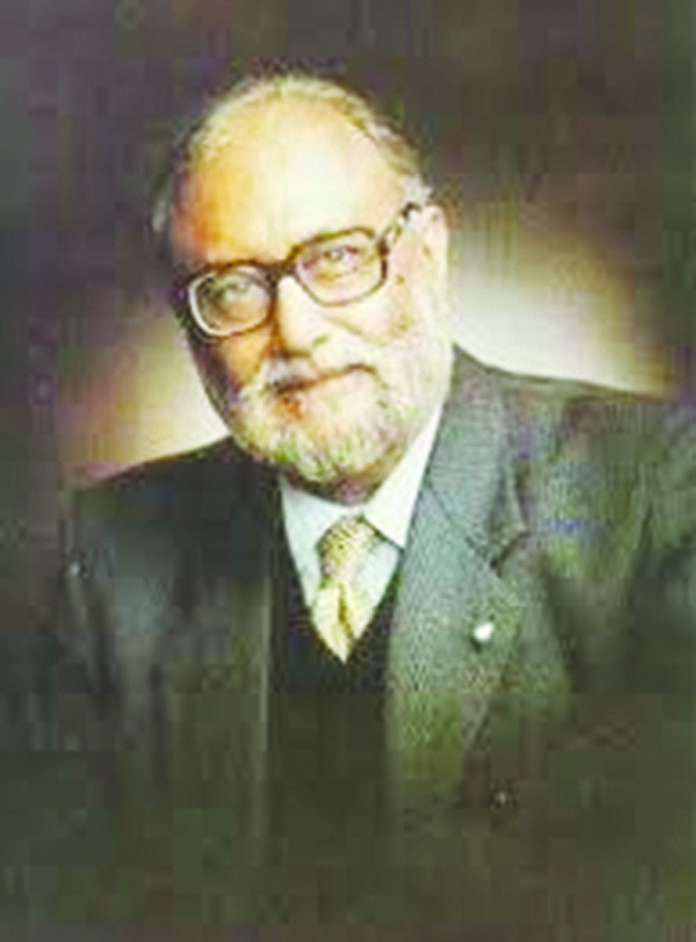
In a world marked by disparities and discrimination, Prof. Abdus Salam created his masterpiece: the International Centre for Theoretical Physics (ICTP) in Trieste, Italy. It was built to bring scientists from across the globe together and to help developing countries share in prosperity through science. How far we seem to be from that world today. And yet, as we drift from that dream, Prof. Salam’s blueprint for a more prosperous, inclusive world feels more urgent than ever.
In 1984, Prof. Abdus Salam delivered a landmark speech at the Annual Meeting of the American Association for the Advancement of Science (AAAS). He passionately articulated the critical role of research and development (R&D), alongside technology and science transfer, as pillars of economic development. This speech offered profound insights for helping to build a world with shared prosperity. He made four key points:
- Innovation, along with technology and science transfer, “are the sustenance” and the “hope for the betterment” of any country;
- Technology transfer without science transfer for developing countries would be futile. To quote Prof. Salam directly: “…in the conditions of today, technology, unsupported by science simply will not take or flourish”;
- Developed countries can and should help developing countries bridge the gap in science;
- To achieve science transfer, countries need education in science, a critical mass of trained scientists, integration of theoretical scientists into applied work, a research agenda, and a culture of scientific research.
It is worth examining Prof. Salam’s insights in the light of modern economic understanding.
The role of research and absorptive capacity
Between the 1980s and the mid-1990s, a group of Southeast Asian countries— the so-called Southeast Asian Tigers, namely Indonesia, Malaysia, the Philippines, Thailand, and Vietnam— experienced significant growth. It was widely regarded as an economic miracle. Many in the policy world believed these countries were on a trajectory to converge to the living standards of developed nations. And then, just as the miracle came, it fizzled out.
Why? The Southeast Asian Tigers forgot to read the memo that Prof. Salam delivered to the AAAS.
In many ways, in his address Dr. Salam was speaking about enabling productivity growth. Over the past several decades, economists have been repeatedly reminded of the importance of productivity growth. Productivity growth— fostered by innovation, human capital, R&D, and the exchange of ideas— explains most of the variation in economic growth across countries.
In short, if you want long-term economic growth, you need to invest in R&D, science, technology and education. The Southeast Asian Tigers’ growth was largely built on capital investment— factories, machines, cranes— and without sustained technological advancement, that growth fizzled out, leaving them caught in the middle-income trap.
Without scientific foundations, technology transfer lacks lasting impact. In our paper (co-authored with Prof. Robert Breunig), titled “Determinants of innovation novelty: evidence from Australian administrative data,” we showed how important absorptive capacity— the ability to learn from other countries and firms— is for firms not only when undertaking innovation in general, but especially for undertaking more novel innovations, such as new-to-world and new-to-country innovations. Education and management capabilities are essential inputs into absorptive capacity.
These findings also apply at the national level: absorptive capacity links economies to the global technological frontier. When Prof. Salam spoke about science transfer, he was, in essence, talking about upgrading the absorptive capacity of developing countries. Even most developed countries lag behind the technological frontier, led by the USA, the UK, Germany, Japan, and China. However, their strong absorptive capacity helps them catch up. For developing nations to advance, they must invest in and support their scientific communities and education systems.
Missing institutions
One crucial piece is missing from Dr. Salam’s original blueprint: institutions. Prominent scholars such as Douglas North and Daron Acemoglu have highlighted how strong institutions— with effective governance, protection against corruption, intellectual property (IP) rights, and robust legal frameworks— form the foundation of economic development, including the ability to generate innovation and productivity growth.
Institutions are critical for fostering productivity growth. First, they protect innovation and R&D investments through patent rights. Without these protections, innovations developed by firms or individuals can be easily appropriated by competitors, discouraging further investment in R&D.
Second, in the absence of robust institutions, public and private R&D investments become vulnerable to corruption-driven expropriation. This generates resource leakage, as innovation spending is diverted or wasted and credit is misappropriated, undermining the effectiveness of such investments.
Policy evaluation is a key tool in the West, ensuring accountability and continuous learning. Independent, objective assessments improve research policy and decision-making. To drive progress, strong institutions, rigorous evaluation, and scientific investment must go hand in hand.
The path to meaningful change— through science, innovation, and institutional reform—can take years, even decades. But this investment is essential. Following the roadmap above can go a long way towards breaking the cycle of low development and stalled progress.
Blueprint for building scientific infrastructure
Based on Prof. Salam’s address and the discussion above, a detailed blueprint for how scientific critical mass can be effectively constructed includes:
a) Building scientific literacy and teaching, including inspiring teachers with firsthand research experience who understand its role;
b) Funding well-equipped laboratories and research institutes, with sustained support and ambitious research agendas;
c) Incorporating local scientific expertise into priority technology choices;
d) Encouraging scientists to support national development through applied work;
e) Investing in basic research, which often underpins major breakthroughs (e.g., Faraday, Maxwell, and Hertz laid foundations for radio and modern communications);
f) Investing in quality education at all levels, from primary schools to universities;
g) Regular evaluation and monitoring by an independent economic and science think tank to ensure effective, corruption-free research institutions aligned with national priorities.
Throughout his life, Prof. Salam emphasized the importance of research institutes. He highlighted how the Indian Institutes of Technology (IITs) were established through international collaboration and linkages with universities in the United States, the United Kingdom, Germany, and the former USSR. Other nations could follow this proven IIT model.
He also emphasized scientific exchanges, secondments, and collaborations between developing and developed nations—all of which should be merit-based. Prof. Salam’s ICTP is a leading example of such exchanges of information. Developing countries should prioritize merit-based scholarships that send top talent to leading universities, strengthening human capital, while also resourcing domestic universities to produce high-quality research. Progress can be benchmarked by publications in top international journals.
Diplomacy and international engagement can play a role as well. Countries such as India, Singapore, Taiwan, and South Korea have used diplomacy and strategic negotiation to coordinate both technology and science transfers from Western countries, thereby building both human capital and the tacit knowledge that comes from experience and participation in joint, complex projects.
Research disparities
Prof. Salam highlighted the growing gap between developed and developing countries in R&D investment. Decades later, this disparity persists, as shown in Figure 1. However, countries such as Türkiye and India are now prioritizing research, recognizing its role in global competitiveness, economic growth, and trade. Other developing countries could benefit from adopting a similar strategy.
Where do we go from here?
In a fractured world where cooperation seems to be losing ground, the lessons of inclusiveness, of working together, and using science to solve our common problems seem ever more pertinent.
Global warming underscores our shared responsibility to collaborate for the planet’s future. Science is key to tackling pollution, especially in developing countries. Poverty and energy scarcity further stress the need for collaboration in science, R&D, and economic growth.
Developing countries cannot wait for developed nations; they must take initiative and avoid free-rider behaviour—waiting for others to act rather than being proactive. Professor Salam’s landmark speech remains a blueprint for progress. Investing in R&D and education, and fostering science transfer, is essential for long-term prosperity. Leading economies such as the United States and Germany, and fast-growing economies such as China, South Korea, and India, all invest heavily in innovation and inputs that enable innovation. Investment in research and innovation must also go hand in hand with building institutions that are competent and free from corruption.
The path to meaningful change— through science, innovation, and institutional reform—can take years, even decades. But this investment is essential. Following the roadmap above can go a long way towards breaking the cycle of low development and stalled progress.





u2vamf