















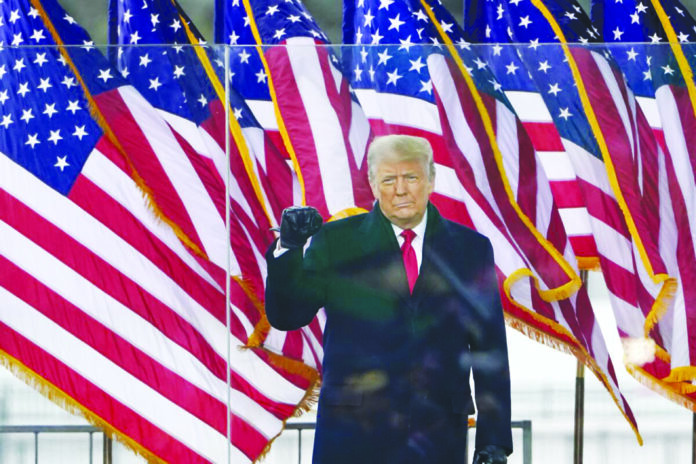
Donald Trump is often described as an isolationist throwback, a president supposedly dragging the United States back to the inward-looking habits of the nineteenth century. The charge is appealing, particularly given his abrasive tone towards allies and his hostility to immigration. But it is also misleading. Trump is not an isolationist. In historical terms, he fits far more comfortably into a long American tradition of assertive statecraft, one concerned less with retreat from the world than with the constant expansion and protection of national power. From the earliest days of the republic, the United States has rarely behaved like a country content to mind its own business. Within a decade of independence, it was fighting an undeclared naval war with France in the Caribbean. Soon after, it was confronting the Barbary States in the Mediterranean. Throughout the nineteenth century, Washington pushed relentlessly westwards, extending its borders to the Pacific through war, coercion and purchase. This was not the conduct of a timid or detached state. It was the behaviour of a nation convinced of its destiny, willing to use force when opportunity or interest demanded.
The presidents often invoked as supposed champions of American restraint James Monroe, Andrew Jackson, James Polk or William McKinley were, in fact, architects of expansion. The Monroe Doctrine itself, declared in 1823, was a remarkable statement of ambition. A young and militarily modest republic announced that the entire Western Hemisphere lay beyond European interference. Its immediate practical effect was limited, but its psychological significance was immense. The United States was claiming a supervisory role over a vast geopolitical space it could barely control. This was not isolationism; it was strategic audacity. The Mexican-American War of 1846 to 1848 confirmed the point. What began as a border dispute ended with American troops in Mexico City and the annexation of huge territories that now form the south-western United States. California, Nevada, Utah, Arizona and New Mexico were absorbed into the Union. There was nothing defensive about this war, and nothing reluctant about its outcome. It reflected a political culture that equated security with growth, and influence with land.
By the end of the century, the United States had become a continental power and was turning its attention outward. Victory over Spain in 1898 delivered control over Cuba, Puerto Rico, Guam and the Philippines. At the same time, Washington embarked on a major naval expansion, inspired by strategists who believed sea power was the true measure of international standing. By the outbreak of the First World War, the US Navy ranked among the world’s largest. America still preferred to avoid European entanglements, but it was no longer a peripheral state. It had entered the ranks of the great powers by design. The only serious experiment with isolationism came after the First World War. In the 1920s and 1930s, the United States reduced its armed forces, rejected membership of the League of Nations and passed neutrality laws intended to keep it out of future conflicts. Even then, the retreat was incomplete. Military planning continued, new technologies were explored, and industrial capacity quietly expanded. When war returned in 1941, the infrastructure of power was ready to be mobilised.
This longer history matters because it places Trump’s foreign policy in a clearer frame. Since returning to office in 2025, he has not dismantled American alliances. He has reaffirmed US commitments to NATO, pressed European states to shoulder more of the burden, authorised strikes against Iranian nuclear facilities, pursued negotiations over Ukraine, and ordered operations in Latin America that no isolationist would contemplate. His administration has called for increased defence spending, not retrenchment. Whatever his rhetoric, his actions point towards engagement backed by force. The pattern is familiar. Like Theodore Roosevelt before him, Trump speaks the language of national strength and views diplomacy as an extension of power rather than a substitute for it. He measures success in terms of leverage gained, rivals deterred and influence asserted. This approach echoes the instincts of earlier presidents who believed that security lay in pre-eminence, not restraint.
None of this is to suggest that such a tradition is either admirable or wise. American history offers ample warnings about the limits of power and the costs of overreach. The same strategic culture that produced continental expansion also produced Vietnam, Iraq and Afghanistan. Confidence easily curdles into complacency. The belief that force can resolve political problems has repeatedly led Washington into conflicts it did not understand and could not easily conclude.Nor does the existence of precedent guarantee success. The world Trump confronts is vastly more complex than that faced by Monroe or McKinley.
Economic interdependence, nuclear weapons, cyber warfare and climate stress have altered the foundations of international politics. The tactics of the nineteenth century cannot simply be repackaged for the twenty-first. A foreign policy focused narrowly on displays of strength may satisfy domestic audiences, but it does little to address the structural conditions that produce instability.
There is also the question of alliances. For eighty years, American power has rested not only on its military reach but on a dense network of partnerships. These relationships helped prevent another great-power war after 1945 and underpinned a system of trade and security that benefited both the United States and its allies.
Trump has not formally abandoned this architecture, but his tariffs, transactional language and public contempt for partners have strained it. Power exercised without regard for shared purpose risks hollowing out the very coalitions that make power effective.
Trump’s defenders argue that he is merely restoring realism to American foreign policy. His critics fear he is weakening the moral and institutional foundations of the Western order. Both positions contain elements of truth. He is not an aberration in American history; he is a product of it. His emphasis on national advantage, territorial security and military capacity reflects instincts that have shaped the republic since its birth. What distinguishes him is less the substance of his objectives than the bluntness with which he pursues them. The danger lies in mistaking assertiveness for strategy. The United States has often been bold; it has not always been thoughtful. Earlier generations expanded across a continent but failed to construct a durable international settlement, stumbling instead into two world wars. After 1945, Washington learned that leadership required institutions, compromise and patience as well as strength. Whether Trump appreciates that lesson remains uncertain.
It is tempting to portray him as a rupture with the past. In truth, he is better understood as a reminder of it. America has never been naturally detached from global affairs. Its default condition has been involvement, usually forceful, sometimes reckless, occasionally constructive. Trump’s presidency continues that story. The question is not whether he is an isolationist. It is whether the pursuit of power, untempered by restraint and cooperation, can still secure the peace his supporters promise.