















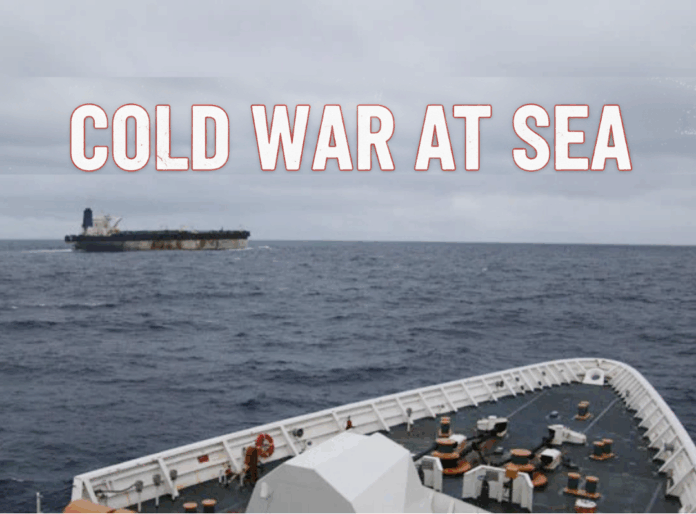
The boarding and seizure of MV Marinera (IMO number 9230880 and formerly Bella 1) at high seas without flag state consent may be a rational politico-military choice. But it sets a risky precedent necessitating an urgent legal review lest the cost of an escalating cold war at sea starts adversely affecting the global maritime economy.
Whose Rules …Yours or Mine?: In the ongoing geo-political contestation in the maritime battlespace, the USA-led West has been a champion of a rules-based international order at sea. This effort is aimed at denying space for hybrid maritime warfare for the powers that hope to gain asymmetric advantage through use of lawfare and proxies while exercising plausible deniability. Use of shadow fleet or dark ships, that is, ships that conceal their identity, position and cargo for sanctions evasion and blue crime, is just such a leading instrument of hybrid maritime warfare, as observed in the case of crude oil shipments from Iran and Venezuela.
The rules-based international order has one caveat in a post-UN world … your rules or mine! Accordingly the major powers have so far refrained from boarding such dark vessels, especially if it carried the flag of another major power. However, all this is about to change. US forces have recently boarded and seized MV Marinera, a crude oil carrier that had sailed from Venezuela waters and changed its name, registry and hoisted the Russian flag while underway prior to its seizure. Russia has strongly protested, calling it an act in violation of international law as United Nations Convention on the Law of the Sea Article 92 requires consent of the Flag State for boarding of its vessel.
The Flags of Convenience model, under which certain countries can register the ships without due diligence, needs to be reviewed to discourage dark shipping, because a laissez-faire approach to ship registry by one country can transform into a global menace. An addendum to the bilateral US–Soviet Incidents at Sea agreement about dark shipping may also be considered as an immediate confidence-building measure between the USA, Russia and China to ensure de-escalation while IMO takes due time to develop global consensus.
It may be mentioned that in the Iran-Iraq Tanker War, Kuwaiti oil tankers had sailed under US flag to ensure energy security and assure an important ally. If Russia’s claim of granting registry to the said ship is correct, it sets a risky legal precedent as US forces apparently boarded the ship by declaring it as stateless under the provisions of the same article of UNCLOS that comments on the possibility or otherwise of a flag change while underway. The exact details from the USA are awaited, but it is assessed that US forces might have used these provisions in the UNCLOS to declare the vessel stateless.
What is at stake?: Now if Russia does a quid pro quo and starts boarding and seizing vessels carrying flags of the USA or its allies at high seas on one pretext or the other, and if China follows suit, the global maritime commons are faced with great instability leading to an impending cold war at sea. Its impact on the cost of doing business at sea, with consumers around the world footing actual charges of enhanced war risk insurance can be well imagined.
If unrestrained, the ensuing escalation at sea could lead to a replay of the Cuban Missile Crisis, albeit with graver consequences. On the lower side, the escalating spiral is set to start a new cold war at sea with dangerous consequences for the future of global maritime commerce.
Mare Liberum and Flag State Control are sacrosanct principles in international maritime law and need to be respected by all. If history is a witness, the US-led Proliferation Security Initiative also faced strong resistance from the world community on the same account. Otherwise, the practice of declaring a ship as stateless based on whatever pretext, using one’s own interpretation of UNCLOS 92, shall grow with associated consequences.
What could be the immediate steps to ensure de-escalation?: The International Maritime Organization must call emergency sessions of its Facilitation Committee and Legal Committee to issue amplifying instructions on the best practices to identify and deal with dark shipping while respecting Flag state control. The growing menace may be akin to piracy when the world came together to enact laws and ensure commonly accepted practices. The same needs to be emulated.
As IMO inter-governmental processes are time consuming, the shipping market must be allowed to regulate itself. Lloyd’s List Intelligence and similar organizations that do not have enforcement powers, while they have the intelligence, should be empowered.
The Flags of Convenience model, under which certain countries can register the ships without due diligence, needs to be reviewed to discourage dark shipping, because a laissez-faire approach to ship registry by one country can transform into a global menace.
An addendum to the bilateral US–Soviet Incidents at Sea agreement about dark shipping may also be considered as an immediate confidence-building measure between the USA, Russia and China to ensure de-escalation while IMO takes due time to develop global consensus.