

















By: Muhammad Hassan Jalil
Islamabad is often seen as a city of privilege: wide roads, federal ministries, elite schools. But tucked away in quieter corners are institutions working with children whose lives have been shaped by instability long before they enter a classroom. One such school quietly serves underprivileged communities. Its work is sincere, and its intentions are admirable. Still, it raises a difficult question: can compassion alone educate children shaped by extreme deprivation, or does discipline also play a role?
These schools started with a simple idea, to provide quality education to children who would otherwise be left behind. Over time, they have developed classrooms, labs, sports activities, and a focus on overall development. Unlike many charity-driven initiatives, they do more than just teach from textbooks. They try to support families, nurture talents, and restore dignity to children carrying heavy social and emotional burdens.
Many students come from fractured environments, poverty, displacement, lack of supervision, and exposure to harsh realities. These experiences don’t disappear at the school gate. They shape behaviour, language, emotions, and how children respond to authority. In such cases, education becomes more than teaching subjects; it becomes about helping children rebuild their social skills and confidence.
The philosophy in these schools leans on empathy. The belief is that patience, care, and gentle guidance will eventually help children adapt. Discipline, in the traditional sense, is kept minimal, because strictness can feel harsh to children who have faced trauma. The intention is humane, yet the results are mixed.
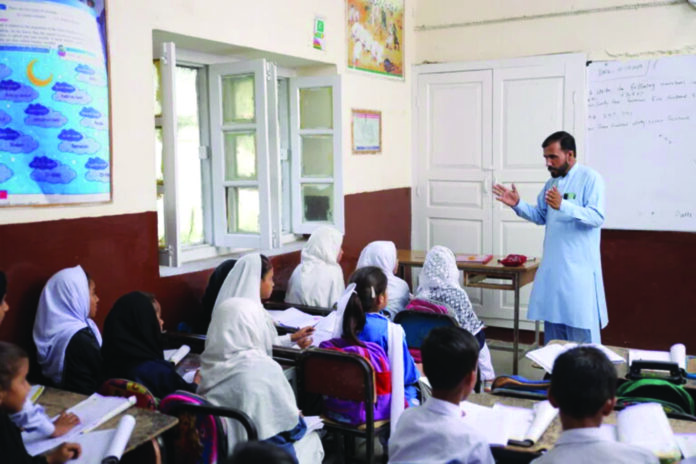
Inside classrooms, teachers are held to high professional standards. Punctuality, planning, accountability, and conduct are taken seriously. Educators are trained and evaluated often more strictly than in mainstream schools. Students, however, are given more leniency. Rules are flexible. Authority to correct behaviour is limited. This can create an imbalance.
This is not an argument for harsh punishment. It is simply an observation: when compassion is not combined with clear guidance, behavioural improvement can be inconsistent. Some students respond very well, showing confidence where there was fear, discipline where there was chaos. They are proof of the system’s potential.
But most students arrive without a clear understanding of boundaries. Kindness alone is not enough to shape behaviour. It sometimes normalizes disruption. This is not a failure of the school’s intent, but a limitation of approach.
If Pakistan is serious about breaking cycles of deprivation, it must look beyond enrolment numbers and ask the harder question: How do we teach children not only to survive school, but to function confidently in society? The answer may start with admitting that kindness, while essential, is not always enough on its own.
Pakistan’s education system rarely addresses this phase. National discussions focus on enrolment numbers, literacy, and infrastructure. What happens after children enter school receives less attention. For welfare schools, the real work begins there. Teaching math is simpler than teaching restraint. Grammar is easier than teaching respect. These are not academic problems, they are social and psychological.
These schools have never claimed to solve all challenges. Leadership is aware of the fragility of the children they serve. Their reluctance to impose strict discipline comes from fear of doing harm, not negligence. Still, it raises a broader question: Does avoiding discipline protect children, or does it delay their adaptation to structured society?
Globally, trauma-informed education models stress “firm compassion”, a balance where empathy goes hand in hand with clear rules. Boundaries are not punishment; they are a form of care. For children who grew up without structure, consistency can be as important as kindness.
Welfare education in Pakistan may be approaching a critical point. Access alone is no longer enough. Sustainability of behavioural reform matters. Without giving teachers authority and institutional support, to enforce fair discipline, schools risk achieving only partial success. They save children from exclusion, but may not fully prepare them to integrate into society.
This does not lessen their contribution. It highlights the complexity of the task. Educating underprivileged children is not a simple success story; it is a constant balance between mercy and order, patience and progress. Recognizing the limits of kindness strengthens, rather than weakens, humanitarian work.
Perhaps the next phase of welfare education lies not in choosing between compassion and discipline, but in redefining discipline as structured guidance rooted in dignity. Schools quietly working in the shadows of the capital are in a unique position to lead this conversation. These observations are not criticism of any single school, but reflections on challenges faced by many welfare-based schools in Pakistan.
If Pakistan is serious about breaking cycles of deprivation, it must look beyond enrolment numbers and ask the harder question: How do we teach children not only to survive school, but to function confidently in society? The answer may start with admitting that kindness, while essential, is not always enough on its own.
The writer is a freelance columnist.





Thank you for sharing this insightful piece! It thoughtfully highlights how combining compassion with structured guidance is essential for truly supporting underprivileged children in Islamabad’s schools.