



















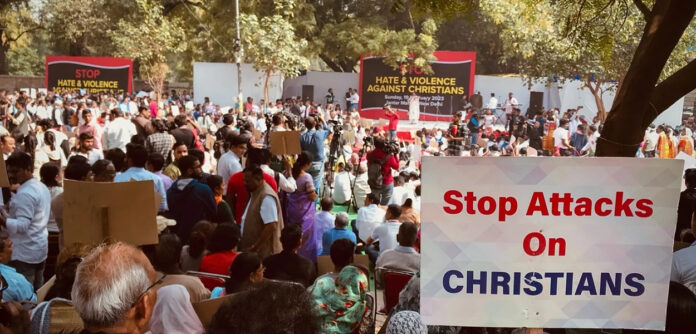
India’s journey from constitutional secularism to deepening political polarisation has become one of the most consequential shifts in its contemporary history. Recent incidents of vandalism targeting churches and disruptions of Christmas celebrations in different parts of India have once again drawn attention to the growing concerns over religious intolerance in the country. While authorities often describe such incidents as isolated or localised disturbances, available data and independent reports suggest that these events are part of a broader and more persistent pattern of hostility towards religious minorities.
According to the Pew Research Center’s 2023 Global Restrictions on Religion report, India continues to rank among the countries with the highest levels of social hostilities involving religion. The report notes that incidents ranging from harassment of religious groups to damage of places of worship have remained consistently high over the past decade. This broader context helps explain why acts of vandalism during Christmas, a festival traditionally associated with public celebration and interfaith participation, have increasingly become flashpoints rather than exceptions.
Independent monitoring groups have documented dozens of incidents involving attacks on churches, disruption of prayer services and intimidation of Christian communities in states such as Chhattisgarh, Uttar Pradesh, Gujarat and Madhya Pradesh. While exact figures vary by source, organizations tracking religious freedom violations have repeatedly pointed to an upward trend since the mid-2010s, particularly during religious festivals. The repetition of such incidents across multiple states undermines the claim that they are spontaneous or unrelated acts.
India’s constitutional framework offers strong protections on paper. Article 25 of the Constitution of India guarantees all individuals the freedom of conscience and the right to freely profess, practise and propagate religion. Articles 26 to 28 further safeguard the rights of religious denominations and prohibit religious discrimination in state institutions. Additionally, Article 14 enshrines equality before the law, reinforcing the secular character of the state. However, the persistence of attacks on minority religious sites highlights a widening gap between constitutional commitments and their implementation.
International observers have increasingly taken note of this disconnect. The United States Commission on International Religious Freedom (USCIRF), in its recent annual reports, has repeatedly expressed concern over what it describes as a “deteriorating environment for religious minorities in India.” The commission has cited instances of violence, vandalism and the alleged misuse of laws related to religious conversion, arguing that these developments warrant closer scrutiny by the international community.
The issue has also received attention in the global media. The Wall Street Journal, in its reporting on India’s internal challenges, has highlighted how attacks on minority communities, including Christians, risk undermining India’s claims of democratic inclusivity. While acknowledging India’s diversity and institutional strength, such reporting underscores the reputational costs of persistent intolerance, particularly for a country seeking a greater role in global leadership and a rule-based international order.
Critics argue that the rise of majoritarian politics has contributed to an environment in which extremist elements feel emboldened. Political rhetoric centred on cultural dominance and religious identity has, at times, blurred the line between nationalism and exclusion. In such an atmosphere, acts of vandalism or harassment may be perceived by perpetrators as low-risk, especially when state responses appear hesitant or inconsistent.
Ultimately, protecting religious freedom is central to preserving social cohesion in a diverse nation. Without consistent enforcement of constitutional guarantees, isolated acts of intolerance risk becoming entrenched patterns. A recommitment to pluralism, grounded in both law and practice, remains essential if India is to arrest this troubling trajectory.
Accountability remains a central concern. Data compiled by rights groups indicate that while cases are occasionally registered following attacks on churches or prayer gatherings, investigations are often slow and prosecutions rare. This perceived impunity deepens insecurity among minority communities and weakens public confidence in law enforcement institutions. It also reinforces the impression that constitutional protections are selectively enforced rather than universally applied.
Beyond its domestic implications, rising religious intolerance carries regional and international consequences. India has long projected itself as a pluralistic society where multiple faiths coexist under a secular constitutional order. This image has been central to its soft power in South Asia and beyond. Continued reports of intolerance risk eroding that narrative, particularly when contrasted with India’s stated commitment to democratic norms on global platforms.
From a regional standpoint, developments within India are closely observed by neighbouring countries. Religious polarisation in a major South Asian state has the potential to inflame cross-border tensions and reinforce competing narratives of exclusion and victimhood. In a region already marked by political volatility, such internal divisions complicate prospects for dialogue and cooperation.
The role of civil society and independent media is therefore critical. However, journalists and activists documenting incidents of religious intolerance increasingly face legal pressure and social backlash. This narrowing space for scrutiny limits informed public debate and weakens democratic accountability, a trend that international watchdogs have repeatedly flagged as a matter of concern.
Addressing the issue requires more than symbolic condemnations following high-profile incidents. Effective responses must include impartial law enforcement, judicial oversight and political restraint in public discourse. Equally important is a reaffirmation of constitutional values through education and institutional practice, ensuring that secularism remains a lived reality rather than a formal declaration.
Acts of Christmas vandalism should thus be seen not merely as seasonal disturbances but as indicators of a deeper challenge confronting Indian society. How the state responds through law, policy and political will shape not only the future of its minority communities but also the credibility of its democratic project.
Ultimately, protecting religious freedom is central to preserving social cohesion in a diverse nation. Without consistent enforcement of constitutional guarantees, isolated acts of intolerance risk becoming entrenched patterns. A recommitment to pluralism, grounded in both law and practice, remains essential if India is to arrest this troubling trajectory.





wow i like your article, i enjoy reading it and have bookmarked it and will continue to follow you, great work, how often do you post? i am the owner of the top linkbuilding platform and directory in germany called toplinkbuildingagenturen.de you you can check it out and even post on it. Thank you