
















In today’s geopolitical landscape, power is not exercised solely through armies and alliances but it is also wielded through narratives that shape perceptions, define legitimacy, and influence policymaking. It’s not merely about who wins on the kinetic battlefield, but whose story prevails in the global court of public opinion. The launch of the Balochistan Studies Project by the Middle East Media Research Institute (MEMRI) serves as a clinical case study in how academic initiatives are weaponized to serve the strategic interests and can function as tools of geopolitical rivalries.
To understand why an institute in Washington is suddenly obsessed with Balochi media, one must look at its lineage. To the casual observer, translating regional media might seem a benign pursuit of scholarship. However, viewed through the lens of Israel’s historical military doctrine and its deepening alignment with New Delhi, the project emerges as a calculated effort to redefine Balochistan. MEMRI was founded in 1998 by Yigal Carmon, a former high-ranking officer in Israeli military intelligence. For decades, the institute has curated extremist translations to portray Muslim-majority states as inherently unstable. The BSP, announced on 12 June 2025, is a continuation of this pattern, but with a sharper, more focused edge.
Information warfare is often misunderstood as simple propaganda. In reality, it is the systematic use of information to achieve a competitive advantage, aiming to influence the decision-making of adversaries and the perceptions of neutrals. For Pakistan, Balochistan has become the ultimate “gray zone” where kinetic operations (military force) and non-kinetic operations (narrative control) overlap. The globalization of a local insurgency through the weaponization of selective translation vide BSP marks a pivotal moment in this evolution:
The methodology employed by MEMRI is a masterclass in the DIME (Diplomatic, Informational, Military, Economic) framework of power. By meticulously translating the charters of militant groups like the Baloch Liberation Army (BLA) and the statements of self-exiled leaders, the BSP achieves two primary objectives. First, it sanitizes the image of violent actors for a Western audience. By framing these movements through the lens of secularism, women’s rights, and “pro-Western” values, the project builds a moral bridge between the insurgents and the corridors of power in the West.
Second, it targets the “E” in the DIME model: the Economy. Balochistan is the linchpin of the China-Pakistan Economic Corridor (CPEC). By consistently highlighting instability and presenting the province as an “occupied territory,” these information operations create a risk-heavy environment that aims to deter Chinese investment. The narrative is clear: if the world views Balochistan not as a sovereign province but as a contested zone of “liberation,” the legal and ethical framework for international business and diplomatic engagement shifts overnight.
The BSP and its proponents understand that in modern conflict, the side that tells the most compelling story wins regardless of whether that story is complete. Pakistan’s challenge is to move beyond the reactive “denial” phase and begin telling a better, more inclusive story of its own. A story where the Baloch people are the protagonists of their own development, not just pawns on a geopolitical chessboard. Until then, the information frontier will remain a playground for those who seek to fragment the federation through the stroke of a translator’s pen.
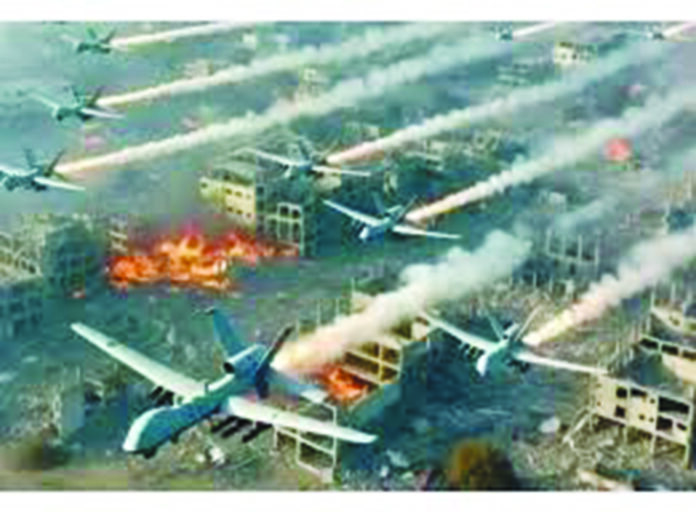
Yet, this intellectual offensive does not exist in a vacuum; it is the “software” that guides “hardware” on the ground. The role of the “Indo-Israel nexus” is central to this 5th Generation Warfare (5GW) matrix. Pakistan’s security establishment has long pointed to the 2016 arrest of Kulbhushan Jadhav as evidence of external facilitation. In 2025, this cooperation has reached a high-tech zenith. During the height of the Pakistan India escalation, India deployed dozens of Israeli-manufactured Harop suicide drones to neutralize Pakistan’s air defence.
This synergy creates a pincer movement against Pakistan. While India provides the physical proximity and historical links to regional insurgencies, Israel provides the “epistemic terrain” , the intellectual and digital infrastructure to globalize the narrative. By publishing secessionist maps and flags under the guise of “research,” MEMRI normalizes territorial fragmentation in the minds of Western think tanks, paving the way for eventual policy lobbying and, potentially, more overt support.
However, information warfare does not create grievances out of thin air, it exploits existing fissures. The persistent sense of socio-economic marginalization among the Baloch youth and the lack of political agency in the province provide the “raw material” for external narrative-shaping.
To counter the strategic encroachment of the Balochistan Studies Project and similar IW initiatives, Islamabad needs a paradigm shift. This begins with acknowledging that Balochistan is a political problem with a security dimension, not a security problem with a political dimension.
The BSP and its proponents understand that in modern conflict, the side that tells the most compelling story wins regardless of whether that story is complete. Pakistan’s challenge is to move beyond the reactive “denial” phase and begin telling a better, more inclusive story of its own. A story where the Baloch people are the protagonists of their own development, not just pawns on a geopolitical chessboard. Until then, the information frontier will remain a playground for those who seek to fragment the federation through the stroke of a translator’s pen.