












AT PENPOINT
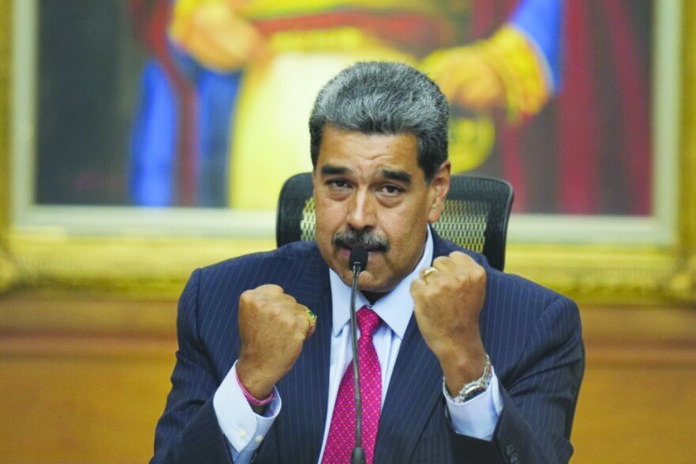
The kidnapping of Venezuelan President Nicolás Maduro may have caused all sorts of convulsions of international law, but the charges against him have made the use of two favourite US weapons more and more unbelievable, even though they are still serious concerns in their own: human rights and drugs.
Even if one was to concede all the charges made against Maduro, and not just in the indictments against him in the New York courts which were levied against him, it becomes clear that the US Administration is not concerned with violations of human rights or by drug-related offences, except as a stick to beat some Third World leader over the head with.
Human rights are important. For the USA, they are all-important. They are the nearest to a state ideology it has, and it was on their basis that it fought the Cold War. The main contention of the USA was that the USSR and its satellites consistently violated human rights, such as the right to property and to life and liberty. However, the USA, while proclaiming its devotion to numerous freedoms, has also been seen to ignore human rights violations by allies when it suits it.
The most glaring evidence comes from the Middle East, where the USA has ignored human rights abuses by such a;;ies as Saudi Arabia, the UAE and Qatar. One of the main abuses is the provenance of governments. The sheikhdoms became almost proverbial in describing the sort of autocratic, anti-freedom, government that the USA opposed so vehemently when it referred to the USSR, any of its satellites or China.
However, perhaps the most complete carte blanche given by the USA to an ally is that given to Israel. In other cases, the denial of rights is to the States’ own citizens. The nearest to an international dimension was the 2018 killing of dissident Saudi journalist Jamal Khashoggi in Istanbul, but since the crime was allegedly committed at the Saudi consulate there, even that violation of Khashoggi’s right to remain alive seems to have occurred on Saudi soil. That was not criticised by the USA, just as much as its recent attempts at genocide in Gaza, which have culminated with the present campaign. (It must not be forgotten that the last year’s events in Gaza come after several years of annual bombings, and must be seen as a ‘last push’ by Israel.)
Drugs are another charge which the USA may have bandied about without sufficient reason. In 1989, Panamanian strongman Gen Manuel Noriega was similarly abducted by US special forces from Panama City, even though he was a four-star officer and commander of the Panamanian Defense Forces. He had been paid by the CIA since 1953, even before he had joined the military, coming onto the payroll after becoming head of military intelligence. Ever since the death of Gen Omar Torrijos in 1981, he had ruled from behind the scenes, and had used his position as head of the military not just to rule through puppet civilian Presidents. His use of the military in drug smuggling, as well as selling to the drug cartels of military equipment drew enough US ire to make the operation against him feasible.
However, the charge against Maduro is a little different. He is President of his country, which Noriega was not, though he ruled Panama de facto. Second, there is an obvious interest in Venezuela, in its oil reserves, which makes the drug charge dubious. Drugs are a serious problem for the USA, but the way they are being used makes them dubious.
The last time the USA wanted to help out its oil companies, it overthrew Muhammad Mossadegh in 1953 in Iran in a coup led by the Shah. Now, almost 73 years later, it is once again trying to destabilize Iran. However, in Venezuela, it has kidnapped the President. One difference is that in Iran in 1953, there was no nonsense about human rights or drugs. And the oil companies were grateful.
Maduro and his son may have been involved in drug smuggling. However, Maduro was also head of a regime which had nationalized US oil companies, so the drug smuggling would probably not be the primary motivation, just as it was not in the case of Noriega. Though Noriega was helpful to the USA in its activities against the Sandinistas in neighboring Nicaragua, he was also selling intelligence to Cuba.
Venezuela was supporting Cuba too, with oil as well as money, which Trump has ordered stopped. That seems to have been more of a problem for the Trump Administration than drug smuggling, but the latter has become the formal charge.
Though drugs are a serious problem for the USA, while Trump has made noises against Mexico and Collombia, it is noteworthy that he has not launched any initiative against drugs domestically. The last time the USA launched an attack on drugs was in the 1980s, when US special forces are reported to have operated in South America against the drug cartels, But this was accompanied by a ‘Just Say No’ campaign in the USA, which was spearheaded by then First Lady Nancy Reagan. That seemed to recognize that the drug trade was powered by demand from users in the USA.
One problem seems to be that the USA is apparently moving towards a legalizing of drugs. Already, most states have made the use of marijuana legal, including for ‘recreational use’ in some states. The next step will be to legalize cocaine and heroin. After all, they are both originally painkillers. It is no coincidence that the most recent drug epidemic in the USA, the fentanyl epidemic, is due to the use of a very powerful painkiller.
The story of marijuana resembles that of alcohol, which was first prohibited by constitutional amendment bin 1920, but which was then repealed in1933. Marijuana has not been legalized by any federal law, but it is on its way. As for narcotics like cocaine and heroin, they were initially purely medicinal in use, and were used recreationally only later.
If they are legalized, whatever the consequences for US society, Trump would end up looking rather silly for going after Maduro. Oil companies have told Trump they are not willing to go back into Venezuela after their experiences, so the castle in Spain Trump was making of oil companies investing in Venezuela to bring its oil to the USA seems to be going up, as castles in Spain do, in a puff of smoke.
The consequences of the debasing of the currency of human rights has become visible with Maduro’s case. The perception was that he was at the head of a heavyhanded government which did not pay much attention to observing human rights. That has been taken off the table. So have the accusations of drug trafficking. There is too much association of Venezuela with Big Oil for these charges to be believed. This means that Maduro will be considered innocent in the court of public opinion, even if he is convicted by a court of law.
This episode has caused much loss of US credibility. The USA was once seen as standing for something. It was, after all, founded as a republic wheals of the Enlightenment could be practised. Human rights were embedded in its constitution, The communist USSR was also a result of that same Enlightenment, though it included a critique of capitalism. It also included a claim that it respected human rights, though it defined them differently.
Communism did not accept the right to property, for example, which was central to the US conception. It is the zeitgeist which has got religious leaders claiming the existence of human rights in their particular faith.
Human rights has assumed the place of religion, it seems, in the Western worldview. However, just as religion has been used to justify all kinds of bad behaviour, it seems human rights is being used for the same purpose. It almost seems as if human rights are reduced to be merely a tool of US foreign policy. The last time the USA wanted to help out its oil companies, it overthrew Muhammad Mossadegh in 1953 in Iran in a coup led by the Shah. Now, almost 73 years later, it is once again trying to destabilize Iran. However, in Venzuela, it has kidnapped the President. One difference is that in Iran in 1953, there was no nonsense about human rights or drugs. And the oil companies were grateful.