

















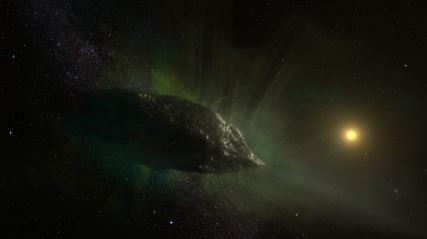
Comet 3I/ATLAS, an interstellar object that recently passed through our solar system, has sparked significant scientific interest after early studies suggested it could be much older than the Sun, possibly dating back to the earliest days of the universe. Researchers have theorized that the comet could be as old as 14 billion years, offering a rare glimpse into the early stages of star formation.
This comet is only the third confirmed interstellar object ever observed in our solar system. Unlike typical comets that are bound by the Sun’s gravity, 3I/ATLAS follows a hyperbolic trajectory, meaning it originated outside our solar system and will eventually depart, never to return.
What has most intrigued scientists is not just where the comet came from, but when it may have formed. If the current age estimates are accurate, 3I/ATLAS could have formed well before the Sun and planets, offering a unique physical glimpse into the early universe.
Before 3I/ATLAS, astronomers had only confirmed two interstellar objects: 1I/ʻOumuamua in 2017 and 2I/Borisov in 2019. While these objects showed unusual properties, neither sparked age estimates anywhere near the age of the universe.
Orbital measurements of 3I/ATLAS indicate that it entered the solar system at a velocity that cannot be explained solely by the Sun’s gravity. Its sharply hyperbolic path confirms that it was not bound to the Sun and will not return. This means that the comet formed around a different star and has spent the majority of its existence traveling through interstellar space.
The discovery of a third interstellar object suggests that such bodies might be relatively common in the galaxy, although they are difficult to detect due to their faintness and brief visibility.
The most striking claim about 3I/ATLAS is its estimated age range of 8-14 billion years. This analysis, led by Michele Bannister of the University of Canterbury in collaboration with Chris Lintott from the University of Oxford, has provided new insights into the comet’s origin.
Since comets cannot be directly dated, scientists relied on kinematic modeling to estimate its age. By studying its velocity and trajectory relative to the Sun and other stars in the Milky Way, researchers suggest that 3I/ATLAS originated from an ancient stellar population formed early in the universe. If confirmed, these findings imply that solid bodies formed around early-generation stars can survive for billions of years as they drift through interstellar space.
Spectroscopic observations of 3I/ATLAS reveal that it is chemically distinct from comets formed in the solar system. Researchers detected strong emissions from atomic nickel and iron—elements rarely seen in cometary atmospheres.
Further data from the James Webb Space Telescope (JWST) showed that the comet is unusually rich in carbon dioxide. This suggests that 3I/ATLAS formed in an extremely cold environment, far from its original parent star, which contrasts sharply with the conditions that shaped most comets in our solar system.
The chemical differences strongly support the idea that 3I/ATLAS formed in a stellar system unlike our own.
Astronomers have also noted unusual physical behavior in 3I/ATLAS. Over 37 nights of observation, they detected jet-like structures emerging from its sun-facing region. These jets exhibited a slow, repeating wobble rather than random outbursts.
By tracking this motion, scientists determined the comet’s rotation period to be about 15.5 hours. The jets shifted position roughly every seven hours and forty-five minutes, indicating a steady precession. This suggests that the comet has a stable internal structure rather than being a loose collection of debris.
3I/ATLAS made its closest approach to Earth on December 19, 2025, when astronomers collected their most detailed data on the comet’s composition and activity. After this close encounter, the comet began moving away from the Sun, gradually fading as solar heating decreased.
Given its hyperbolic orbit, the comet will eventually leave the solar system entirely, similar to previous interstellar visitors. Once it departs, it is unlikely to be observed again.
The study of 3I/ATLAS offers scientists a rare opportunity to examine material from ancient stars, potentially from the earliest phases of cosmic history. This helps refine our models of star formation, chemical evolution, and the long-term survival of solid bodies in interstellar space.
Although some speculative ideas have been proposed, including theories of artificial origin, researchers emphasize that current observations are fully consistent with natural astrophysical processes.