














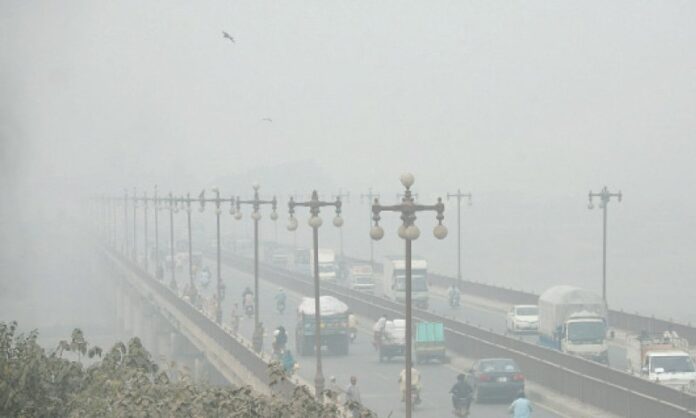
A cruel irony permeates the air we breathe in Lahore: a city that once welcomed winter fogs is now drowning in toxic air. Every exhalation is a borrowed breath, and every breath of air is a cocktail of chemicals, smoke, and dust. Smog is now a plague that keeps returning rather than a summertime annoyance.
For years, our sky had been gray with little thought. Brick kilns, burning crop residue, vehicles, dusty unpaved roads, and industrial smoke all blended together to gradually poison the air. In actuality, what we had referred to as winter smog was actually a time bomb that had steadily accumulated and turned our lungs into landfills. Over the years, the disdain for the environment developed.
But suddenly something is different. It appears that the Punjab administration is the first to view smog as a structural challenge that needs to be handled with systems rather than words, rather than as a periodic annoyance that should only be partially addressed.
At the heart of this change is measurement. After starting with just three operational monitoring stations, the province now has 75 fixed stations, 10 mobile units, and plans to add 25 more by the end of the year. Authorities will now be able to identify the enemy thanks to improved information.
Measurement led to prediction, which in turn led to preparation. With the help of satellite data, a newly created AI-based predictive model can now forecast smog waves up to one week in advance. Together with a central Smog War Room connected to divisional weather centers, law enforcement organizations, and dashboards to manage real-time data, this network can detect threats and take preventative action.
It won’t happen quickly. However, it has to be genuine. None of the parties are present in the air we breathe today. Every citizen, every child, and every future generation has it. Additionally, clean air is no longer a luxury, even though it used to be a privilege.
Smog is not produced by a single source. Unpaved road dust, open construction fugitive dust, and loose public works fugitive dust are major contributors to wintertime particle pollution, according to recent studies that included a source apportionment exercise. In order to combat this, Punjab erected 15 truck-mounted dust suspension devices, or high-capacity mist cannons, each of which can suppress dust across a distance of 120 meters. In construction zones, dust-control SOPs including installing fences and sprinkling water are now mandatory.
Vehicle and industrial emissions are also receiving attention. To evaluate the quality of fuel sold, the province has set up fuel-testing laboratories in major cities for the first time, with the help of mobile units. Over 260,000 cars have been screened this year using its new emission-testing system, which comprises 100 analyzers and multiple fixed sites across Lahore.
The concept of symbolic and uneven enforcement is being revised. A network of quick-response centers and AI-connected surveillance services operate along with a new Environmental Protection Force of 250 cops on electric bikes, equipped with cameras on their bodies and digital reporting. Through a green app, a bilingual hotline, or a WhatsApp chatbot, citizens may file complaints, and over 96% of the cases have now been resolved.
Agriculture and industry, which have received little attention in smog debates, have been included in the proposal. Additionally, drone surveys, digital mapping, ID assignments, and requests to improve clean-production techniques are being made for the brick kilns that are prone to fire. Over 13,500 industries have now been identified, and many of them have received low-interest loans to update their emission control systems. As part of the new Climate Resilient Punjab Vision and Action Plan 2024, stubble burning, a traditional but detrimental agricultural practice, is being tackled via satellite notifications, mechanized harvests, subsidized machinery, and incentives.
Instead of using ad hoc fixes, we are witnessing a systemic solution rather than a bandaid one. Boilers or dumping water on them do not result in environmental recovery. It happens gradually; all dusty roads are paved, all trees are planted, and all filthy fuels are prohibited. It takes place on a regular basis with people’s participation and clear regulations. It is training, not acting.
However, there remains opposition to this notwithstanding the implementation of these measures. The amount of harmful air quality in cities like Lahore keeps rising. Opponents also point out that some options, like mist cans, are water-intensive and may only be a temporary solution rather than a long-term one.
However, temporary discomfort should not be mistaken for failure. The fact that fuel testing didn’t exist until a year ago, that dust suppression, which was previously thought of as cosmetic, is now part of official policy, and that vehicle emission testing has screened hundreds of thousands of vehicles are all indicators of intent, capability, and most importantly, seriousness. The only thing left for citizens, business, and policymakers to do is make a commitment.
It is undeniable that environmental recovery is not a glamorous process. It doesn’t garner media attention. However, it restores respect to our skies, heals lungs, and saves lives. We are forced to spend time because it takes time. Because each breath of contaminated air costs us not just a little discomfort but also our productivity, health, and the lives of future generations.
We will eventually look back and say, “That was the time we reclaimed our air,” if Punjab continues on this path of scale, forecast, imposition, reform, and citizen participation. At this point, the promise of pure air began to define our winters instead of pollution.
It won’t happen quickly. However, it has to be genuine. None of the parties are present in the air we breathe today. Every citizen, every child, and every future generation has it. Additionally, clean air is no longer a luxury, even though it used to be a privilege.