
















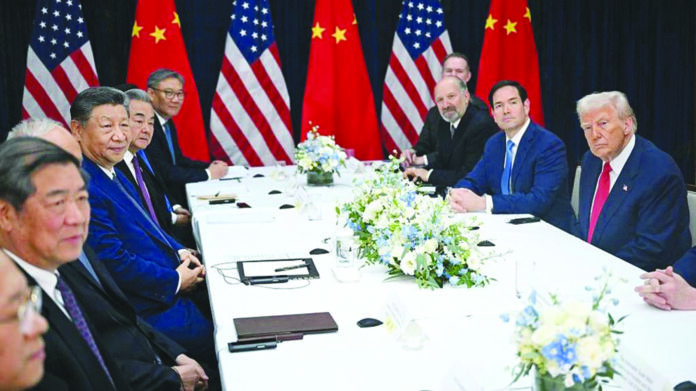
The last great scramble for strategic advantage was fought with tank columns and tanker convoys; the next will be fought with magnets so tiny they can sit on the head of a pin. In late autumn, when the Chinese and US presidents met in Seoul and a bargain was struck, Beijing pausing export curbs on rare earths and promising agricultural purchases, Washington trimming tariffs and shelving punitive export lists, the world did not merely avert a tariff showdown. It witnessed the opening move in a more consequential contest: a race to secure the raw ingredients of tomorrow’s military edge and industrial power. What was negotiated in diplomatic parlours will soon be contested in deserts, mountains and coastal sands. Pakistan sits squarely in that contested geography.
Resource security, the ability to guarantee access to minerals, metals and processing capacity critical for advanced technology, is fast replacing trade deficits as the axis of great-power competition. The 20th century’s oil politics taught the lesson: energy dependence translated into political vulnerability. The 21st century repeats the lesson with different materials. Rare earth elements, lithium, cobalt, copper and their ilk are not merely commodities; they are strategic levers. They power electric motors, satellites, hypersonic missiles and the data centres that run artificial intelligence. Whoever controls them, and crucially, the capacity to process them, holds disproportionate sway over both civilian and military technologies.
China’s rise in this domain was neither accidental nor spontaneous. Beijing invested early and comprehensively in refining and separation capacity, creating chokepoints in the supply chain that a simple tally of mines cannot reveal. That monopoly of processing, far more than the geology of deposits, is what prompted the recent flurry of diplomatic outreach and supply-chain realignment by the USA and its partners. Washington now looks to diversify: reopening old mines, courting friendly jurisdictions, and quietly deepening technical and investment ties to secure alternate sources of feedstock. The point is not merely to replace Chinese suppliers but to reduce strategic vulnerability.
Pakistan’s place in this emergent contest is awkward and potentially epochal. Geological surveys and recent discoveries suggest substantial deposits across the country: the Peshawar Alkaline Province, coastal placer sands in Sindh and Makran, copper-gold giants such as Reko Diq, the latter expected, by some estimates, to produce 200,000 tonnes of copper annually from 2028 and to generate tens of billions in wealth over decades. Add lithium prospects in the Eastern Hindu Kush, gemstones, antimony and other strategic minerals, and the map takes on new gravity. Yet mining today accounts for a sliver of national output; governance, technology and social consent lag far behind geological promise.
That asymmetry, wealth beneath our feet and institutional fragility above it, is precisely what sets off alarms. China’s long-standing presence through CPEC, Gwadar and industrial linkages gives it an established pathway to integrate any future extraction into its global logistics and processing networks. For Washington, the calculus is simple: let strategic materials flow unmediated through Chinese-built corridors, and you accept a new vector of dependence. Hence the renewed US overtures, tariff negotiations and mineral cooperation forums. Add Russia and Iran to the chessboard, each with their own strategies and openings, and Pakistan becomes less a partner and more a prize.
The Seoul meeting highlighted that geopolitics now hinges on molecules and supply chains as much as armies. Pakistan’s choice is clear: let raw wealth flow abroad or use minerals to drive industrialization, jobs, and resilience at home. Success requires institutions with rare political will. Managed prudently and transparently, the new great game can become a growth story; fail, and the country risks being carved into spheres of influence. History will not ask if the minerals were ours, but whether we used them to build a sovereign, prosperous state.
The history of great-power competition offers a blunt lesson: the presence of strategic commodities invites external leverage and internal fracture unless the host state governs the process. Oil taught this in the 20th century; rare earths and lithium risk teaching it in the 21st. Pakistan must therefore do what weaker states in resource zones have failed to do elsewhere: convert geological bounty into durable public benefit while managing external overtures on its own terms.
This is not a call for naïve neutrality. It is a prescription for leverage through competence. First, the state must draw a clear, transparent roadmap for the sector: a national rare earth strategy, an implementation arm empowered by the National Security Committee and anchored in the Mines and Minerals Act 2025. The forum held in April and the Act’s reformist intent are promising signals; success will depend on consistent enforcement, not intermittent announcements.
Second, value addition must be the north star. Raw exports are a one-time cheque. Processing, refining and downstream manufacturing create jobs, skills and a tax base that can underwrite resilience. That requires closing technology gaps, through conditional partnerships that demand local refining capacity, technology transfer and skill development rather than simple extraction contracts that strip minerals and export them for processing abroad.
Third, the social and environmental bargain must be honored. Communities in mineral-rich districts have long borne the costs of extraction: water stress, pollution and limited economic spillovers. A credible revenue-sharing model, enforceable environmental safeguards and genuine local participation are not merely ethical necessities; they are security instruments. They blunt insurgent narratives and create local constituencies in favor of orderly development.
Fourth, Pakistan must diversify partnerships and ensure transparency. Relying on one patron may yield short-term gains but risks dependency. A multilateral framework with regional, Western, and private partners can reduce strategic vulnerability, while procurement should be audited and guarantees used sparingly.
Finally, the state must protect sovereignty over transit and logistics. Minerals are only as valuable as the routes that carry them. Gwadar is valuable in itself; its true strategic cost or advantage will be determined by who controls the nodes where minerals are processed and shipped. Pakistan must ensure that port access, rail links and export corridors preserve national oversight and do not become opaque conduits for external strategic capture.
The Seoul meeting highlighted that geopolitics now hinges on molecules and supply chains as much as armies. Pakistan’s choice is clear: let raw wealth flow abroad or use minerals to drive industrialization, jobs, and resilience at home. Success requires institutions with rare political will. Managed prudently and transparently, the new great game can become a growth story; fail, and the country risks being carved into spheres of influence. History will not ask if the minerals were ours, but whether we used them to build a sovereign, prosperous state.



Orlistat from canada [url=http://skaypharm.com/]cialis sky pharmacy[/url] Cialis kaufen [url=http://northwestpharmacycanadaprescriptions.com/]canadian pharmacy cialis 5mg[/url] [url=http://skyapharmacy.com/]canadian pharmacies mail order[/url] [url=http://mednowca.com/]hq canadian meds[/url] [url=http://northwestpharmacydrugstore.com/]canadian pharmacies that accept paypal[/url] [url=http://canadian24hourepharmacy.ru/]canadian pharmacy[/url]. Canadian pharmacies shipping to usa Canada meds no perscriptions
купить аттестат в москве за 11 класс r-diploma3.ru – купить аттестат в москве за 11 класс .