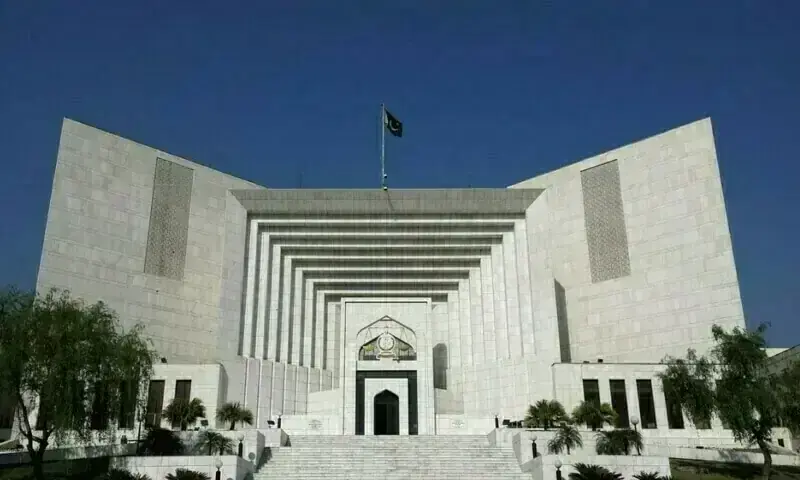
Top court rules plaints can’t be rejected merely on belief that allegations may be difficult to prove
The Supreme Court of Pakistan ruled courts can’t reject a plaint under Order VII Rule 11 merely because allegations may be difficult to prove. It revived a suit tied to a disputed Rs65 million property transaction.

SC says courts can’t decide merits of cases at preliminary stage by assessing evidence or truth of allegations
Judgment clarifies difference between existence of cause of action and its eventual proof under CPC
Majority verdict sets aside IHC order, revives suit involving disputed Rs65 million property transaction
ISLAMABAD: The Supreme Court of Pakistan has ruled that a plaint cannot be rejected under Order VII Rule 11 of the Code of Civil Procedure (CPC) simply because a court believes the plaintiff may ultimately fail to prove the allegations, clarifying that cases involving disputed facts must proceed to trial where evidence is recorded and claims are properly examined.
The apex court held that where a plaint contains the essential facts establishing a legally recognizable cause of action, it cannot be dismissed at the preliminary stage without conducting a proper trial. The court emphasised that the power to reject a plaint under Order VII Rule 11 is limited to examining whether the pleadings, if accepted as true, disclose a legal right and a cause of action.
A three-member bench comprising Justice Jamal Khan Mandokhail, Justice Shahid Waheed and Justice Muhammad Shafi Siddiqui announced the verdict on a petition filed by citizen Nisar Ahmad Afzal. The majority judgment was authored by Justice Shahid Waheed, while Justice Muhammad Shafi Siddiqui recorded a dissenting opinion.
The Supreme Court set aside the judgments of the Islamabad High Court and the trial court, restored the plaintiff’s suit and remanded the matter to the trial court for a fresh decision in accordance with law after recording evidence.
In its detailed judgment, the court observed that proceedings under Order VII Rule 11 are confined to determining whether the facts stated in the plaint, assuming them to be correct, establish a cause of action. At this stage, the court cannot examine evidence, assess the credibility of allegations or determine whether the plaintiff is likely to succeed in the case.
The judgment highlighted the fundamental distinction between the existence of a cause of action and its eventual proof. It stated that once a plaint contains the material facts required to establish a legal claim, it cannot be rejected merely because the court considers that proving those facts may be difficult. Doing so, the court observed, would effectively amount to deciding the merits of the dispute before a full trial, which is impermissible under the law.
According to the judgment, the plaintiff had alleged that he sold a property situated in Sector F-11/2, Islamabad, for PKR 65 million on the basis of trust. However, the agreed sale consideration was allegedly not paid, while ownership of the property was transferred in the purchaser’s name in violation of the agreement.
The Supreme Court held that these allegations, on their face, raised claims of fraud and deceit, and their truthfulness could only be determined after recording evidence during the trial.
The majority judgment noted that the subordinate courts had mistakenly treated the possible difficulty in proving the plaintiff’s allegations as equivalent to the absence of a cause of action, whereas both concepts were legally distinct.
in his dissenting note, Justice Muhammad Shafi Siddiqui took a different view, observing that the property had been transferred voluntarily and that there was an agreement for payment of the sale consideration at a later stage. He held that in case of non-payment, the appropriate legal remedy was recovery of the sale price rather than cancellation of the property transfer.
The dissenting judge concluded that the trial court and the Islamabad High Court had correctly rejected the plaint, maintaining a different interpretation of the legal issues involved.
Comments
No comments yet. Be the first to join the discussion!