Sonam Wangchuk urges supporters to back cause as Delhi hunger strike enters 19th day
Sonam Wangchuk has asked supporters to back the demands of a youth-led protest rather than focus on ending his hunger strike in New Delhi. The sit-in, now in its 19th day, is demanding India’s education minister resign over exam paper leaks.

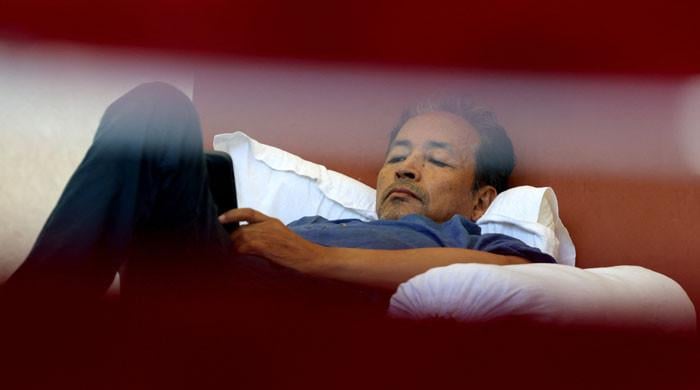
NEW DELHI: Indian activist and educationist Sonam Wangchuk has urged supporters to focus on the protest’s demands rather than on persuading him to end his fast, as his hunger strike at Delhi’s Jantar Mantar entered its 19th day.
Vijeta Dahiya, spokesperson for the Cockroach Janata Party (CJP), said Wangchuk’s physical condition had weakened during the protest. Dahiya said Wangchuk, who is nearly 60, had lost muscle mass and was struggling in the heat and humidity, adding that he had also appeared dizzy. Wangchuk is widely known in India and internationally for water conservation work, including the ice stupa innovation, which communities in Pakistan’s Baltistan region have also tried to replicate. He is also a recipient of the Ramon Magsaysay Award.
The sit-in at Jantar Mantar began on June 20 with a demand for Education Minister Dharmendra Pradhan’s resignation after question papers for the National Eligibility-cum-Entrance Test (NEET), a highly competitive medical college entrance examination, were leaked and the test was later cancelled. Dahiya said paper leaks had recurred over the years and added that, according to the movement’s records, 22 students died by suicide after this year’s NEET paper leak.
Filmmaker and author Natasha Badhwar, who visited Wangchuk with a group of journalists, described his message to supporters in direct terms.
He told us not to save him or ask him to stop his hunger strike and instead put the same energy into the cause and press the government to listen to the demands of the youth.
Protest draws youth and public figures
Dahiya said many young people had joined the hunger strike alongside Wangchuk since the protest began. While some stopped after their health deteriorated, others were continuing, and Dahiya said around 30 people in total had taken part, with more observing fasts from their homes for varying periods.
Badhwar said hunger strikes were part of a longer tradition of non-violent protest in India, tracing that legacy to Mahatma Gandhi. She also referred to other such movements, including protests against dams and anti-corruption campaigns. She noted that environmentalist Professor G.D. Agrawal, also known as Swami Sanand, died in 2018 on the 111th day of a hunger strike for stronger protection of the Ganges.
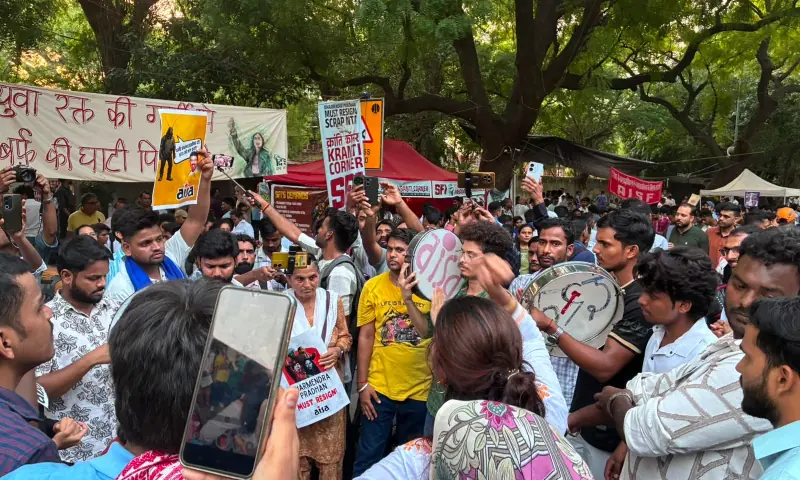
Describing the scene at Jantar Mantar, Badhwar said the site was crowded, noisy and overwhelming, but still felt safe. She said the protest space combined banners, security personnel, television cameras, food stalls, conversations, performances and interviews, creating what she called a strong sense of solidarity. She said seeing young people and ordinary citizens gather in person was reassuring at a time when much public discussion takes place online.
Dahiya said organisers had repeatedly appealed to participants to remain peaceful and egalitarian, invoking Mahatma Gandhi and B.R. Ambedkar, and added that there had been no reported incidents of misconduct towards women. Badhwar also said the venue had remained orderly and safe despite drawing thousands of visitors over nearly a month in intense summer conditions.
Government absence and planned march
According to Dahiya, the protest has attracted not only members of the public but also well-known figures and politicians, while no government representative has visited the site. Badhwar described the hunger strike as a desperate step taken at a difficult time and said remaining visible in public had become important because, in her view, neither the mainstream media nor the government appeared to be paying much attention.
Attention is now turning to July 20, when CJP members plan to march from Jantar Mantar to Parliament while lawmakers are in session. Dahiya said organisers had asked potential participants to register through a missed call and, based on responses received so far, were expecting several thousand people, although actual numbers would only be clear once the march began.
Badhwar said such a march carried risks, recalling earlier street protests and warning that confrontation with opposing groups could lead to violence. She also referred to the 2020 protests against the Citizenship Amendment Act, saying many first-time women protesters were detained and that activists say some are still imprisoned on what they describe as fabricated charges.
Dahiya said the movement remained committed to non-violence.
There will be no vandalism and no violence. It will be nothing like what happened in Nepal, Bangladesh or even Sri Lanka. India will show to the world that peaceful resistance can bring in change.
Comments
No comments yet. Be the first to join the discussion!