SC reserves ruling on NAB bail jurisdiction after FCC dispute
The Supreme Court has reserved its ruling on whether bail applications in pending NAB appeals fall within its jurisdiction or must be transferred to the Federal Constitutional Court. The bench heard competing arguments from the federal government and defence counsel.

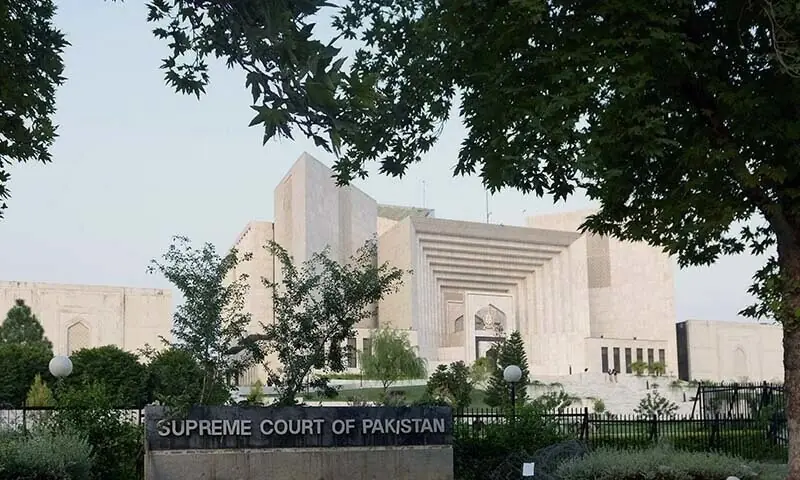
ISLAMABAD: The Supreme Court on Thursday reserved its decision on a jurisdictional question over whether it can continue hearing bail applications in pending National Accountability Bureau appeals or whether such matters must now go before the newly formed Federal Constitutional Court under the 27th Constitutional Amendment.
A three-member bench headed by Justice Muhammad Ali Mazhar, and comprising Justice Musarrat Hilali and Justice Shahid Bilal Hassan, heard arguments on whether bail pleas in pending NAB appeals fall within the class of cases that must be transferred to the FCC. While wrapping up the proceedings, the bench indicated that its ruling could be announced within a day or two.
Dispute over forum for bail pleas
The federal government told the court that both appeals and bail applications in pending NAB matters should now be heard by the FCC. The issue arose in the context of changes introduced through the 27th Amendment and a recent amendment to the NAB law.
Appearing for under-trial prisoner Aamir Mahmood, senior counsel Ibadur Rehman Lodhi argued that bail requests by under-trial prisoners were governed by Section 497 of the Criminal Procedure Code, which deals with grant of bail, and not Section 426, which concerns suspension of sentence by an appellate court for a convicted person, with release on bail during the pendency of appeal.
He contended that the newly inserted Section 32-A of the NAB law, added through the NAB Amendment Act on March 5, applied to second appeals against convictions handed down by high courts. According to the amendment, any person convicted, or the Prosecutor General Accountability if so directed by the NAB chairman, may file a second appeal before the FCC within 30 days if aggrieved by a high court decision under Section 32.
Lodhi maintained that in pending matters, the Supreme Court remained competent to hear bail applications under Section 32 of the NAB law. He argued that in NAB cases only appeals against a high court’s final ruling were to go to the FCC, whereas if bail was declined by a high court, the matter could still be taken to the Supreme Court. He also said Section 32 of the National Accountability Ordinance did not apply to bail questions.
Bench observations during hearing
Justice Mazhar observed that the court was not examining Parliament’s intent in amending the NAB law. He added that the Supreme Court had not given up its authority, but the 27th Amendment provided that appeals would go to the FCC.
During the hearing, Justice Mazhar questioned how the Supreme Court could act as an appellate forum in bail matters when the NAB law pointed to the FCC as the appellate court. He asked the defence counsel to identify a legal basis on which the Supreme Court could continue hearing bail applications in NAB matters and suggested the court was seeking a workable middle course.
At one stage, Lodhi responded:
“For God’s sake, the Supreme Court should not surrender its authority for some ‘clandestine’ motives of the government,”
He added that the court should retain at least some semblance of authority.
Justice Mazhar also asked whether, if a bail application were converted into an appeal, the Supreme Court would effectively become an appellate forum, noting that when the court granted bail to an accused, the application was converted into an appeal. He further reminded counsel that under Article 199, appeals from high court decisions were to be dealt with by the FCC, and asked whether there was any precedent for the Supreme Court hearing a matter despite not being the forum of appeal.
Lodhi replied that the law conferred appellate jurisdiction on the FCC only against high court decisions in NAB cases and did not expressly authorise that court to hear bail matters. He stressed that the March 5 amendment used the term appeal and did not refer to bail.
Justice Mazhar also raised the question of whether the Supreme Court might still have some other supervisory role under the law. Attorney General for Pakistan Mansoor Usman Awan told the bench that in the past the Supreme Court had decided bail matters after examining the entire case, citing the example of Khawaja Saad Rafique’s bail.
Comments
No comments yet. Be the first to join the discussion!