

Russia launches Soyuz crew to ISS as NASA chief makes rare Baikonur visit
Russia launched a Soyuz crew carrying one American astronaut and two Russian cosmonauts to the ISS from Baikonur on Tuesday. The mission coincided with a rare visit by NASA's chief to Russia's launch site.

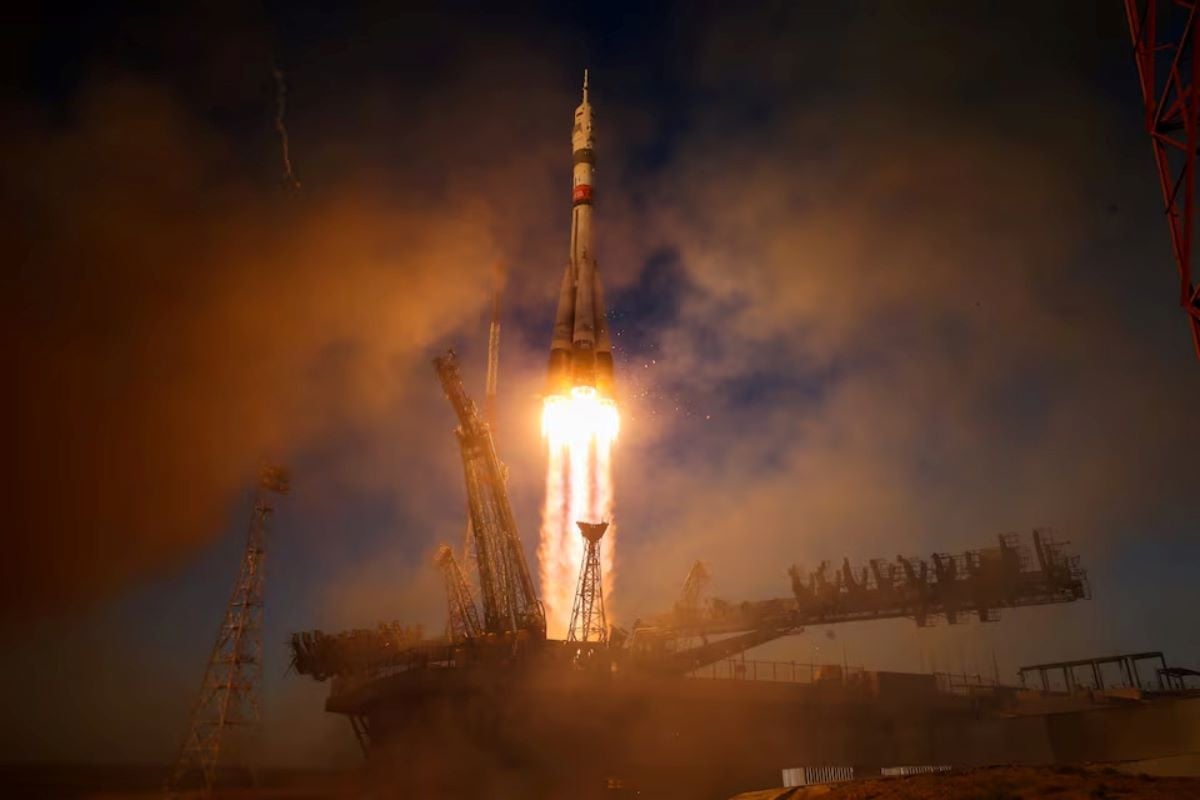
WASHINGTON: Russia on Tuesday launched two cosmonauts and one American astronaut to the International Space Station from Kazakhstan, marking the return of crewed flights from a launchpad that had recently undergone repairs.
US astronaut Anil Menon and Russian cosmonauts Pyotr Dubrov and Anna Kikina lifted off aboard the Soyuz MS-29 spacecraft from the Baikonur Cosmodrome at 10:47am EDT, or 1447 GMT. They were headed to the ISS for a mission of about eight months as the station's 75th rotation crew. The spacecraft reached the orbital outpost a little more than three hours later while passing over the Mediterranean Sea, where the trio joined three Americans, two Europeans and two Russians already on board.
The launch was also notable for the joint presence of NASA Administrator Jared Isaacman and Roscosmos Director Dmitry Bakanov at Baikonur. It was the first time since 2018 that a NASA chief had visited the Russian launch site. Tensions linked to the Russia-Ukraine war had largely kept Bill Nelson, who led NASA under former US president Joe Biden, from making similar visits.
The Expedition 75 mission is Menon's first trip to space. Menon, 49, is married to SpaceX engineer Anna Menon, who flew with Isaacman and two others on the privately funded Polaris Dawn mission in 2024. Dubrov, 48, and Kikina, 41, are each on their second spaceflight. Kikina is the only woman among Russia's 23 active cosmonauts and was also the first Russian to travel to the station aboard SpaceX's Crew Dragon, on an October 2022 mission that revived joint US-Russian astronaut exchanges.
After the launch, Isaacman praised the American crew member in a post on X.
Anil has spent his entire life preparing for this moment. He is a scholar, military officer, physician, pilot, husband, father and will undoubtedly become one of the great American astronauts.
ISS cooperation amid wider tensions
Cooperation between NASA and Roscosmos on the 27-year-old International Space Station has continued despite years of broader strain between Washington and Moscow, including over Russia's war in Ukraine. The partnership has endured largely because of technical dependence: US solar arrays provide power for the whole station, while Russian thrusters help maintain its orbit.
At the same time, both countries regard the ISS as important to preserving their human spaceflight programmes, even as the increasing militarisation of Earth's orbit has added another source of friction between them.
The ageing station has also brought operational disputes. Air leaks on the ISS have at times strained ties between the two agencies, which have disagreed over how to locate and address the source of the problem. Last month, NASA instructed its astronauts to prepare for a possible evacuation during a disagreement with Russia over one such leak. A cosmonaut on board had planned to use a saw to open a compartment believed to contain the source, prompting concern among NASA officials.
The condition of the station, which is expected to be retired soon after 2030, was likely among the matters discussed during Isaacman's meetings with Russian space officials. A video posted by Roscosmos on Telegram showed Isaacman speaking with Bakanov while senior Roscosmos officials stood nearby. NASA and Roscosmos did not immediately respond to questions about the meeting.
Bakanov had travelled to Florida last summer to observe a joint US-Russian astronaut launch on a SpaceX capsule. During that visit, he met then-acting NASA chief Sean Duffy to discuss the ISS and possible cooperation related to the moon, although no agreements or new projects emerged from the talks.
Launch site returns to service
The mission also underscored the return to use of Baikonur's Site 31 for crewed launches. The last crewed launch from that site had severely damaged the historic pad, leaving Russia's only launch site capable of sending people into space out of action for months while repairs were carried out. Russia resumed flights from the pad in March with an uncrewed cargo mission to the ISS.
Comments
No comments yet. Be the first to join the discussion!


