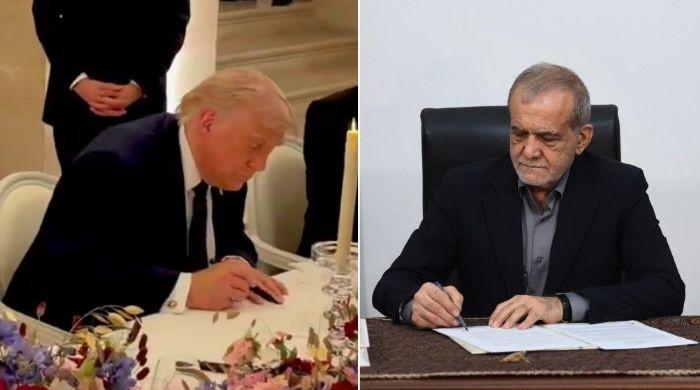
Iran ‘quits’ Islamabad MoU, vows to defend 'every inch' as Hormuz crisis deepens
Iran withdraws from the Islamabad MoU, accusing the US of repeated violations that made the deal void. President Pezeshkian vows to defend “every inch” as Hormuz tensions deepen.

Tehran accuses Washington of dismantling Islamabad Memorandum through repeated violations and declares agreement ‘no longer binding’
President Pezeshkian vows Iran will defend every inch of its territory as fresh attacks intensify regional tensions
Trump drops proposed 20% Hormuz transit fee, seeks Gulf trade and investment deals instead
Iran introduces bill to regulate transit through Strait of Hormuz, says more measures are on the way
Oman reiterates neutral mediation role, urges all parties to uphold international law and freedom of navigation
Tehran tells UN Security Council the US systematically undermined the Islamabad MoU and continued acts of aggression
Iran claims strikes on US military assets in Kuwait and a US base in Jordan as Washington presses ahead with fresh attacks
TEHRAN/WASHINGTON/MUSCAT: Iran on Tuesday vowed to defend "every inch" of its territory and announced it was withdrawing from the Islamabad Memorandum of Understanding (MoU), accusing the United States of systematically violating and ultimately dismantling the agreement, as military exchanges, diplomatic tensions and competing claims over the strategic Strait of Hormuz further heightened the regional crisis.
Iranian President Masoud Pezeshkian issued a defiant response to recent remarks by US President Donald Trump, who had claimed that the United States had destroyed the bulk of Iran's military capabilities.
Responding to Trump's comments, Pezeshkian questioned whether Washington had achieved its objectives on the battlefield.
"Their rhetoric continues, but the question is – have they reached their goals on the battlefield?" Pezeshkian said in televised remarks, according to Al Jazeera.
"The people who decided to try to tear apart our country – what have their actions ultimately achieved?" he asked.
"We will defend every inch of our homeland with our actions."
Meanwhile, Iran's Deputy Foreign Minister Kazem Gharibabadi declared that Tehran was no longer bound by the Islamabad MoU with the United States, saying Washington had itself rendered the agreement void.
"America not only violated the memorandum of understanding but also dismantled it," Iran's state broadcaster IRIB quoted Gharibabadi as saying.
"The failure to implement one of the clauses was enough to collapse the entire memorandum of understanding, and now America has violated all of its obligations."
Trump rejects transit fee, backs Gulf investment
Earlier, US President Donald Trump said no country should be allowed to charge transit fees for passage through the Strait of Hormuz.
"We would like to invest tremendously in the United States as opposed to charging a fee. And I like that actually because I don't think anybody should be able to charge a fee for the strait or for any other strait relationship in terms of other sections of the world," Trump said during a meeting with Iraqi Prime Minister Ali al-Zaidi at the White House.
Trump said Gulf states had expressed willingness to increase investments in the United States instead of relying on transit charges.
"The Gulf states are going to invest a tremendous amount of money into the US, and that was very satisfactory to me. I think it's actually much better," he said.
The US president said he had spoken with the leaders of Saudi Arabia, the United Arab Emirates, Qatar, Bahrain and Kuwait.
"I spoke to all of them, and they would love to invest more money in the United States at record amounts, and that would be very acceptable. This way, there's no fee. I don't like the concept of a fee."
Trump argued that it was unfair for the United States to shoulder responsibility for protecting one of the world's most strategic maritime routes without receiving broader economic benefits.
"It's not fair that we're protecting this strait for the entire world," he said.
Asked whether he regretted lifting the naval blockade or granting sanctions waivers, Trump said he had given diplomacy an opportunity but blamed Iran for escalating the conflict.
"No. I gave them a chance. I wanted to give them a chance at making a deal ... and they shot first, and that was a big mistake because we have been knocking the hell out of them," he said.
Later, Trump formally abandoned his earlier proposal to impose a 20 per cent fee on all cargo transiting the Strait of Hormuz, saying trade and investment agreements with Gulf countries would replace the plan.
"Based on highly productive conversations with Middle East leadership, I have decided to replace the 20% United States reimbursement fee with trade and investment deals that the various Gulf states will be making into the United States," he wrote on Truth Social.
— Rapid Response 47 (@RapidResponse47) July 14, 2026
Trump did not cite any specific commitments, but said investments would be "massive" while remaining beneficial for Gulf countries.
Shortly after his original proposal on Monday, the United Nations' shipping agency said it opposed imposing fees on ships passing through international waterways but would await further details.
In another Truth Social post on Tuesday, Trump announced that while the Strait of Hormuz remained open to international shipping, Iranian-linked vessels would face renewed restrictions.
"We will therefore have a full blockade, but only on ships coming to and from Iranian ports, or carrying anything to do with Iranian cargo," he wrote.
Iran moves to regulate Hormuz transit
An Iranian lawmaker said a bill had been submitted to parliament to regulate transit through the Strait of Hormuz amid escalating tensions with the United States.
Ebrahim Azizi, chairman of parliament's National Security and Foreign Policy Committee, said the legislation had been submitted "last night, coinciding with the downing of US drones."
"We remain steadfast in defending our red lines, particularly regarding the management of the Strait of Hormuz," he wrote on X.
شب گذشته همزمان با انهدام پهپاد های آمریکایی، طرح "اقدام راهبردی تأمین امنیت و پیشرفت پایدار تنگه هرمز و خلیج فارس" در صحن علنی مجلس اعلام وصول شد.
مجلس شورای اسلامی محکم و استوار بر روی خطوط قرمز به ویژه مدیریت تنگه هرمز ایستاده است. این اولین قدم است، اقدامات بعدی خواب را از…— ابراهیم عزیزی (@Ebrahimazizi33) July 14, 2026
"This is the first step; subsequent measures are forthcoming."
Oman reiterates neutral role
Oman said it continued its "transparent and neutral cooperation" with all parties to restore freedom of navigation through the Strait of Hormuz.
"Oman continues its transparent and neutral cooperation with all parties to restore freedom of navigation in the Strait, in full compliance with international law," the Foreign Ministry said.
#بيان | في ضوء المناقشات والأطروحات المتصلة بالملاحة في مضيق هرمز، تؤكد وزارة الخارجية أن سلطنة عُمان تواصل تعاونها الشفاف والمحايد مع جميع الأطراف لاستعادة حرية الملاحة في المضيق، بما يتوافق تماماً مع القانون الدولي. وتؤكد سلطنة عُمان التزامها الكامل بواجباتها كدولة طرف في… pic.twitter.com/6D6XaKXAjj
— وزارة الخارجية (@FMofOman) July 14, 2026
"The Sultanate of Oman remains fully committed to its obligations as a State Party to the United Nations Convention on the Law of the Sea and calls on all parties to respect and abide by international law."
Iran links reopening of Hormuz to its rights
Iranian military spokesman Mohammad Akraminia said the Strait of Hormuz would not reopen through military pressure.
"The Strait of Hormuz will never reopen through US attacks, war or evil. The only way to reopen it is by respecting the rights of the Iranian people," he said, according to Iranian state television.
Akraminia also said Iran remained committed to avenging those killed during the war, including former supreme leader Ali Khamenei.
Shipping industry opposes transit charges
German shipping company Hapag-Lloyd said imposing fees for passage through international waters would be "fundamentally wrong."
According to Al Jazeera, the company told Reuters it could not reliably estimate the financial impact of the Gulf crisis on its business.
Israeli attacks continue in southern Lebanon
According to Lebanese media outlet El-Nashra, explosions occurred in Safita on the southern outskirts of Yahmar al-Shqif following Israeli attacks, while additional explosions were reported in Kfar Tebnit.
Israeli forces also demolished several residential homes in Majdel Zoun in the Tyre district and Haddatha in the Bint Jbeil area early Tuesday, while Bayut al-Siyad came under artillery shelling.
Iran claims strikes on US assets
According to Iran's state news agency IRNA, the Iranian Army said it had carried out drone and missile strikes against US military assets in Kuwait, including communication systems, fuel depots, Patriot missile batteries, a control tower and an ammunition warehouse.
The army also claimed its navy targeted a hostile American vessel with cruise missiles in response to US attacks.
Iran lodges complaint at UN
Iran submitted a letter to UN Secretary-General Antonio Guterres and the president of the UN Security Council, accusing the United States of violating the Islamabad Memorandum of Understanding and continuing acts of aggression.
Iran's Permanent Representative to the United Nations, Amir Saeid Iravani, wrote:
"Almost immediately after the signing of the Memorandum, and continuing to the present day, the United States has not only failed to honour its commitments but has actively and systematically undermined the very foundations of the Memorandum."
Iran claims strike on US base in Jordan
Iran's Islamic Revolutionary Guard Corps (IRGC) said Iranian ballistic missiles had targeted a US air base in Jordan, while urging Jordanians to dismantle American military bases.
Jordan's armed forces, however, said they intercepted and destroyed four missiles that entered the kingdom's airspace from Iranian territory.
Meanwhile, the US military conducted a third consecutive night of strikes against Iran after President Trump reinstated a blockade on Iranian shipping.
US Central Command said the operation began after Trump publicly warned that Iran would be hit "very hard."
Bahrain also announced that its air defence systems had intercepted and destroyed Iranian aerial attacks over the kingdom.
Earlier, Trump declared on Truth Social that the Strait of Hormuz would remain open while reaffirming a blockade targeting Iranian shipping.
"The Hormuz Strait is OPEN, and will remain OPEN, with or without Iran. We are reinstating THE IRANIAN BLOCKADE," he wrote.
Iran's top joint military command rejected Trump's assertions, saying Washington had no authority over the future of the strategic waterway.
Iranian Foreign Minister Abbas Araghchi also insisted that Tehran remained the guardian of the Strait of Hormuz.
Responding to Trump's earlier proposal, Araghchi remarked on X: "20% is of course too much. We will be fair."
UAE says Iranian missiles struck oil tankers in Strait of Hormuz, one sailor killed
One Indian crew member was killed and eight others were wounded when two Emirati oil tankers were struck by Iranian cruise missiles in the Strait of Hormuz, the United Arab Emirates Ministry of Defence said on Tuesday, in the latest escalation in the strategic waterway.
Abu Dhabi National Oil Company's shipping arm, ADNOC L&S ADNOCLS.AD later confirmed the very large crude carriers (VLCCs) Mombasa B and Al Bahyah were struck while transiting Hormuz and had sustained "significant damage".
UAE state oil giant ADNOC has been among the most active participants in a U.S. military-led operation to move Gulf crude out to international buyers through ship-to-ship (STS) transfers beyond the Strait of Hormuz, Reuters reported last month. US Central Command, which has not acknowledged the STS transfers, said on July 12 it had facilitated the transit of more than 800 vessels and over 400 million barrels of crude through the strait over the previous two months.
The UAE defence ministry said the tankers were targeted in the southern lane of the strait while in Omani territorial waters. The dead crew member was aboard the Mombasa, it said.
Of the eight wounded, four were seriously injured. Six of the wounded were Indian nationals and two were Ukrainian nationals, the ministry said.
The attacks caused material damage to both tankers after fires broke out on board. The ministry said the fires had been brought under control.
It condemned what it called a "blatant attack" and said the UAE retained "its full right to respond to this escalation".
The Islamic Revolutionary Guard Corps (IRGC) said on Tuesday that two "offending" supertankers had been hit and disabled in the Strait of Hormuz after ignoring repeated warnings, turning off navigation systems and attempting to pass through what the Guards described as a mined route.
The IRGC's statement did not name the vessels or say whether it was referring to the same tankers cited by the UAE Ministry of Defence.
In the statement, the Guards accused the US of "inciting vessels to use an illegal route" and said cooperation with the "aggressor enemy" would only result in damage, delays in reopening the Strait of Hormuz and a global energy crisis.
Separately, the United Kingdom Maritime Trade Operations agency said on Tuesday that a tanker had been hit by an unknown projectile while travelling 40 nautical miles northeast of Oman's Qalhat.
UKMTO said the tanker's master reported that the projectile struck the starboard-side engine room and that all crew were safe.
Kuwait condemns Iran’s attack on UAE tankers
Kuwait has denounced Iran’s attacks on two Emirati oil tankers passing through the Strait of Hormuz, which killed an Indian crew member and injured several others, calling it “reprehensible”, according to Al Jazeera.
The country’s foreign ministry described the act as a “flagrant violation of international law” and a “direct threat to the security and safety of maritime navigation and global energy supplies”.
It also expressed its solidarity with the UAE and urged an end to fighting in the region.
Iran rescues vessel crew after collision in Hormuz: Fars agency
Twenty-three foreign crew members have been rescued after a bulk carrier collided with another vessel north of Qeshm Island, in the Strait of Hormuz, according to the semi-official Fars news agency, as per Al Jazeera.
The bulk carrier suffered serious damage to its hull and began taking on water, prompting the captain to order an emergency evacuation, Fars said, adding that all crew members were safely transferred to Qeshm Island.
Iran has shipped 80 million barrels of oil in past 26 days, monitor says
TankerTrackers, a maritime traffic monitor, says Iran has shipped out more than 80 million barrels of crude oil and refined products, which are currently worth $6bn, in the past four-week period, according to Al Jazeera.
But millions more barrels are still awaiting departure, it said.
“Now that the US Navy blockade is being reinstated more than a month ahead of schedule, it appears that around 30 million barrels of Iranian crude oil have yet to depart,” the tracking group said.
“However, there are also more than 60 million barrels of floating storage capacity available within the blockade perimeter should Iran be forced to scale back its oil production.”
4 injured in US strike on southwestern Iran
Four people were injured after projectiles fired by US forces struck the southwestern Iranian city of Omidiyeh early Tuesday, a senior provincial official said.
Valiollah Hayati, deputy governor of Iran's Khuzestan province, said parts of Omidiyeh came under attack at around 2:10 am local time (3:40am PKT Tuesday), according to the state-run IRNA news agency.
"According to initial reports and assessments, four people have been injured in this attack," Hayati said.
Explosions in Bandar Abbas, Kish and Qeshm islands and on Abu Musa Island
Soon after the US military announced renewed strikes on Iran, Iranian media reported explosions in the port city of Bandar Abbas, Iran's Kish and Qeshm islands and on Abu Musa Island in the Gulf.
Iran's Fars news agency said residents in the city of Jam in Iran's Bushehr province also heard several explosions but that the exact location of the blasts was not clear. No casualties were reported. Iranian media reported explosions for more than three hours.
Iran's southwestern Khuzestan province was hit by US projectiles early on Tuesday, Iran's official news agency IRNA reported, citing a provincial security official, adding that four people were wounded and rescue operations were underway. A loud explosion was also heard in Iran's southern city of Bushehr, according to Iran's semi-official Mehr news agency.
Iran's state TV cited the Iranian army as saying that it targeted a "hostile" US vessel with cruise missiles and US facilities and equipment in Kuwait with drones. Iranian media also said Iran's Revolutionary Guards shot down a US MQ-1 drone over Hormuz, while sirens sounded early on Tuesday in Bahrain - home to another US military base.
The incidents, which followed earlier exchanges of missile and drone attacks, extended the hostilities that followed Iran's announcement at the weekend that it was closing the vital waterway, casting further doubt on an interim deal to halt the war and driving oil prices higher.
The UN shipping agency pushed back against Trump's proposal, saying it opposes any fees for straits used in international navigation and stressing that there is no legal basis for introducing mandatory tolls on strait transits.
Trump has previously suggested the US could charge tolls on shipping through the strait, but has not done so and it remains unclear whether he would follow through this time.
The US Navy-led Joint Maritime Information Centre said the blockade would take effect at 2000 GMT on Tuesday and apply to all vessel traffic regardless of flag, covering the entire Iranian coastline including ports and oil terminals.
It said the measure would not impede neutral transit passage through the strait to or from non-Iranian destinations, and that humanitarian shipments would be permitted subject to inspection.
The US Embassy in Abu Dhabi and the US Consulate General in Dubai have cancelled consular appointments from July 13 to 15 due to the regional security situation, the embassy said in a security alert.
Comments
No comments yet. Be the first to join the discussion!