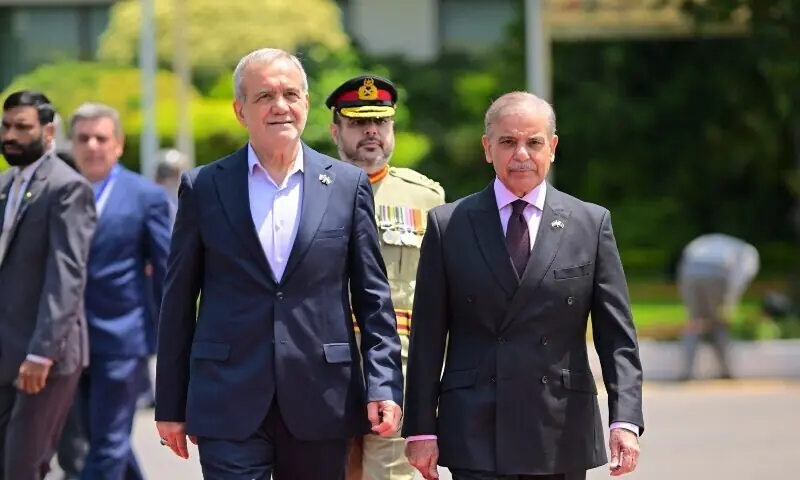
PM urges restraint in call with Iranian president amid renewed regional tensions
Prime Minister Shehbaz Sharif urged Iran and other parties to exercise restraint during a call with President Masoud Pezeshkian, the PMO said. Pakistan also reiterated support for dialogue and the Islamabad MoU amid renewed US-Iran tensions.

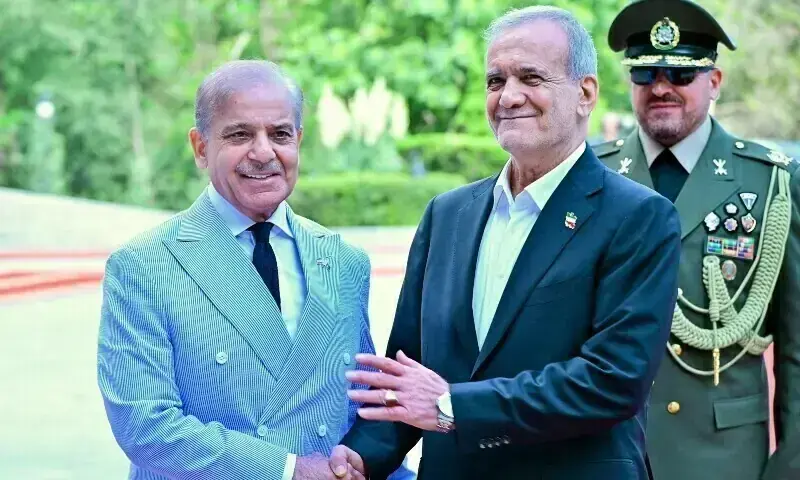
ISLAMABAD: Prime Minister Shehbaz Sharif on Friday urged Iran and other parties involved in the latest Middle East tensions to avoid steps that could undermine recent progress toward peace, during a telephone conversation with Iranian President Masoud Pezeshkian, according to the Prime Minister’s Office.
The PMO said the premier expressed deep concern over the latest escalation and stressed the need to restore calm in the region. In its statement, the office said Shehbaz asked all sides to act with restraint and avoid any move that could reverse diplomatic gains made in recent months.
According to the PMO, the prime minister also emphasised the importance of honouring commitments made under the Islamabad Memorandum of Understanding, which he described as a lasting framework to promote mutual understanding, respect and shared prosperity in the region and beyond. The statement said he reaffirmed Pakistan’s commitment to regional peace and told the Iranian president that Islamabad was ready to continue playing an honest and sincere role in encouraging dialogue and supporting peace efforts between Washington and Tehran.
During the call, President Pezeshkian thanked Prime Minister Shehbaz, Deputy Prime Minister and Foreign Minister Ishaq Dar, Chief of Defence Forces and Chief of Army Staff Field Marshal Asim Munir, and other senior Pakistani leaders for attending the funeral ceremony of late supreme leader Ayatollah Ali Khamenei, the PMO said. It added that the Iranian president also reiterated Tehran’s commitment to peace and appreciated Pakistan’s support and efforts for regional stability.
The Prime Minister’s Office said the two leaders also reviewed progress on decisions taken during Pezeshkian’s visit to Islamabad last month and agreed to speed up follow-up steps. It added that Shehbaz conveyed his good wishes to current supreme leader Ayatollah Mojtaba Khamenei, while both sides agreed to remain in close contact and continue consultations on issues of mutual interest and regional peace.
Foreign Office had also called for restraint
Earlier this week, Pakistan voiced deep concern over the rising tensions in the Middle East after overnight strikes between the United States and Iran. In a statement, the Foreign Office said a fresh conflict would serve no one’s interest and urged all sides to avoid actions that could further damage regional peace and stability.
Pakistan calls on all parties to exercise restraint and refrain from any actions that may further undermine regional peace and stability. There is no alternative to continued engagement, dialogue and diplomacy to achieve [a] shared goal of peace in the region
The current flare-up follows reported attacks by Iran on at least three ships in the Strait of Hormuz in recent days, after which the United States carried out extensive strikes on Iranian targets on Tuesday and Wednesday. Those attacks were followed by retaliatory Iranian strikes on Gulf countries. US forces said their latest operations were aimed at reducing Iran’s ability to threaten freedom of navigation in the strategic waterway, citing recent attacks on commercial ships.
Background to the Islamabad MoU
This was not the first exchange of strikes between the US and Iran despite a ceasefire that had been in place since April. Last month, the United States launched attacks inside Iran in response to what US President Donald Trump said was the downing of a US Apache helicopter. Iran then said it struck bases and other targets in the Gulf in retaliation.
More than a week after those attacks, the Islamabad MoU was signed, giving the two sides 60 days to negotiate a comprehensive agreement on Iran’s nuclear programme and related matters. The arrangement also called for a complete halt to military operations on all fronts.
However, at the Nato summit in Ankara on Wednesday, Trump said the ceasefire was over and warned that the US would strike Iran hard that night. Washington and Tehran then exchanged attacks for a second consecutive day, adding to uncertainty over the future of the understanding reached earlier.
Comments
No comments yet. Be the first to join the discussion!