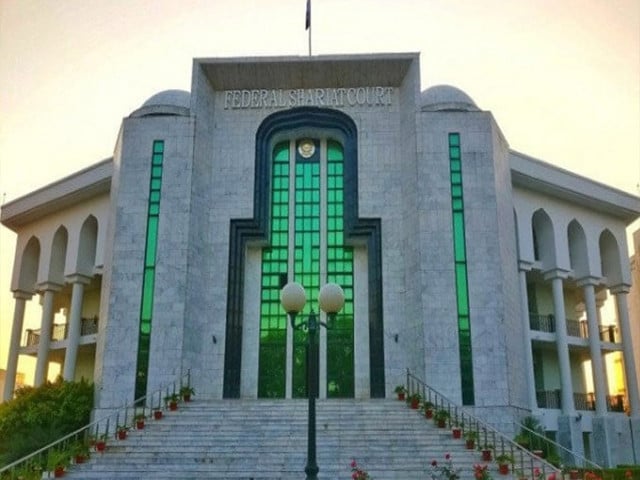
JUI-F moves Federal Shariat Court against Islamabad child marriage law
JUI-F has challenged the Islamabad Capital Territory Child Marriage Restraint Act, 2025 in the Federal Shariat Court. The petition contests the law’s definition of a child and seeks changes to age and sentencing provisions.


ISLAMABAD: Jamiat Ulema-i-Islam-Fazl (JUI-F) has filed a petition in the Federal Shariat Court (FSC) challenging the constitutional validity of the Islamabad Capital Territory Child Marriage Restraint Act, 2025, and seeking a declaration that parts of the law are inconsistent with the Holy Quran and Sunnah.
The petition was filed under Article 203D read with Article 227 of the Constitution. According to the plea, the law’s definition of a child as a person below 18 conflicts with the Islamic concept of puberty, or bulugh, as the threshold for being eligible for marriage. Senior counsel Kamran Murtaza submitted the petition in June.
Challenge to age definition
The petition asks the FSC to declare Section 2(a) of the ICT Child Marriage Restraint Act, 2025 repugnant to the Quran and Sunnah to the extent that it treats pubescent persons as children who cannot contract nikah. It also requests the court to direct the federal government to amend the definition of child so that it excludes those who have attained puberty, whether established by physical signs or, where such signs are absent, by the age of 15 in line with the Hanafi school.
The plea refers to the FSC’s March 6, 2023 ruling in the Ali Azhar case, in which Section 2(a) of the Sindh Child Marriages Restraint Act, 2013 had been challenged. In that case, the court dismissed the petition and held that fixing the minimum marriage age at 18 was not repugnant to the injunctions of Islam.
JUI-F’s fresh petition argues that the 2023 judgment, while driven by concern for children’s welfare and the importance of education, proceeded per incuriam because it relied heavily on the concept of Rushd, or mental maturity, as a condition for marriage, with reference to Verse 6 of Surah An-Nisa. The petition contends that classical Islamic jurisprudence, including the position of Imam Abu Hanifa cited in the judgment itself, has not treated Rushd as a requirement for the validity of nikah.
According to the petition, Rushd relates to the transfer of property to an orphan rather than to the permissibility of marriage, and it argues that the earlier ruling merged two separate Quranic injunctions dealing with different issues. On that basis, the petition asks the FSC to overrule, or declare per incuriam, the reasoning in the 2023 Ali Azhar case to the extent that it linked the Quranic concept of Rushd with marriageability.
Requested amendments and sentencing provisions
The petition further argues that the 2023 judgment relied on Masalih Mursalah and Sadd al-Dara’i to override what it describes as the established Sunnah practice of marriage after bulugh without engaging with the classical Hanafi doctrine.
It also asks the court to direct the federal government to introduce a judicial exception mechanism into the law, modelled on legislative practices in Jordan, Malaysia, Egypt and Tunisia, which the petition says were approved by the FSC in PLD 2022. Under such a mechanism, parties seeking to marry below the age of 18 would be able to approach a competent court for permission by showing genuine exceptional circumstances, including attainment of puberty and financial capacity.
In addition, the petition challenges Section 4 of the Act, arguing that its mandatory minimum sentence of two years’ rigorous imprisonment, without room for judicial discretion based on the circumstances of a case, is repugnant to the Islamic principles of ta’zir and adl. It asks the FSC to direct the federal government to amend the provision to allow judicial discretion in sentencing within the prescribed range.
The plea also seeks a declaration against Section 5 of the Act to the extent that it classifies consensual cohabitation within what the petition terms a valid nikah as child abuse and imposes a mandatory minimum sentence of five years’ imprisonment.
Comments
No comments yet. Be the first to join the discussion!