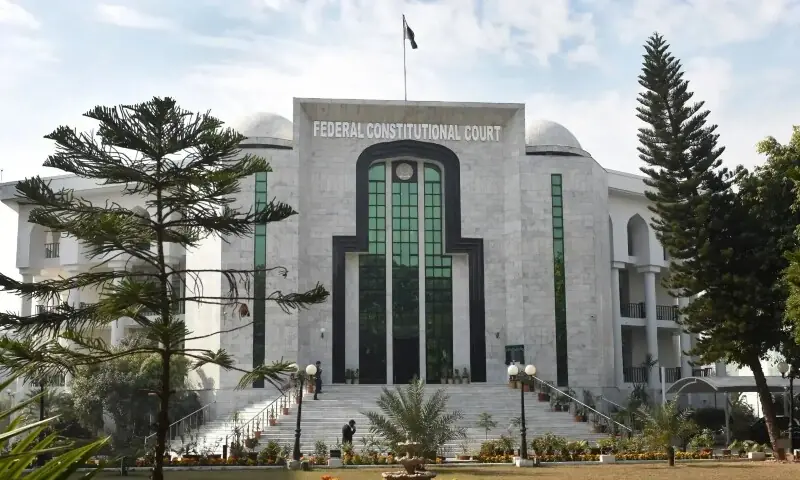
Federal Constitutional Court limits registrar’s role in petition scrutiny
The Federal Constitutional Court has ruled that the registrar cannot decide whether constitutional petitions are maintainable. A 16-page order said such determinations require judicial adjudication by the court.


ISLAMABAD: The Federal Constitutional Court has held that questions about whether a constitutional petition or appeal is maintainable can only be decided by judges, not by the court’s registrar, in a ruling that defines the boundary between administrative case handling and judicial authority.
In a 16-page order written by Justice Syed Hasan Azhar Rizvi, the court partly accepted an appeal filed by Razia Aslam against a registrar’s decision to return her constitutional petition under Article 175E(3) of the Constitution. The case stemmed from an order and return notice issued on February 14, 2026, through which the registrar declined to entertain her petition.
Registrar’s objections examined
According to the order, the registrar had listed five objections. These were that the petition did not point to a matter of public importance linked to the enforcement of fundamental rights, sought relief for an individual grievance through the court’s extraordinary constitutional jurisdiction, did not meet the requirements of Article 175E(3), included an improperly drafted notice for respondents, and was filed without first availing the legal remedy.
Justice Rizvi ruled that the registrar went beyond the powers granted under the Federal Constitutional Court Rules, 2025, by deciding that the petition itself was not maintainable. The judgment said the registrar serves as the executive head of the court office and performs administrative, ministerial and certain procedural functions connected with the filing and processing of cases.
Judicial power cannot rest with an administrative office
The court said those functions are confined to checking procedural compliance, including scrutiny of form, limitation and other codified defects. It held that deciding maintainability involves interpreting constitutional provisions and applying judicial reasoning, which makes it an exclusively judicial task falling within the court’s jurisdiction.
The order further stated that permitting the registrar to decide maintainability would in effect place judicial authority in the hands of an administrative functionary, something the rules do not envisage and which would be inconsistent with the constitutional principle of separation of powers.
The judgment also noted that the registrar may, under the rules, call for amendments in pleadings, decline to receive documents filed contrary to procedural requirements, and refuse petitions that are not filed in accordance with the rules or contain scandalous material. However, it made clear that these powers do not allow the registrar to decide substantive legal questions.
Meaning of ‘scandalous’ clarified
Justice Rizvi also addressed the scope of the term scandalous in the rules. The court held that the expression relates to defects of form and presentation and cannot be read as authorising the registrar to reject petitions on the basis of legal merit or on the ground that they appear frivolous.
The order added that if a petition is frivolous or vexatious, that concern can be dealt with by the court itself through the imposition of costs under the applicable rules.
Comments
No comments yet. Be the first to join the discussion!