Politics has repeatedly cast a shadow over World Cup history
A timeline published by AFP Sport and carried by Dawn traces several World Cup tournaments where political power shaped events on or off the field. It says the latest case is the controversy over Donald Trump’s intervention in Folarin Balogun’s suspension.

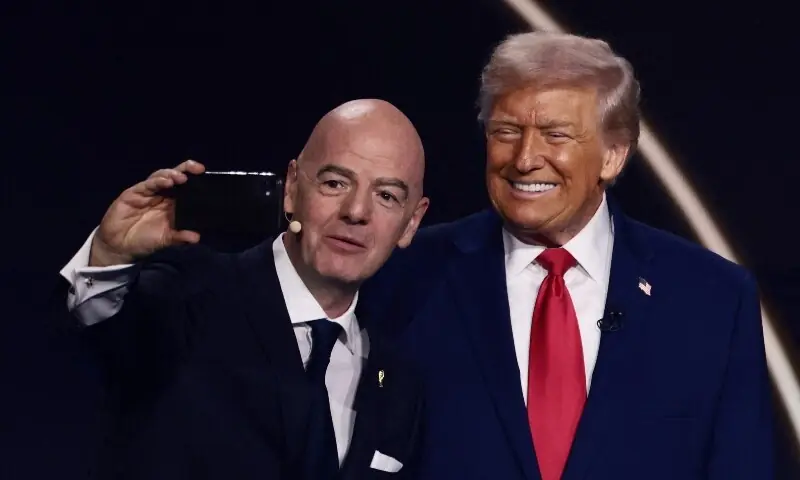
ISLAMABAD: The controversy surrounding US President Donald Trump’s intervention over Folarin Balogun’s suspension is the latest example of politics spilling onto football’s biggest stage.
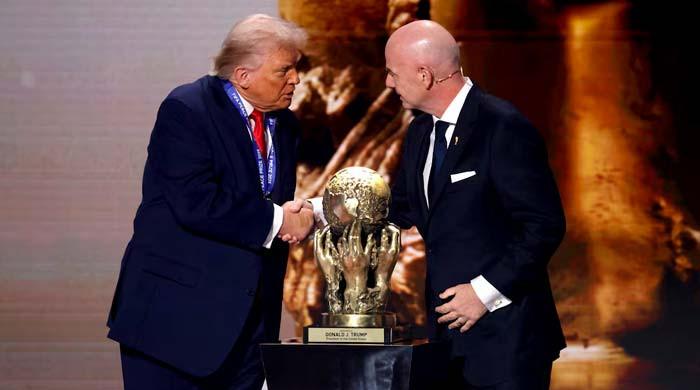
Trump telephoned FIFA president Gianni Infantino to seek a review of the red card shown to the co-host’s star striker. Balogun is now available for Monday’s last-16 match against Belgium after FIFA said the ban would be suspended for a year.
Multiple earlier World Cups saw political power, dictatorship or state influence intersect with events on and off the pitch.
1934 and 1938 tournaments under fascist influence
At the 1934 World Cup in Italy, fascist ruler Benito Mussolini used the tournament to promote both his regime and football as a symbol of ‘the new Italian’. He attended every match and also made unexpected visits to referees’ changing rooms during the competition.
Italy went on to win the tournament, although suspicions persisted over the standard of officiating in its matches. The then FIFA president Jules Rimet later commented on the way the event had been run.
“This tournament was organised by Mussolini, not by FIFA,” Jules Rimet, the then-FIFA president, observed dryly.
Four years later, the 1938 World Cup in France unfolded against the backdrop of Nazi Germany’s annexation of Austria in March through the Anschluss. That brought into German control a group of gifted Austrian players known as the Wunderteam. Most Austrian players were reluctant to represent Germany, and in an April friendly Austria beat Germany 2-0 in front of Adolf Hitler.
Germany’s campaign in France ended in the first round with a 4-2 defeat to Switzerland, while Italy retained the title. The Italian side wore black shirts similar to those of Mussolini’s militia. On the eve of the final against Hungary, Mussolini delivered a blunt message to his team.
Italy defeated Hungary 4-2. Hungarian goalkeeper Antal Szabo later reflected on the result in stark terms.
“I may have conceded four goals, but I saved their lives,” remarked Hungarian goalkeeper Antal Szabo.
Argentina 1978 and allegations around Peru match
The 1978 World Cup was staged in Argentina during ‘The Dirty War’, when the military junta under Jorge Rafael Videla was targeting opponents through abductions, torture and killings. The Higher School of Mechanics of the Navy, or ESMA, identified as a torture centre, stood near Buenos Aires’ Monumental Stadium, where the final was played.
FIFA, then led by Brazilian Joao Havelange, ignored objections to the country hosting the tournament. On the field, Argentina needed to beat Peru by at least four goals to move above Brazil and reach the final. Peru, though already out of contention after topping a first-round group that included eventual finalists the Netherlands, lost 6-0.
The scale of that result prompted suspicion, with whispers of an arrangement between the military regimes in Argentina and Peru. Doubts about the hosts’ conduct were not limited to that one match.
“Everything, even the air, is in favour of Argentina,” remarked Hungary coach Lajos Baroti.
Argentina later defeated the Netherlands after extra time in the final.
1982 Kuwait intervention on the pitch
Another incident came during the 1982 World Cup. Kuwait were trailing France 3-1 in a second group match when Alain Giresse scored what appeared to be France’s fourth goal. Kuwaiti players stopped, saying they believed they had heard a whistle, and demanded that the goal be disallowed.
The dispute escalated when Sheikh Fahad Al-Ahmed Al-Jaber Al-Sabah, president of the Kuwaiti Olympic Committee, entered the field and told Soviet referee Myroslav Stupar to cancel the goal. Stupar complied with the demand, although France still added another goal a minute from time. Sheikh Fahad was killed eight years later when Iraqi troops invaded Kuwait.
Comments
No comments yet. Be the first to join the discussion!