

Thousands protest in Erfurt as Germany’s AfD re-elects leaders at party conference
Thousands protested in Erfurt as Germany’s AfD held its annual conference and re-elected Alice Weidel and Tino Chrupalla. The party, now leading some national polls, faces strong opposition as it looks to upcoming regional elections.

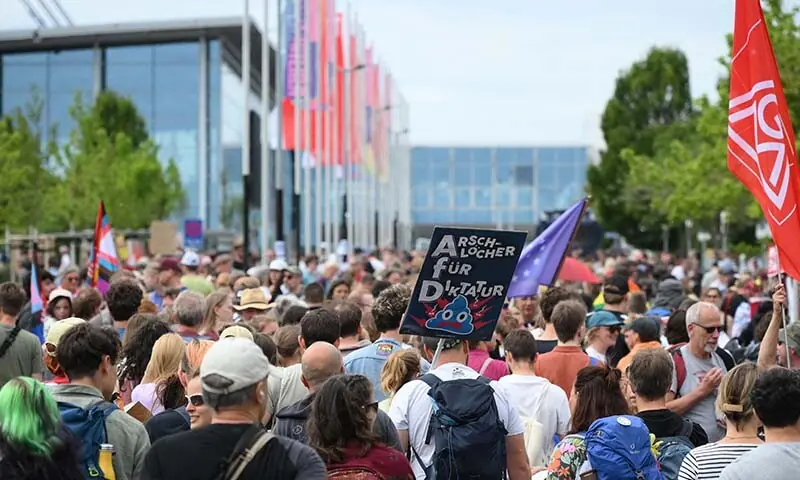
BERLIN: Thousands of people demonstrated in the eastern German city of Erfurt on Saturday against the far-right Alternative for Germany party, as AfD delegates gathered for a two-day annual conference and re-elected co-leaders Alice Weidel and Tino Chrupalla.
Protesters from trade unions, civil society organisations and left-wing parties assembled around the city, while police from across Germany were deployed ahead of the event. Under the watch of riot police, demonstrators sat in rows to block highways and roads leading to the convention centre. Police put the turnout at about 15,000 in and around Erfurt.
The conference opened with Weidel and Chrupalla retaining the leadership of a party that has climbed to the top of national opinion polls, ahead of Chancellor Friedrich Merz’s conservative CDU/CSU bloc. In opening speeches, party leaders attacked the demonstrators, calling them anti-democratic, and presented the AfD’s rise as evidence of growing support before regional elections later this year.
Speaking to delegates, Weidel said the party represented what she described as a final opportunity to reverse Germany’s decline and protect national identity. She also repeated the party’s hardline stance on immigration.
"For this remains our last chance to save our country”, Weidel stated.
“More and more people in this country want to support us in the fight against Germany’s decline, in the fight for our fatherland and for our identity”, he added.
Minutes before the convention began, a song titled Send them back was played on the AfD’s social media livestream. Inside the venue, vintage-style cards carrying slogans including You will be deported were being sold.
Regional ambitions and poll gains
The gathering comes before elections in the eastern states of Saxony-Anhalt and Mecklenburg-Vorpommern in September, contests the AfD hopes will strengthen its path towards national power. Chrupalla told the conference the party expected to move from regional to national government.
“We will govern. First at a regional level, then at the national level”, Chrupalla said in a speech focused on party unity.
Both leaders were returned unopposed, but Chrupalla secured 70 per cent of the vote, down from 81pc at the previous leadership vote two years ago. The report also described Chrupalla as a trained painter and varnisher from Saxony and Weidel as a former Goldman Sachs analyst from western Germany.
One of the party’s most controversial figures, Bjoern Hoecke, addressed delegates in a speech mixing nostalgia with sharp criticism of Germany’s condition. He cited public safety and even the state of motorway toilets as signs of national decline.
“A great Germany is a Germany where one need not fear taking a walk through the city park in the evening. A great Germany is a country where apartment keys can be left hanging on the outside of the door”, he said.
Opposition to the party
Georg Becker, a spokesperson for the anti-AfD umbrella group Widersetzen, said the Erfurt protests were meant to show resistance to what organisers see as a growing far-right threat in Germany.
“We want to make it clear that we simply won’t tolerate this, that fascism is on the rise here in Germany”, Becker said.
Founded more than a decade ago, the AfD has built support through nationalist messaging, demands for tougher immigration measures and appeals to voters dissatisfied with successive governments and years of economic stagnation. Weidel said criminals and illegal migrants had no place in Germany and vowed that deportations would be carried out rigorously.
Political opponents accuse the party of backing racist policies and attitudes at odds with Germany’s democratic values, and say it could endanger the constitutional order. Mainstream parties have maintained a firewall against cooperation with the AfD to keep it out of coalition governments. AfD leaders reject claims that they oppose Germany’s democratic foundations, and earlier this year obtained a court injunction requiring the domestic intelligence service to suspend a previous extremist classification of the party.
Recent polls have put AfD support at as much as 29pc, compared with about 22pc for Merz’s conservatives. The party’s strongest backing is in the former communist east, where surveys indicate the highest levels of disillusionment with the traditional party system.
Chrupalla has advocated ending military aid to Ukraine and has called for a reset in relations between Berlin and Moscow, which have become openly hostile because of the war in Ukraine.
Comments
No comments yet. Be the first to join the discussion!


