

Activists urge end to manual sanitation work after Karachi deaths
Activists at a Karachi discussion called for an end to manual sanitation work after three workers died in Usmanabad in 2025. Speakers urged legal, technological and policy steps to replace the practice and protect workers.

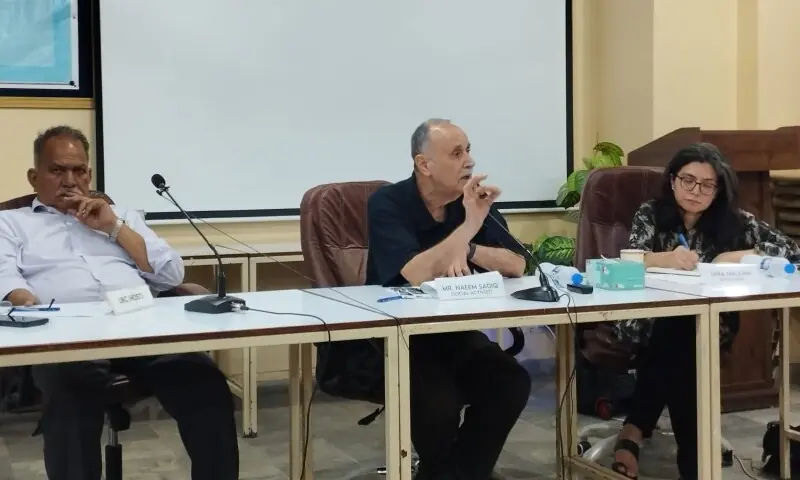
KARACHI: Civil society members at a discussion held on Thursday at Karachi’s Urban Resource Centre called for an end to manual sanitation work in Pakistan, describing the practice as inhumane and preventable while stressing the need to protect workers’ dignity.
Advocate Sara Malkani, social activist Naeem Sadiq and URC’s Zahid Farooq referred to a September 2025 incident in Karachi’s Usmanabad in which three sanitation workers — 22-year-old Vishal, 19-year-old Shahir and 42-year-old George — died after suffocating inside a manhole during cleaning work. The three men belonged to the same family and had been hired for Rs15,000 to clean the manhole.
Malkani said that, on behalf of a group of human rights activists, she filed a constitutional petition in the Sindh High Court in November 2025 seeking a declaration that manual gutter cleaning violates human dignity and is therefore unconstitutional. She said the petition also asks the court to direct legislative and regulatory institutions to frame a law banning what it describes as an inhumane practice. According to her, the Karachi Water and Sanitation Corporation, the Sindh government and local government bodies have been named as respondents.
Petition and official response
Malkani said the practice could be avoided because gutter-cleaning technology already exists. Recalling the response submitted by the KWSC to the Sindh High Court, she said the utility acknowledged that machinery was available but stated that “due to some circumstances, people have to go inside gutters.”
She said the utility did not explain those circumstances in its reply to the petition. Malkani also said KWSC had stated that the workers who died were hired through a private company. She argued that responsibility for gutter cleaning ultimately rests with municipal authorities, regardless of whether the work is carried out by public employees or private contractors.
KWSC Employees’ Union Secretary General Mohsin Raza, who was present at the dialogue, said machinery was available within the corporation but much of it still depended on manual handling. "We do not have a standardised system; some manholes are 4 feet deep, while others may be up to 24 feet deep, so in many cases staff still have to enter the manholes," he said, adding that the machinery currently in use also required manual operation.
Concerns over stigma and safety
During the panel discussion, Malkani also spoke about what she described as the discriminatory nature of sanitation work in Pakistan, especially in relation to religion. "The practice also continues because sanitation workers have not been given any status in society," she said.
A 2025 Amnesty International report described sanitation work as stigmatised because of its association with a caste system in South Asia. In Pakistan this is reflected through religious identities, with people involved in such work being treated by broader society as undesirable.
Sadiq said sanitation workers were being dehumanised because society remained indifferent to their condition. "It is a problem that we expect our brothers and fellow citizens to clean up after us," he said.
“Will we continue to disregard these people the way we have for many decades? Would a civilised society force its people to enter manholes?”
He also questioned why discussion often centred on compensation after such deaths rather than on putting workplace safety measures in place, referring to the compensation offered after the deaths of the three workers in Usmanabad. Sadiq said that in another country, such an incident could result in the heads of the relevant authorities being held answerable. He urged people attending the event to organise around the issue and press for an end to manual gutter cleaning.
According to the National Commission for Human Rights, sanitation workers in Pakistan face dangerous working conditions without sufficient occupational safety safeguards or legal protection. In its 2025 report, Amnesty International recommended replacing manual gutter cleaning with machinery and training workers to use the equipment. The rights group also called for constitutional changes to protect against caste-based discrimination affecting communities linked to sanitation work.
Comments
No comments yet. Be the first to join the discussion!

