

Miftah Ismail questions NFC utility amid weak provincial devolution
At a Karachi seminar on the 2026-27 budget, Dr Miftah Ismail questioned the utility of the NFC award in the absence of effective provincial devolution to local governments. Dr Ishrat Husain also called for tighter links between budgeting, policy goals and institutional oversight.

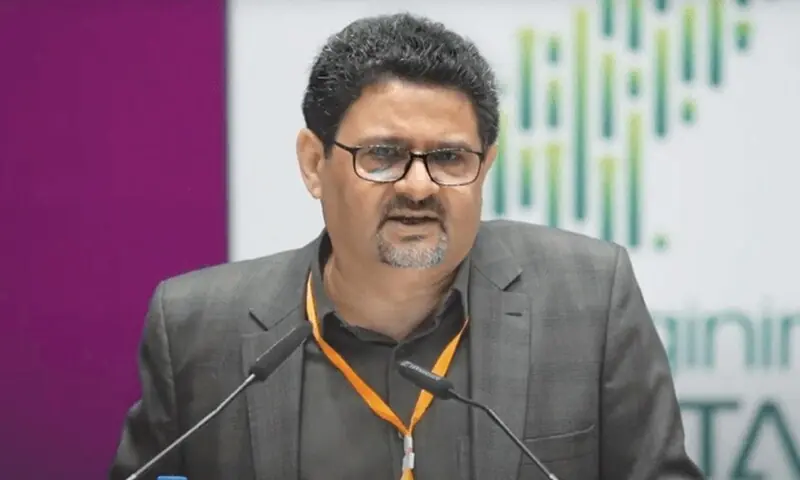
KARACHI: Former finance minister Dr Miftah Ismail on Monday questioned the effectiveness of the National Finance Commission (NFC) award, arguing that it loses purpose when provinces do not pass financial resources onward to local governments through functioning Provincial Finance Commissions (PFCs).
Speaking at a seminar titled Budget Insight 2026–27 organised by the Applied Economics Research Centre (AERC) at Karachi University, Dr Ismail said provinces in Pakistan had not been effectively devolving powers and funds to the local level. He said that if that continued, concentrating authority at a single level could be more workable than having what he described as monopolies spread across four layers of government.
He also termed taxes on petroleum products highly regressive, saying they place a disproportionate burden on lower-income groups. Referring to fuel consumption patterns, he said around 50 to 60 per cent of petrol in Pakistan was used by motorcyclists, who were paying close to Rs100 per litre in taxes and levies.
Dr Ismail said Pakistan had made weak progress across multiple sectors and noted that India and Bangladesh had moved ahead of Pakistan on a range of economic and social indicators. He added that Pakistanis had become poorer over the last four years as real incomes kept falling.
Addressing education, he said literacy gains seen before 2010 had since reversed. He cited Sindh as an example, saying nearly 60pc of fifth-grade students were unable to fluently read even second-grade textbooks, which he said reflected a serious crisis in education.
He further said Pakistan had not achieved meaningful progress in health, nutrition and broader human development. According to Dr Ismail, child malnutrition remained at an alarming level, while Pakistan currently had the highest number of hepatitis patients in the world.
On trade and industry, he identified high electricity prices as the main barrier to export growth. He said exports could not rise significantly unless power tariffs were brought down to levels comparable with those in India, Bangladesh and other countries in the region. He contrasted Pakistan’s exports of about $30 billion with Vietnam’s roughly $400bn, saying both countries had similar export volumes in 1990.
Budget process and institutional gaps
Former State Bank of Pakistan governor Dr Ishrat Husain told the seminar that the budget should be seen not simply as a statement of receipts and expenditures, but as part of a wider medium-term policy framework. He said Pakistan’s budgeting process had not been properly connected with national policy priorities, which had produced weak outcomes.
He said the disconnect between policy and implementation would remain unless goals in agriculture, industry, education and health were matched with the financial resources needed to achieve them.
Referring to the 2010-11 NFC award, Dr Husain said it had set a goal of increasing the tax-to-GDP ratio to 15pc within five years. He noted that 15 years later the ratio was still around 11pc, and said target-setting by itself could not deliver results without practical steps and regular oversight.
He also pointed to the lack of an institutional mechanism to examine budget allocations, targets and outcomes after the budget is approved. In this context, he called for activation of the National Economic Council (NEC), the constitutional body headed by the prime minister and including the provincial chief ministers and the federal economic team.
Dr Husain also criticised the weak connection between education policy and science, research and information technology, saying it had contributed to troubling unemployment levels among university graduates.
Speaking about governance, he said the bureaucracy was still working through colonial-era systems that caused delays, while other countries had shifted to e-governance and e-filing for real-time decisions. He called for the entire government system to be digitised to cut inefficiency and reduce delays in development projects worth billions of dollars.
He also stressed that education should be prioritised in budget-making despite what he described as resistance from groups whose privileges could be affected. He proposed quarterly financial review meetings, digital monitoring of development targets and timely corrective action.
Population and resource distribution
Karachi University Vice Chancellor Dr Khalid Mahmood Iraqi said rapid population growth remained one of the country’s central challenges. He criticised the NFC award’s reliance on population as the main basis for resource distribution, saying this indirectly encouraged population growth.
He said developed countries had controlled population growth in pursuit of economic and social advancement, while unchecked growth in Pakistan was hampering development. He also said education and health, which had helped other countries progress, had never been given sustained priority by successive governments in Pakistan.
Later, Dr Muhammad Sabir of the Social Policy and Development Centre presented a detailed analysis of the 2026-27 budget. AERC Director Prof Nooreen Mujahid, Dean of Arts and Social Sciences Prof Samina Saeed and Dr Amir Hussain of AERC also addressed the event.
Comments
No comments yet. Be the first to join the discussion!


