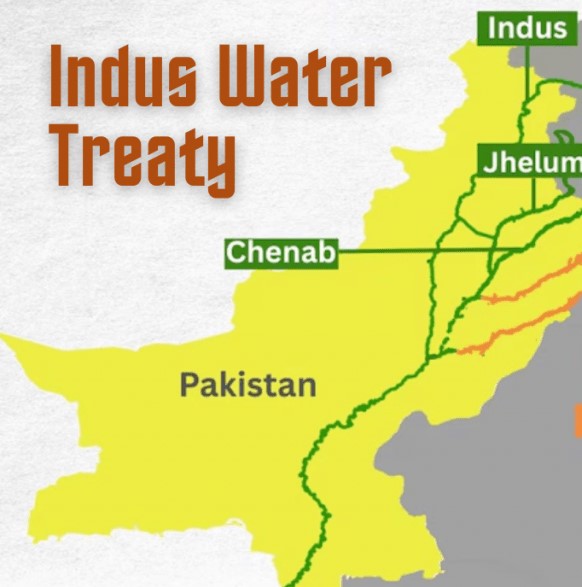
India's IWT move threatens global legal order, regional peace: Experts
Pakistan and international legal experts condemn India’s unilateral decision to put the Indus Waters Treaty in abeyance, saying it breaches international law, weaponises water, and raises risks to regional stability.

ISLAMABAD: Political leaders, international legal experts and policy analysts on Tuesday strongly condemned India's unilateral decision to place the Indus Waters Treaty (IWT) in abeyance, warning that the move undermines international law, threatens regional stability and risks escalating tensions in South Asia.
Speaking at an international seminar titled "Indus Waters Treaty: An Instrument of Peace and Regional Stability," participants described the 1960 treaty as a legally binding international agreement that cannot be suspended or revoked unilaterally.
The seminar, jointly organised by the Institute of Regional Studies (IRS) and the Ministry of Information and Broadcasting, brought together federal ministers, diplomats and international experts, who argued that India's suspension of hydrological data sharing and treaty-mandated inspections amounted to the weaponisation of water and posed a serious threat to the livelihoods of more than 240 million Pakistanis.
The speakers noted that more than 80 per cent of Pakistan's cultivated land depends on the Indus river system, making uninterrupted data sharing, predictability and treaty compliance essential for food security, disaster preparedness and sustainable water management.
Deputy Prime Minister and Foreign Minister Ishaq Dar said New Delhi's decision to place the treaty in abeyance had undermined the international legal order and heightened the risk of conflict in the region.
He urged the international community to view transboundary rivers as instruments of cooperation rather than confrontation, recalling that Pakistan accepted significant concessions while signing the treaty in the interest of long-term regional stability.
"The sanctity of treaties is one of the foundations on which peaceful relations between nations are built," Dar said, calling on the international community to reject the weaponisation of water.
Information Minister Attaullah Tarar said India's actions had weakened respect for international law and the global rules-based order.
Describing the Indus as an integral part of Pakistan's identity and civilisation, he said Pakistan's right to the waters of the Indus was inalienable and that India's attempt to suspend the treaty lacked legal, moral and political justification.
Pakistan Peoples Party Chairman Bilawal Bhutto Zardari said India's actions had effectively weaponised water against Pakistan and warned that lasting peace in South Asia would remain elusive if the treaty continued to be undermined.
Drawing a parallel with global concerns over the Strait of Hormuz, Bilawal questioned how regional peace could be sustained while the Indus Waters Treaty remained in abeyance. He called on the international community to support Pakistan's legal position and proposed a new international convention against the weaponisation of global commons, including water.
Climate Change Minister Dr Musadik Malik said India's actions had compounded Pakistan's climate challenges and transformed a water issue into "a crisis of justice."
Former defence minister Khurram Dastgir Khan accused India of accelerating water infrastructure projects on rivers covered by the treaty after announcing its suspension, while former minister of state for foreign affairs Hina Rabbani Khar said the agreement already contained a clearly defined mechanism for amendments, making unilateral action legally untenable.
Legal expert Ahmer Bilal Soofi argued that transboundary waters constituted global commons under international law and said India's decision effectively acknowledged a breach of its treaty obligations, allowing Pakistan to pursue legal and diplomatic responses.
Former National Defence University president Lt Gen (retd) Aamer Riaz alleged that India had long pursued projects on western rivers allocated to Pakistan, reflecting an intent to use water as a strategic tool.
Pakistan Commissioner for Indus Waters Syed Mehr Ali Shah said India's actions violated the treaty's dispute resolution mechanism under Article IX and regretted the suspension of treaty-mandated data sharing.
International experts also voiced concern over India's actions. Dr Roxolana Zigon of the University of World Civilizations in Moscow praised Pakistan's restrained response despite what she described as provocative statements from Indian officials.
US policy expert Laurie Watkins argued that withholding river data and failing to respond to Pakistan's communications violated established principles of customary international law, regardless of India's claims regarding the treaty.
Prof Victor Gao, Vice President of the Centre for China and Globalization in Beijing, termed India's suspension of the treaty "a crime against humanity" and said attempts to weaponise water would have wider regional implications.
Concluding the seminar, IRS President Ambassador Jauhar Saleem said lasting peace and water security depended on adherence to international law, respect for treaty obligations and continued cooperation between states. He stressed that the Indus Waters Treaty remained the only viable framework for ensuring certainty, transparency and stability in the management of shared water resources.
Comments
No comments yet. Be the first to join the discussion!