Carrick's United: The Case for Time, the Profiles for Glory
Michael Carrick’s tweaks since January have lifted United to third and brought tactical clarity. With Cunha, Mbeumo and Sesko leading the attack—and Ederson targeted for midfield—could they truly challenge for the title?

By Bilal Mahmood Sulehri
When Michael Carrick took over in January, United were seventh in the Premier League. They are currently third with the season not yet finished. That trajectory alone should end the debate about whether he deserves more time. But the more important question is whether this squad can be turned into something that genuinely challenges for the title rather than merely qualifying for the Champions League.
What Carrick changed
Carrick took over from Ruben Amorim, who had attempted to implement a 3-4-2-1 system that asked for profiles the squad did not possess. The wing-backs could not defend at both ends of the pitch. The midfield lacked mobility for the transitions the league demands. Bruno Fernandes was pushed deep to facilitate build-up, taking him away from where he is most dangerous.
Carrick stripped the system back to a 4-2-3-1 with Kobbie Mainoo as the deep connector in the double pivot, Benjamin Sesko as the reference point through the middle, and the best wide players available on each flank. The results have been encouraging without being spectacular. Beating Liverpool 3-2 at home and Manchester City 2-0 at the same ground are genuine indicators of tactical clarity. The draw against Sunderland was hard-fought and indicated defensive solidity against a well-drilled side. This is a team that can beat anyone on its day and has found ways to grind out results when control eludes them.
The front three
The starting front three for next season should not be a matter of debate. Matheus Cunha, Bryan Mbeumo, and Benjamin Sesko form the most coherent attacking unit United have had in years.
Cunha
Cunha arrived from Wolves in June 2025 for £62.5m. He scored 15 Premier League goals last season and offers the ability to play as a No 10, a false nine, or from either flank. His best position is the free role behind the striker where he can drift, create, and score. His tactical intelligence allows him to exploit gaps between opposition lines and his link-up play has improved throughout his time in England.
Mbeumo
Mbeumo arrived from Brentford in July 2025 for £71m. He scored 20 Premier League goals last season. He operates primarily from the right, cutting inside onto his stronger left foot. He is equally effective as a right-winger in a front three or as an inside forward who stretches the play wide. His pace forces teams to make decisions and his finishing from difficult angles has become a signature part of his game.
Sesko
Sesko signed from RB Leipzig in August 2025 for £73.7m. He is 22, 6 foot 5 and already the reference point for everything United build around in the final third. He can hold the ball against Premier League centre-backs, attack space behind the defence, and win aerial duels at both ends of the pitch. His mobility for his size is unusual and allows him to press effectively while also being a genuine goal threat in the box.
When the three start together, United have pace, creativity, physical presence, and goal threat from multiple positions. If Bruno needs to be rested, Cunha can drop into the No 10 role with freedom to roam. The balance between them is what makes the unit functional.
The midfield question
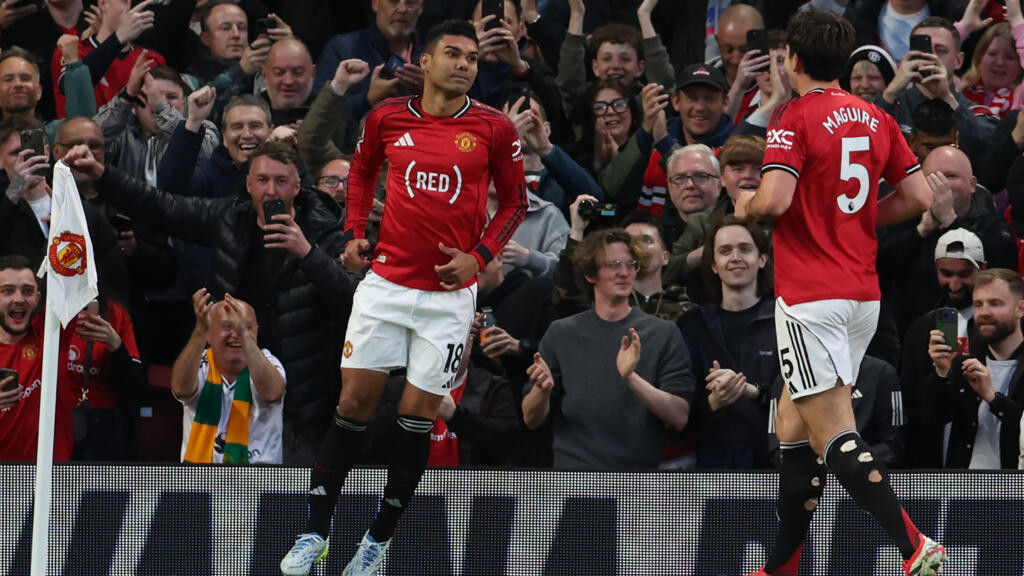
Casemiro is leaving. His final Old Trafford appearance is due soon. United are losing their most experienced midfielder and the gap he leaves cannot be filled by one signing alone.
Ugarte must also leave. His mobility does not suit the system Carrick wants to play. When the double pivot is exposed on the counter, his positioning does not recover quickly enough.
Ederson of Atalanta is the primary target. United have identified him as a potential recruit. His agent confirmed in March 2026 that a move is likely. The fee discussed is around €45m, down from Atalanta's previous asking price of over €60m. He is an athletic midfielder who wins the ball back, carries it forward, and fits the physical profile of the Premier League.
The second new midfielder needs to complement Mainoo, who has been exceptional when available. Bruno Guimaraes from Newcastle fits that profile. United have held formal meetings with his agents. Reuters reported in March 2026 that United are in advanced talks at around €80m. Real Madrid have also entered the race, which complicates the negotiation but does not close it.
Guimaraes makes sense because a 31-year-old Bruno cannot play every game across a 38-match Premier League season and a Champions League campaign. The squad needs depth that allows rotation without a drop in quality. This is not about replacing Bruno. It is about ensuring the squad can sustain a title challenge across all competitions.
Mount stays. His wages are a barrier to moving him and he offers genuine value as a rotation option in the double pivot or as the left-sided eight when available. But his injury record means the club cannot build plans around him playing 38 games.
Toby Collyer is back from a loan at West Brom that was cut short by injury. He offers cover in the deeper midfield role and deserves a chance in pre-season. Jack Fletcher, the 19-year-old academy midfielder, has also been catching the eye. He assisted both goals in a U21 win over Southampton and has been named in first-team squad discussions.
Can United close the gap?
The gap to Arsenal in first place is 14 points. That is not a gap that disappears in one window. But it is a gap that shrinks if three things happen.
First, the Casemiro replacement must be the right profile. Ederson or equivalent. Someone who can sit, break up play, and allow Mainoo to operate in the half-spaces where he is most effective. Without that, the double pivot lacks balance and the back four is exposed on the transition.
Second, the centre-back situation must be resolved with clarity. Harry Maguire signed a new contract in April 2026 and will be part of the plans. The deeper issue is Martinez. He has not been able to stay fit for a full season and his achilles problems are recurring. The squad cannot rely on him for 38 Premier League games plus Champions League fixtures. If Martinez leaves, two centre-backs are needed. If he stays, one addition alongside De Ligt and Yoro may be sufficient.
Third, the full-back situation must be resolved with Diogo Dalot signed and a reliable fourth choice identified.
If those three things are in place by August, and if the front three stay fit for the majority of the season, United have the foundation to push Arsenal and Manchester City harder than they have in years.
Who should leave
Rashford goes. Five managers have now overseen the same output. He is not in the XI and the dressing room dynamic has been damaging for multiple cycles. The Saudi window is open. Take the money.
Onana goes either permanently or on a loan with an obligation to buy. The errors in Champions League ties and against Liverpool at Anfield have cost the team in the moments that define seasons. Replace with a goalkeeper who commands the box and has clean hands in one-v-one situations.
The case for two years
Sacking a manager after one season and hiring another is the loop that has broken this club for a decade. Carrick deserves two windows and a pre-season to build a squad that fits his ideas. It looks like he will get a contract very soon.
The foundation is there. The front three is already assembled. The questions about the squad are answerable. What United need from the club is speed in the market, clarity of plan, and the discipline to stop complicating things that do not need to be complicated.
Comments
No comments yet. Be the first to join the discussion!