

June 18, 2026
Sindh unveils Rs3.562tr budget with no new taxes and higher pay
Sindh has presented a Rs3.562 trillion budget for FY2026-27 with no new taxes, a seven per cent increase in salaries and pensions, and a Rs720 billion development programme. The budget projects a deficit of about Rs36.9 billion.

June 18, 2026
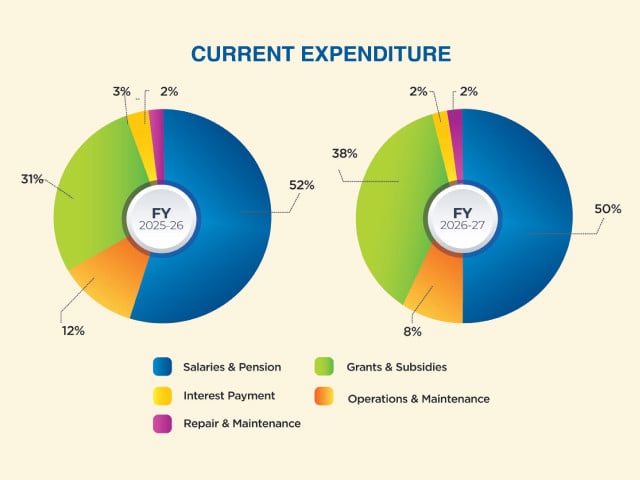
KARACHI: Sindh Chief Minister Syed Murad Ali Shah on Wednesday presented a Rs3.562 trillion budget for fiscal year 2026-27 in the Sindh Assembly, setting out a plan with no new taxes, a seven per cent increase in salaries and pensions, a Rs720 billion development programme and a Rs13.2 billion social protection package.
According to the budget presented by the chief minister, total receipts are estimated at about Rs3.525 trillion, leaving a projected deficit of roughly Rs36.9 billion. Shah said the province had prepared its financial plan in a difficult global and domestic environment shaped by geopolitical tensions, inflationary pressure, climate-related risks and wider economic uncertainty. He told the assembly that although Pakistan’s economy had shown signs of recovery in the outgoing fiscal year, people were still facing strain from higher living costs, energy prices and inflation.
Shah said the province’s budget strategy for the next year rests on four principles: protecting Sindh’s constitutional rights, preserving fiscal sustainability, supporting national stability and continuing investment in public welfare. He also said the provincial government had to reduce its development portfolio from a projected Rs575 billion to Rs400 billion after making a contribution towards national strategic requirements under a negotiated arrangement with the federal government.
Addressing the assembly, the chief minister said priority projects and public services had been protected despite the fiscal constraints.
"Even in a difficult fiscal environment, we have protected priority development projects and essential public services that directly affect the lives of our people," he said.
Relief measures and pay raise
The budget does not propose fresh taxes. Instead, the provincial government announced relief measures for education, agriculture, insurance and employment-related sectors. These include cutting sales tax on education support services to five per cent, continuing concessional tax rates for overseas employment recruiting agencies and beauty salons integrated with point-of-sale systems, and lowering taxation on insurance agents and brokers.
For agriculture, the budget raises the exemption threshold for agricultural super tax from Rs150 million to Rs500 million and reduces the applicable rate from 10 per cent to 8 per cent. Shah also announced a seven per cent increase in salaries and pensions from July 1. He said the salary increase would also be reflected through the amalgamation of the Ad hoc Relief Allowances of 2022 and 2025. The minimum monthly wage has been raised from Rs40,000 to Rs43,000.
The chief minister said the government wanted to shield vulnerable groups from economic hardship through a Rs13.2 billion social protection package. The package includes the Kitchen Garden Initiative, the Benazir Hari Card Programme, the Benazir Women Agriculture Workers Programme, and support schemes for widows and orphans.
Development allocations
Under the Annual Development Programme for FY27, the budget sets aside Rs25.9 billion for education, Rs17.4 billion for health, Rs121.6 billion for local government and municipal infrastructure, Rs40.9 billion for public health engineering, Rs30.9 billion for irrigation, Rs39.5 billion for transport and communications, and Rs6.3 billion for agriculture and livestock.
Shah told the assembly that Sindh recorded the highest development spending in its history during the outgoing fiscal year, with more than Rs900 billion released for development activities despite inflationary pressure and rising construction costs.
Flood housing and PPP projects
Referring to post-flood reconstruction after the 2022 disaster, the chief minister said one million houses had been completed under the Sindh Peoples Housing for Flood Affectees Programme. He added that financing arrangements had been secured for about 1.7 million housing units with international support of $1.675 billion. He also said the programme had strengthened women’s ownership rights by transferring land ownership to hundreds of thousands of beneficiaries.
A major part of the speech focused on a new round of public-private partnership projects that the government says are intended to help turn Sindh into a regional centre for trade, finance, technology, renewable energy and sustainable development. Shah said the province’s PPP programme had received international recognition, including appreciation from the United Nations Economic Commission for Europe, The Asset magazine and The Economist, and described it as one of the most successful sub-national PPP frameworks in Asia.
Among the proposed flagship initiatives is the development of Keti Bandar as a maritime, logistics, industrial and energy hub. Shah said Shaheed Zulfikar Ali Bhutto had launched Port Qasim, while PPP Chairman Bilawal Bhutto had directed him to initiate the Keti Bandar project. He said the government would carry out an internationally benchmarked viability assessment for a modern coastal economic corridor that would include port infrastructure, industrial zones, logistics and warehousing facilities, export-oriented manufacturing clusters, energy projects and multimodal transport links. The proposed plan will also examine connections with the Dhabeji Special Economic Zone, Thar’s energy resources and emerging regional trade routes.
0 Comments
No comments yet. Be the first to join the discussion!


